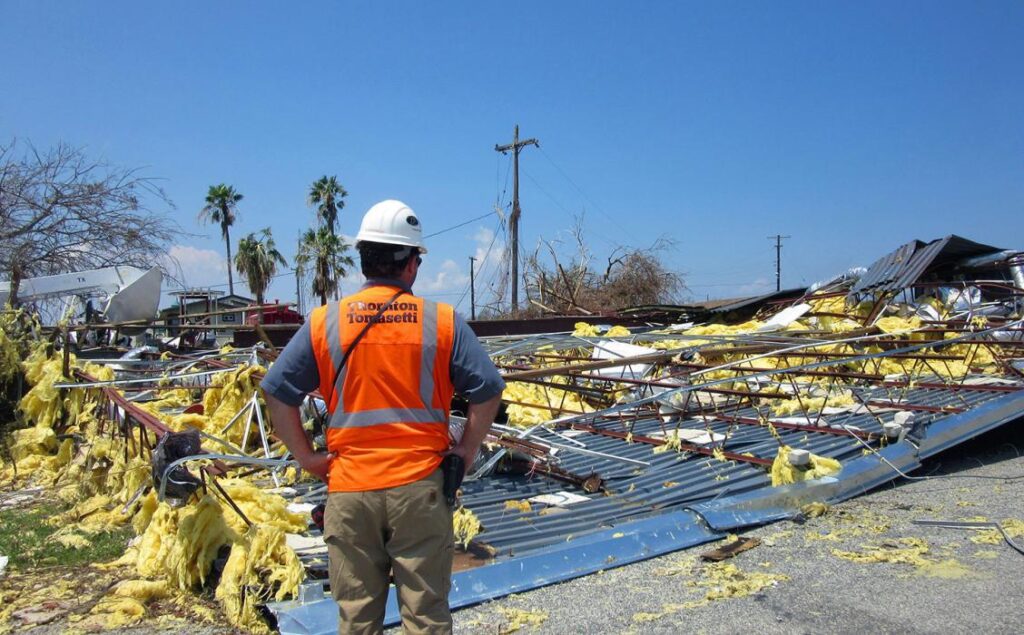
Structural engineers performing on-site evaluation as part of engineering for catastrophe response. Rapid assessments and stabilization are critical to saving lives and accelerating community recovery.
Catastrophic events—whether natural disasters like hurricanes, earthquakes, and wildfires, or human-induced incidents such as industrial accidents—strike with devastating speed. In their aftermath, lives hang in the balance, infrastructure teeters on collapse, and communities face prolonged uncertainty. Engineering for catastrophe response emerges as the critical discipline that bridges immediate life-safety needs with long-term recovery and future resilience.
Structural engineers specializing in this field act as second responders, providing rapid, data-driven assessments, stabilization strategies, and recovery planning. Unlike routine design projects, catastrophe response demands agility, on-site decision-making under pressure, and multidisciplinary collaboration. Firms like Preeminent Solutions Engineering (PS Eng Inc.) exemplify this expertise, offering tailored services that prioritize safety, regulatory compliance, and cost-effective rebuilding.
Understanding Catastrophe Response in Structural Engineering
Engineering for catastrophe response refers to the specialized application of structural engineering principles in the wake of major disruptive events. It encompasses rapid damage evaluation, structural stabilization, hazard analysis, and support for recovery operations. Catastrophes are typically defined in the insurance industry as events generating claims exceeding $25 million, often involving multiple carriers—think hurricanes, tornadoes, floods, or earthquakes.
Engineers in this space operate across four key phases of disaster management: mitigation (pre-disaster), preparedness, response (immediate), and recovery. Their role is most visible in the response and recovery phases but informed by deep knowledge of mitigation strategies.
Core responsibilities include:
- Conducting visual and instrumental safety assessments to classify buildings as safe (green tag), restricted (yellow), or unsafe (red).
- Supporting urban search and rescue (USAR) teams by evaluating collapsed structures for safe entry and extraction routes.
- Performing forensic analysis to determine failure modes and root causes.
- Developing stabilization plans, including shoring and temporary supports.
- Advising on resilient reconstruction that incorporates updated codes and performance-based design.
This work draws on standards like ATC-20 for post-earthquake evaluations and ATC-45 for windstorms and floods, ensuring consistency and reliability in high-stakes environments.
Learn more about related forensic structural engineering services that uncover hidden defects contributing to failures.
Immediate Response: On-Site Assessments and USAR Support
In the chaotic hours and days following a disaster, structural engineers are often among the first technical experts on scene. They join USAR teams—coordinated under frameworks like the UN’s INSARAG—to provide engineering clarity amid uncertainty.
Engineers assess risks of secondary collapse, aftershocks, or further degradation from weather. They identify viable access paths, recommend shoring techniques, and monitor live structural behavior. Decisions must be rapid yet defensible, often relying on visual cues, experience-based judgment, and tools like drones for inaccessible areas.
For example, after major earthquakes, engineers evaluate partially collapsed buildings to guide rescue efforts while minimizing risks to teams. In hurricane zones, they inspect wind-damaged roofs, foundations, and load paths—focusing on continuous load paths that tie roofs, walls, and foundations together to resist uplift and lateral forces.
Damage Assessment and Forensic Analysis
Post-initial response, detailed evaluations determine habitability, repair feasibility, and insurance claims validity. Engineers use advanced techniques: drone surveys, 3D scanning, GIS mapping, and non-destructive testing to quantify damage without further compromising structures.
They differentiate between construction defects, design flaws, and event-induced failures—crucial for litigation, insurance, and learning. In wildfire zones, assessments might focus on ember intrusion and heat damage; in flood scenarios, on scour, buoyancy, and corrosion.
Recovery, Stabilization, and Resilient Rebuilding
Transitioning to recovery involves shoring unstable structures, designing temporary shelters, and planning permanent repairs or retrofits. Engineers prioritize performance-based design—ensuring structures not only meet minimum codes but achieve specific resilience goals, such as rapid functional recovery for hospitals or critical infrastructure.
Techniques include base isolation, energy-dissipating devices, elevated foundations in flood zones, and hip roofs with reinforced connections in hurricane areas. Lessons from events like Hurricane Laura or major earthquakes feed into simulations and digital twins for better predictive modeling.
Multidisciplinary teams—structural, geotechnical, civil, and mechanical—coordinate with contractors, emergency managers, and stakeholders for holistic solutions.
Technologies and Innovations Shaping the Field
Modern catastrophe response leverages drones, LiDAR, AI-driven damage prediction, and real-time monitoring sensors. Variable Depth Pushover methods and tsunami simulators advance modeling for complex hazards.
StEER Network deployments and NIST’s multi-hazards research translate field data into improved codes and practices.
These tools accelerate assessments, reduce risks to personnel, and provide richer datasets for future mitigation.
Building E-E-A-T: Expertise in Action
Professionals in this field combine licensed structural engineering credentials with hands-on disaster deployment experience. Firms maintain rigorous quality controls, adhere to ethical standards, and contribute to industry bodies like IStructE and NCSEA. This builds trust for clients ranging from government agencies to insurers.
Conclusion: Engineering a More Resilient Future
Engineering for catastrophe response is more than reactive; it embodies proactive learning that strengthens the built environment against inevitable hazards. By combining rapid expertise with forward-thinking resilience strategies, structural engineers restore hope and functionality while reducing vulnerabilities for the next event.
Communities and organizations facing disasters benefit immensely from partnering with experienced teams equipped for these challenges. Whether in immediate response or long-term planning, this specialized engineering discipline saves lives, preserves assets, and paves the way for stronger recoveries.
FAQs on Engineering for Catastrophe Response
Q1: What is the primary role of structural engineers in catastrophe response?
A: They provide rapid safety assessments, support USAR operations, stabilize structures, and guide recovery to protect lives and enable rebuilding.
Q2: How do engineers assess building safety after a disaster?
A: Through standardized visual evaluations (e.g., ATC protocols), tagging systems, and advanced surveying tools to classify risk levels quickly.
Q3: Can engineering prevent all catastrophe damage?
A: While not all damage is preventable, resilient design, retrofits, and mitigation significantly reduce impacts and speed recovery.
Q4: Who typically hires catastrophe response engineers?
A: Insurers, property owners, government agencies, emergency managers, and contractors involved in recovery.
Q5: What training prepares engineers for this work?
A: SAP training, USAR certifications, and experience with forensic and emergency response protocols.