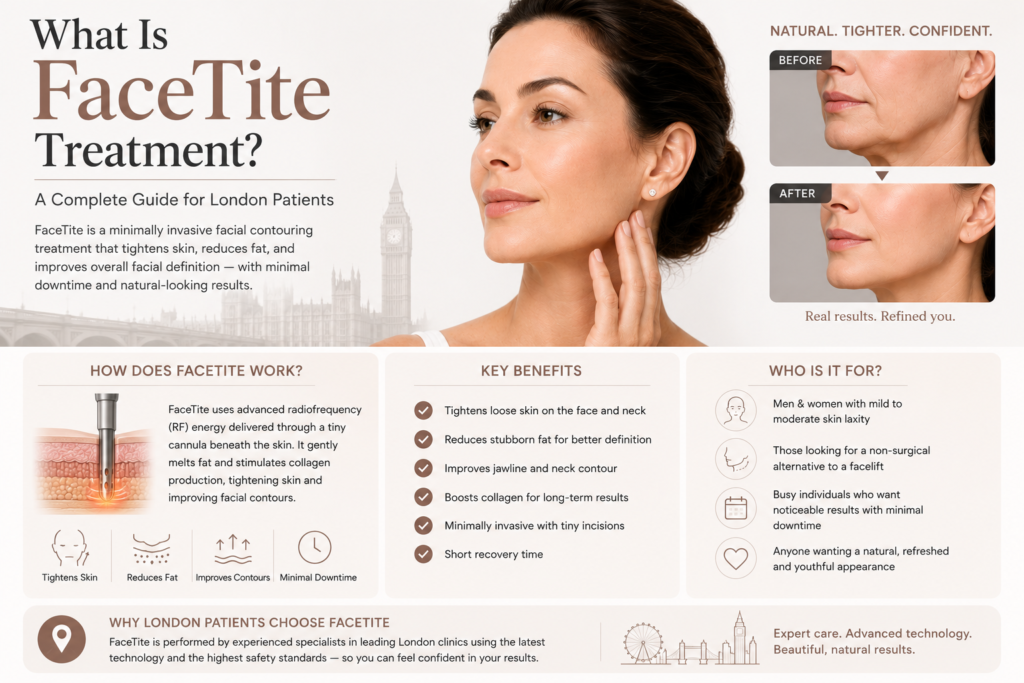
What Is FaceTite Treatment? A Complete Guide for London Patients
If you’ve been researching ways to tighten sagging skin without committing to surgery, chances are FaceTite has come up more than once. It’s one of the most requested treatments in London’s aesthetics clinics right now, but a lot of patients still aren’t entirely sure what it involves, how it works, or whether it’s actually right for them.
This guide breaks down everything you need to know before booking a consultation.
FaceTite Explained Simply
FaceTite is a minimally invasive skin-tightening treatment that uses radiofrequency energy to firm up loose or sagging skin, typically around the jaw, cheeks, and neck. Unlike a surgical facelift, there’s no cutting away of skin and no general anaesthetic involved. A small probe is inserted beneath the skin through a tiny entry point, and radiofrequency energy heats the deeper tissue layers from within.
That heat does two things. It causes immediate contraction of existing collagen fibres, and it triggers your body to produce new collagen over the following months. The combined effect is skin that looks visibly firmer right after treatment, with continued improvement over time as collagen rebuilds.
Think of it as sitting somewhere between injectables and surgery. It delivers more noticeable tightening than something like radiofrequency skin treatments applied externally, but without the downtime, scarring, or cost of going under the knife.
How the Procedure Works Step by Step
A typical FaceTite session starts with local anaesthetic applied to the treatment area, so the process itself is far less daunting than it might sound. Once numbed, the clinician inserts a thin internal probe beneath the skin. An external electrode sits on the surface, working alongside the internal probe to monitor temperature and keep everything within a safe, controlled range throughout the session.
As the radiofrequency energy passes through the tissue, it heats the deeper layers, causing immediate tightening. The treatment typically takes 45 minutes to an hour, depending on how much area is being addressed. Many patients treat the jawline, neck, and cheeks in a single session, since these areas tend to respond well together.
Because the entry points are tiny, there’s minimal scarring, and most patients describe the sensation as warmth rather than pain, particularly once the anaesthetic takes effect.
What to Expect During Recovery
This is where FaceTite really sets itself apart from surgical alternatives. Recovery is measured in days, not weeks. Expect some swelling and mild bruising for the first week or so, similar to what you might experience after a dental procedure.
Most patients return to normal daily activities within a few days, though more strenuous exercise is usually held off for around two weeks. Full results take longer to appear, typically becoming most visible around three to six months post-treatment as new collagen continues forming.
Compare that to the two-to-four-week recovery window typically needed after a surgical facelift, and it’s easy to understand why so many London patients are choosing to explore a Non-Surgical Facelift in London rather than committing to surgery straight away.
Who Is a Good Candidate for FaceTite?
FaceTite works best for patients dealing with mild to moderate skin laxity, the kind that shows up as early jowls, a slightly softening jawline, or a neck that’s just beginning to lose firmness. Most candidates fall somewhere between their late 30s and early 60s, though skin quality matters more than age alone.
It’s not designed to replace surgery for patients with significant excess skin. If sagging has progressed to the point where skin needs to be physically removed rather than just tightened, a facelift remains the more appropriate option. That said, for anyone in the early to moderate stages of skin laxity, FaceTite can genuinely delay or eliminate the need for surgery altogether.
Patients who’ve had a facelift in the past and want a refresh without repeating the full surgical process also tend to be excellent candidates, since FaceTite offers meaningful tightening without the recovery burden a second surgery would involve.
How Long Do Results Last?
Results typically last one to three years, though this varies based on lifestyle factors like sun exposure, skincare routine, and how your skin naturally ages over time. Because FaceTite stimulates genuine collagen production rather than simply masking sagging temporarily, the improvement tends to hold up well compared to more superficial treatments.
Some patients choose to extend and enhance their results by pairing FaceTite with regenerative treatments that support skin quality at a cellular level. Exosome therapy has become particularly popular in this regard. While FaceTite tightens structurally, treatments like Skin Therapy Exosome is Advanced Regeneration Treatment work on repair and renewal at the surface, improving overall texture and tone alongside the deeper tightening effect.
Is FaceTite Painful?
Most patients report the procedure itself is comfortable, largely thanks to the local anaesthetic used throughout. Some describe a warming sensation as the radiofrequency energy passes through tissue, but significant pain isn’t typical.
After the procedure, mild soreness and tightness are common for the first few days, similar to post-workout muscle soreness. Over-the-counter pain relief is usually sufficient for anyone who needs it, and most patients find the discomfort manageable without disrupting their week.
Cost and What Influences It
FaceTite pricing varies depending on how many areas are being treated and the specific clinic performing the procedure. Treating just the jawline typically costs less than a full face and neck session. It’s also worth noting that combining FaceTite with other procedures, such as liposuction or regenerative skin treatments, can affect overall pricing, so it’s best to get a personalised quote during a consultation rather than relying on general estimates found online.
Choosing Where to Have FaceTite Done in London
Given how popular FaceTite has become, London now has plenty of clinics offering it. But results depend heavily on the skill and experience of the practitioner performing the treatment, not just the technology itself.
Look for a clinic that takes time to properly assess your skin during a consultation, rather than rushing you toward booking. Verified before-and-after results, transparent pricing, and a practitioner willing to explain honestly whether you’re a good candidate all matter more than flashy marketing.
Cavendish Clinic is one option worth researching if you’re comparing providers in London, offering FaceTite alongside complementary regenerative treatments for patients wanting a more complete approach to skin rejuvenation.
Final Thoughts
FaceTite has earned its place as one of the most sought-after non-surgical treatments in London, and for good reason. It offers a genuine middle ground between doing nothing and committing to full surgery, with results that build gradually and look natural rather than overdone.
If sagging skin around your jaw or neck has started bothering you, booking a proper consultation is the best next step. A qualified practitioner can assess your specific skin and tell you honestly whether FaceTite is the right fit, or whether a different approach would serve you better.