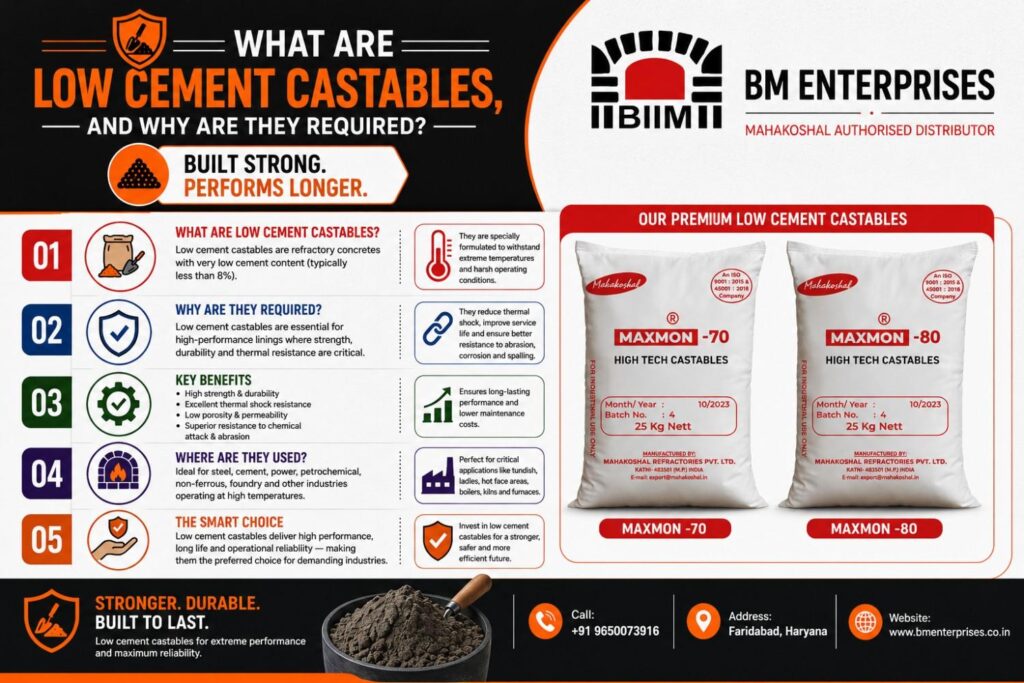
Introduction to Low Cement Castables
Furnaces, kilns, boilers, incinerators, and other high-temperature equipment require refractories that can resist extreme temperatures, mechanical stresses, abrasions, and temperature fluctuations. Conventional refractory linings do not have adequate properties to fulfill the needs of modern industries in terms of durability, resulting in frequent maintenance, production losses, and high costs. Low cement castables have become one of the most popular refractory solutions used in many industries due to their outstanding properties. BM Enterprises provides premium-quality low cement castables that are highly durable, thermally stable, and last for a long time. We are among the leading refractory materials suppliers in India who provide reliable refractory solutions for steel plants, cement industries, power plants, foundries, petrochemical industries, and other applications with high temperatures. Choosing proper refractory castable cement plays an important role when installing refractory linings in the furnaces or repairing worn-out refractory linings in the furnaces. Some of the products which have been specifically engineered to provide better performance and minimize maintenance include Maxmon 70 and Maxmon 80.What Are Low Cement Castables?
Low cement castables represent high-performance monolithic refractory materials that are made using premium quality refractory aggregates, fine powders, reactive alumina, micro silica, special additives, and much less amount of calcium aluminate cement than conventional refractory castables. As opposed to the conventional castables that are comprised of roughly 15–20% cement, low cement castables are made using only 3-8% cement. The presence of lesser amounts of cement reduces porosity upon firing and produces dense refractory material having better mechanical properties. The optimized particle size distribution allows achieving very high packing density for the castable and, hence, increases its strength while using less amount of water. The reduced amount of water further prevents shrinkage and improves thermal conductivity properties of the material as well as reduces the formation of cracks during heating. These refractory materials are widely used in different industries since they have good thermal shock resistance, chemical corrosion resistance, abrasion resistance, slag penetration resistance, and wear resistance.Composition and Raw Materials
The performance of low-cement castables is mostly determined by the type of raw materials that are employed in their production. The superior grade of castables normally consists of the following:- High Alumina Aggregates
- Calcined Alumina
- Reactive Alumina
- Calcium Aluminate Cement
- Micro Silica
- Performance Additives
- Dispersing Agents
| Feature | Conventional Castables | Low Cement Castables |
| Cement Content | High | Low |
| Water Requirement | Higher | Lower |
| Porosity | Higher | Lower |
| Mechanical Strength | Moderate | Excellent |
| Thermal Shock Resistance | Moderate | Superior |
| Service Life | Average | Long |
| Heat Resistance | Good | Excellent |
Why Are Low Cement Castables Required?
Industries always try to find means of increasing efficiency in production and minimizing down time and cost incurred in maintenance. This is where the low cement castable comes in handy because of its high performance in tough conditions. Due to the reduction in cement content in these castables, the hydration products will be less after curing. As the castables heat, there will be reduced shrinkage and internal stresses, which makes the refractory lining stronger and thus not prone to cracking. Yet another very important reason why low cement castables are preferred is because of their outstanding resistance to molten metal, slag, hot gases, and chemicals. The high density, less porosity, and excellent bonding properties make it possible for equipment to run for long without the need for maintenance. Improved Thermal Efficiency Low cement castables are stable up to 1600°C and above, depending on the specific type and formulation of low cement castable used. Greater Mechanical Strength Low porosity allows low cement castables to possess greater mechanical strength, such as crush resistance and resistance to wear and tear. Longer Lifespan Improved durability means that these refractory products last longer due to fewer instances of lining failure.Key Features of Low Cement Castables
Some of the most important benefits include:- Excellent high-temperature stability
- Superior abrasion resistance
- High mechanical strength
- Low porosity
- Reduced shrinkage
- Excellent thermal shock resistance
- Improved resistance to slag attack
- Better chemical resistance
- Lower maintenance costs
- Longer refractory lining life
Applications of Low Cement Castables
Low cement castables are widely used in numerous industries because of their exceptional durability and thermal performance.Steel Industry
- Ladles
- Tundishes
- Reheating furnaces
- Blast furnaces
- Electric arc furnaces
Cement Industry
- Rotary kilns
- Cooler linings
- Burner pipes
- Cyclones
- Calciner systems
Power Plants
- Boilers
- Fluidized bed combustion units
- Ash handling systems
- Chimneys
Foundries and Non-Ferrous Industries
- Induction furnaces
- Aluminum furnaces
- Copper furnaces
- Heat treatment furnaces
- Holding furnaces
Maxmon 70 and Maxmon 80 Low Cement Castables
BM Enterprises supplies Maxmon 70 and Maxmon 80 high-alumina low cement castables of the best quality for tough applications.Maxmon 70
The Maxmon 70 is a high-performance refractory castable consisting of about 70% alumina. It provides excellent properties for abrasion resistance, thermal shock resistance, and mechanical strength. It is used in cement plants, boilers, steel furnaces, and other industrial heating equipment. Typical Features- Approximately 70% Alumina
- High strength
- Excellent thermal stability
- Good abrasion resistance
- Reliable performance
Maxmon 80
Maxmon 80 is developed for use where additional toughness is required against heat, slag, and wear. The presence of about 80% alumina content makes it more effective for harsh operating environments. Typical Features- Approximately 80% Alumina
- Excellent slag resistance
- Superior hot strength
- Low porosity
- Long operational life
- High durability
Why Choose BM Enterprises?
BM Enterprises has emerged as a dependable source of quality refractory material in industries throughout India. Our objective is to provide the best quality product in accordance with the stringent demands of the industry and to provide technical assistance.Our Advantages
- Authorised Distributor & Stockist
- High-quality refractory products
- Reliable technical guidance
- Ready stock availability
- Timely nationwide delivery
- Competitive pricing
- Experienced industry professionals
- Customized refractory solutions