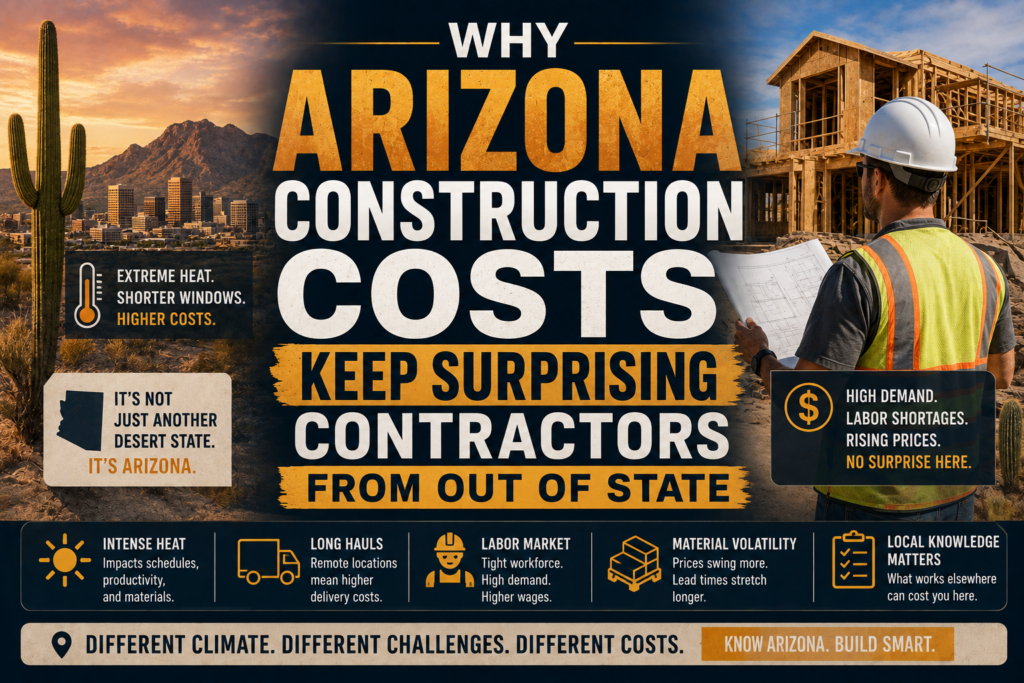
Arizona attracts a lot of construction activity from contractors and developers based elsewhere, drawn by the state’s growth, particularly around Phoenix and its surrounding suburbs. That growth is exactly what makes Arizona easy to misjudge on cost: it looks like a straightforward Sun Belt market on paper, but a handful of conditions specific to the state extreme heat, unusual soil behavior, water constraints, and a construction boom that’s tightened labor faster than most estimates account for routinely catch out-of-state bidders off guard.
Extreme Heat Isn’t Just a Discomfort Issue It’s a Productivity Cost
Arizona’s summer heat, especially across the Phoenix metro area, regularly reaches levels that directly affect labor productivity and safety compliance. Many jurisdictions and responsible contractors now build in mandatory rest breaks, adjusted work hours, or shifted schedules to avoid the most dangerous midday heat during peak summer months and all of that translates into real cost, either through reduced daily output or through paying overtime to shift crews toward early morning and evening hours instead.
An estimate built without accounting for this seasonal productivity loss will consistently underprice labor for any Arizona project with exterior work scheduled during peak summer months. It’s not a minor adjustment heat-related productivity loss during the hottest stretch of the year is a well-documented and substantial factor, and treating Arizona’s summer like a normal construction season anywhere else in the country is one of the more common estimating mistakes contractors make on their first Arizona project.
Soil Conditions Are More Complicated Than “Desert Ground”
A lot of out-of-state estimators assume desert soil means simple, dry, easy-to-work ground. In much of Arizona, that assumption is wrong in an expensive way. Large areas of the state have caliche a hardened layer of calcium carbonate-cemented soil that can be extremely difficult and slow to excavate through, sometimes requiring specialized equipment or blasting rather than standard excavation methods. Other areas deal with expansive clay soils that shift with moisture changes, requiring foundation design adjustments to avoid structural movement over time.
Neither of these conditions is uniform across the state, which means a generic “desert soil” cost assumption, applied without checking actual geotechnical conditions for the specific site, can significantly underprice site work and foundation costs.
Water Rights and Availability Affect More Than People Expect
Arizona’s water situation is a genuine and ongoing constraint on development, particularly in fast-growing suburban areas around Phoenix. Some jurisdictions have implemented water availability requirements that directly affect whether and how a project can proceed, and certain areas have seen new development restrictions tied specifically to groundwater supply concerns. This isn’t a cost line item in the traditional sense, but it’s a real project risk factor that affects timelines, entitlement complexity, and site feasibility in ways a generic Sun Belt cost estimate won’t flag.
Monsoon Season Creates a Real, Concentrated Weather Risk
Arizona’s summer monsoon season brings intense, often sudden thunderstorms and flash flooding risk that’s easy to overlook if you’re used to the state’s dry reputation for most of the year. Site work, particularly excavation and grading, can be significantly disrupted during this concentrated storm season, and flood-prone areas require specific drainage and grading design considerations that add real cost. A schedule that doesn’t build in monsoon-season contingency, treating Arizona as uniformly dry year-round, is missing a genuine and predictable weather risk window.
Explosive Growth Has Tightened Labor Faster Than Most Benchmarks Reflect
The Phoenix metro area in particular has seen sustained, rapid construction growth for years, driven by population growth, semiconductor and manufacturing investment, and continued residential development. That growth has tightened the skilled trade labor market considerably, and labor costs in the busiest parts of the state have climbed faster than a lot of standard regional cost databases have kept pace with. A bid built on labor rate assumptions even a year or two old can be meaningfully out of date in Arizona’s faster-moving submarkets, particularly around Phoenix, Chandler, and Gilbert.
What an Arizona-Specific Estimate Actually Needs
Putting this together, an accurate Arizona construction estimate needs to account for:
- Heat-adjusted labor productivity, with realistic scheduling around the most extreme summer months
- Site-specific geotechnical conditions, since caliche and expansive clay soils vary significantly by location and can dramatically affect excavation and foundation costs
- Water availability and entitlement risk, particularly for new development in fast-growing suburban areas
- Monsoon-season weather contingency, built into the schedule rather than treated as a rounding error
- Current, fast-growing-market labor rates, especially in the Phoenix metro area, rather than a static regional average
None of these are exotic considerations for an estimator who’s actually worked Arizona projects across multiple parts of the state they’re the kind of detail that gets built in automatically with real local experience, and exactly the kind of thing a generic Sun Belt cost benchmark tends to miss. There’s a solid overview of the trades, project types, and cities covered by this kind of region-specific estimating process spanning Phoenix, Tucson, Flagstaff, and dozens of other Arizona communities on this page on Arizona construction estimating services, worth reviewing for anyone bidding into the state for the first time or checking an in-house estimate for regional gaps.
The Takeaway
Arizona’s growth and sunny reputation make it easy to underestimate as a straightforward, generically warm-climate market. In reality, extreme heat productivity loss, unpredictable soil conditions, water constraints, concentrated monsoon risk, and a labor market that’s tightened faster than most benchmarks reflect all shape real project costs and a bid that treats Arizona like any other Sun Belt state is missing distinctions that experienced local estimators account for as standard practice.