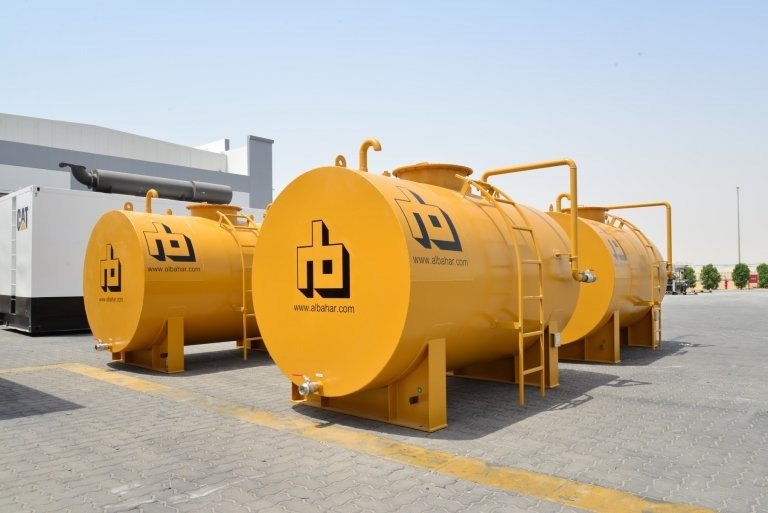
For any facility running standby generators, a fleet yard, or an industrial process dependent on diesel or oil supply, fuel storage tanks are one of the few pieces of infrastructure that’s simultaneously safety-critical, compliance-regulated, and easy to under-specify. A tank that meets the letter of a budget but not the spirit of a standard tends to surface as a problem during an inspection, not during procurement.
Above Ground Fuel Storage Tanks or Underground Fuel Storage Tanks — The First Decision
Above ground fuel storage tanks dominate in the Gulf for good reason: they’re easier to inspect, cheaper to install (no excavation), and any leak is visible immediately rather than silently contaminating soil or groundwater. Underground fuel storage tanks remain in use where surface space is constrained or aesthetics require it, but they demand a more rigorous leak-detection and corrosion-monitoring regime precisely because a fault isn’t visually obvious. Facility managers should treat the choice as a maintenance-access decision as much as a space one.
Double Wall Fuel Tanks vs. Single-Wall: Not Just a Budget Line
A double wall diesel tank — or double wall fuel tanks generally — provides integral secondary containment: if the inner wall fails, the outer wall or bund still holds the fuel rather than releasing it directly to the ground. A bunded fuel tank achieves the same result with an external bund rather than a true double skin. Many GCC municipalities now expect this level of containment as standard for new installations rather than an upgrade option, so checking local requirements before defaulting to single-wall on cost grounds is worth doing early, not after a tank has already been ordered.
The Standards Question: What a UL142 Tank Actually Covers
UL142 is the reference standard most commonly cited for steel above-ground atmospheric storage tanks, covering construction, weld integrity, and venting design. Any UL142 tank manufacturer in UAE should be able to supply design-approval and test documentation directly, rather than a generic “industry standard” claim — UL142 establishes the baseline that local GCC civil-defence bunding, spacing, and fire-separation rules are usually layered on top of.
Diesel and Oil Aren’t Interchangeable Specifications
A diesel storage tank isn’t automatically the right choice for lubricant, hydraulic, or waste-oil storage, even though the steel shell looks identical — which is why buyers searching for oil storage tank manufacturers in UAE markets specifically shouldn’t assume a generic diesel tank supplier covers the same ground. Different oil chemistries interact differently with tank linings and seals, and diesel tanks are typically fitted with water-drain and particulate-filtration points that oil storage doesn’t need in the same way.
Shape and Format: Rectangular, Cube, and Cylindrical
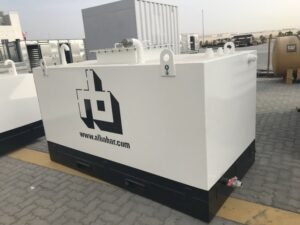
A rectangular fuel tank or cube tank makes better use of a constrained plant-room footprint than a cylindrical equivalent of the same capacity, at some cost in structural simplicity. When comparing fuel storage tanks for sale from different fabricators, footprint efficiency is worth weighing alongside price per litre, particularly on retrofit sites where the tank has to fit an existing bund or enclosure.
A Short Pre-Procurement Checklist
- Confirm the fluid — diesel or oil, since this changes lining and fitting requirements and which storage tank manufacturers in UAE actually stock the right spec.
- Confirm containment class — single-wall, double wall fuel tanks, or bunded, checked against current local municipality requirements.
- Confirm the standard — ask any fuel tank manufacturer for UL142 (or equivalent) documentation directly.
- Confirm capacity against actual runtime need — size to litres-per-hour consumption × required backup hours, not a round number.
About the contributor: This piece was contributed with input from Al Bahar Metal Cabinets & Enclosures Manufacturing (MCEM), a Dubai-based fuel storage tank manufacturer in the UAE supplying above-ground, underground, double-wall, and bunded tanks across the UAE, Oman, Kuwait, Qatar, and Bahrain.