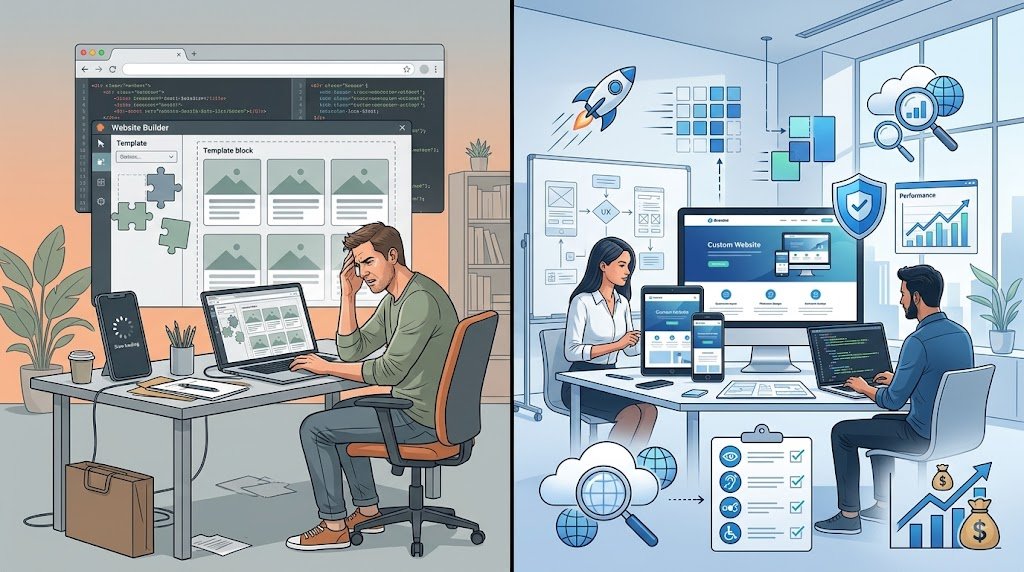
AI-powered website builders have fundamentally shifted expectations around web development. Platforms like Wix ADI, Framer AI, and Hostinger let you generate a full site from a simple text prompt. Choose some colors, select a layout, and watch it assemble itself. For many people, this sounds like exactly what they need.
Small business owners juggle dozens of responsibilities daily. Skipping months of back-and-forth development while saving thousands sounds incredibly appealing.
Yet the real question is whether speed and convenience align with what your website actually needs to accomplish. A basic digital presence is one thing. A site that generates revenue and builds credibility is something else entirely. That distinction reveals why human expertise continues to matter.
The Draw of Automated Design
Before criticizing AI tools, it is worth acknowledging what they do well. They are fast. They are affordable. They dramatically lower the barrier to entry for anyone wanting an online presence.
Launching a personal blog or testing a business concept becomes effortless. You get a responsive, visually acceptable site without writing code. The results are often surprisingly clean for what they are.
But launching a site and competing in a crowded market are fundamentally different challenges. Once growth becomes the goal, limitations surface quickly.
Escaping the Template Problem
AI systems learn by studying patterns across millions of existing websites. Request a site for a dental practice, and you receive a predictable dental template filled with generic imagery and boilerplate copy.
Your competitor receives that same template when they ask for the same thing. Nothing distinguishes the two experiences.
When someone visits your website, they should immediately grasp what makes your business worth choosing. AI-generated pages rarely achieve that because they rely on averages rather than identity. Stock photography and templated language signal sameness.
A website designer approaches the problem from the opposite direction. They investigate your brand, study your voice, and examine your goals before writing a single line of code. The finished product reflects who you actually are rather than what an algorithm assumes you should look like.
Beyond Visual Appeal: The User Experience Problem
Looking attractive on a screen is only one dimension of effective design. Functionality and user flow matter just as much, if not more.
AI tools understand conventions. They place navigation menus where users expect them and position call-to-action buttons in standard locations. But understanding layout conventions is not the same as understanding people.
Real designers obsess over the visitor journey. They ask what someone needs when they first arrive and what single action should follow. Mapping that path from initial curiosity to completed conversion demands genuine empathy.
Every audience behaves differently. A B2B software buyer navigates a site in ways that differ drastically from someone ordering pastries from a local bakery. A thoughtful website designer recognizes these behavioral differences and builds custom pathways tailored to each context.
The Missing Strategic Layer
A website functions as a business tool, not a digital brochure. Treating it as anything less leaves value on the table.
When you engage a web design company, the work begins with questions that go far beyond aesthetics. What does your ideal customer look like? What promise differentiates you from competitors? What single result should every page drive toward?
Those conversations shape everything that follows — from content structure to visual hierarchy to technical architecture. Without them, design becomes decoration.
AI builders skip this phase entirely. They ask for your industry and company name, then produce something that resembles every other result in that category. No strategy informs the outcome.
A website conceived without strategic thinking amounts to scattered pages with no collective purpose. Conversion suffers because no one defined what conversion should look like.
When Pre-Built Systems Hit Their Ceiling
AI platforms offer a fixed menu of features and integrations. Within those boundaries, everything functions smoothly. The moment requirements extend beyond the standard offerings, friction begins.
Need a custom CRM integration? A complex product configurator? An unusual checkout flow tailored to your sales model? Pre-built systems were not designed for those scenarios.
Most AI builders treat customization as a premium add-on rather than a core capability. Even at higher tiers, meaningful modifications remain restricted. You are essentially working inside someone else’s framework.
A human developer writes code specifically for your requirements. They do not squeeze your operations into a predetermined structure. Custom API connections, unique database logic, and bespoke user interfaces all become possible when someone who understands code is building for you.
As your business evolves, that adaptability becomes increasingly valuable. Partnering with a web design company that can scale alongside you prevents the painful migration headaches that rigid platforms eventually force.
Code Quality, Speed, and Search Visibility
Most business owners never see the code running behind their websites. But search engines see it clearly, and they make ranking decisions based on what they find.
Many AI-generated sites produce unnecessarily bloated code. They load redundant scripts to power drag-and-drop editing features that end users never interact with. The result is slower page loads across every page.
Speed directly affects search rankings and user satisfaction simultaneously. Studies consistently show that visitors abandon pages taking longer than three seconds to load. Every additional second compounds the problem.
Clean, hand-written code eliminates that overhead. Every element serves a purpose, and nothing loads unnecessarily. A skilled website designer optimizes images, compresses files, and structures pages for peak performance as standard practice.
Beyond raw speed, technical SEO demands expertise that AI tools cannot match at a meaningful level. Structuring headers, implementing schema markup, and understanding crawl behavior all require human judgment. Building site architecture intentionally — routing authority toward your highest-priority pages — is something that competitive SEO demands. Rigid AI-generated code structures often struggle with the complex hierarchies required.
Accessibility Standards and Building Trust
Web accessibility represents both a legal obligation and a moral imperative. Every visitor, regardless of ability, should be able to navigate your content effectively.
AI tools have made progress here but still fall short in real-world testing. Auto-generated alt text frequently misses the actual content of images. Color contrast ratios sometimes fail WCAG guidelines without triggering warnings. Screen reader navigation rarely receives thorough automated validation.
Human testers navigate sites without mice, test with assistive technologies, and verify compliance against established standards. This diligence protects organizations from legal exposure while genuinely expanding their potential audience.
Trust operates on subtler psychological levels as well. Visitors recognize template-based sites instinctively. Generic layouts combined with stock imagery create an impression of low investment, which transfers directly to perceptions about your business quality.
A custom-built site communicates something different. It signals that you treat your brand seriously and pay attention to details that matter. When prospective customers encounter a polished, original online presence, confidence in doing business with you increases naturally.
A Balanced Perspective on AI Tools
Artificial intelligence is not without genuine value in specific contexts. Freelancers launching their first portfolio benefit from the simplicity. Event organizers running short-term campaigns appreciate the speed. Organizations with zero budget for web development gain more from AI than from having nothing online at all.
However, for established businesses with growth ambitions, AI platforms frequently become constraints disguised as solutions. They flatten differentiation, limit functionality, and replace strategic thinking with algorithmic defaults.
AI works best as a supporting tool within a larger workflow. Experienced professionals use it to accelerate preliminary tasks like generating image variations or exploring color directions. The critical decisions — strategy, architecture, user experience, brand expression — still belong to people.
Most successful website designer professionals already incorporate AI selectively into their process. The difference lies in knowing when to trust the tool and when to override it with human judgment that considers context no algorithm can fully grasp.
Final Thoughts
Building a website represents a meaningful business investment. The appeal of instant results and minimal cost is understandable, but closer examination reveals significant trade-offs.
An AI tool produces a website. A skilled professional produces a competitive advantage.
Real growth requires more than pages assembled from templates. It demands strategic thinking, custom design decisions, and technical craftsmanship applied with intention. Choosing the right web design company means partnering with people who understand both technology and the businesses they serve.
Ultimately, what separates a forgettable web presence from one that drives real results is the human judgment behind it. Algorithms can generate layouts, but only people build brands that customers remember and trust.