By Austin Peppers
Grafting a pepper isn’t hard to attempt and isn’t easy to get right — the species you pick matters more than the cut does.
Quick answer: grafting pepper plants works best within the same species (annuum-to-annuum, chinense-to-chinense). Cross-species grafts are workable but heal slower; grafting onto tomato or eggplant doesn’t reliably work at all.
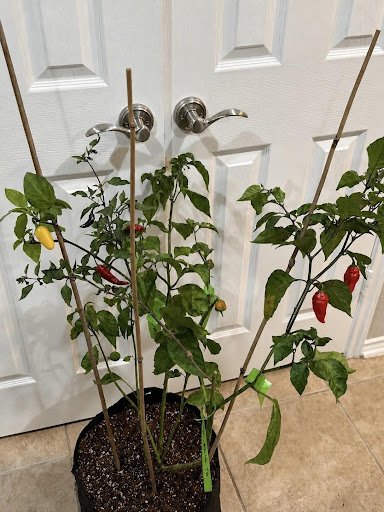
Grafting isn’t only a tomato trick. We ran a multi-graft experiment on a seven-month-old Carolina Reaper — by then it had branched out with pencil-thick wood, plenty of separate branches to carry a graft each, above the soil line. Onto those branches went four varieties: Sweet Moruga, 7 Pot Heatless, Lemon Spice Jalapeno (an annuum riding on chinense roots), and Purple Ghost Pepper. With the Reaper’s own branches still fruiting alongside the grafts, that’s five peppers growing on one plant. The Sweet Moruga was the stubborn one — that graft failed twice before the third attempt finally held.
That failure rate is ordinary, not a sign of doing it wrong. A graft union is a small wound healing under exact conditions, and it fails quietly more often than people expect before it succeeds.
What decides whether it takes
Species relationship matters more than almost anything else:
| Combination | Result |
|---|---|
| C. annuum onto C. annuum | Best odds — the reliable baseline |
| C. chinense onto C. chinense (our Reaper rootstock) | Good odds, same-species |
| C. chinense and C. annuum mixed | Workable, but the union heals slower |
| C. baccatum or C. pubescens as rootstock | Consistently poor performers |
| Pepper onto tomato or eggplant | Doesn’t reliably work, even close Solanaceae relatives |
Past species, the two practical variables are stem diameter — match them closely — and the first week of healing: high humidity, low light, steady warmth. Rush that window and the union never fully forms.
The payoff: a grafted pepper plant running several varieties on one rootstock is a real space-saver in containers, and a vigorous, established rootstock can carry a slower variety along faster than it would grow on its own roots. The full pepper plant grafting technique — the cuts, troubleshooting — is in The Chile Pepper Almanac (Amazon), and WikiPepper.org has a free grafting guide with the complete compatibility reference. And if you’d rather skip the scalpel entirely, the live pepper plants at Austin Peppers — austinpeppers.com — arrive already established on their own roots. For practical reasons, we don’t ship a lot of these.