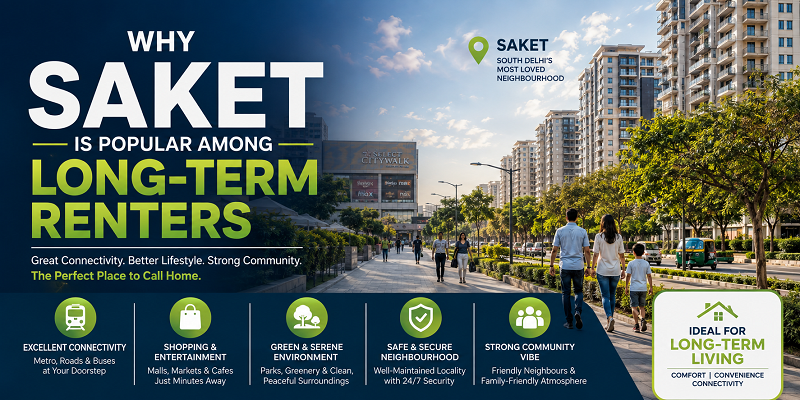
Saket sits in the heart of South Delhi, and it has quietly become one of the city’s most stable rental markets. Ask anyone who has lived here for a few years, and they’ll tell you the same thing: once you settle in, you rarely want to move out.
That’s not an accident. Saket combines metro connectivity, established social infrastructure, and a housing mix that suits families and working professionals equally well. This is what draws tenants who plan to stay for years, not months.
For people exploring the market, a wide range of housing options are available, from a compact Saket room on rent for a single working professional to a full Independent Floors for Rent in Saket for a family that wants more space and privacy. This variety is one of the quiet reasons the locality keeps its tenant base year after year.
Key Takeaways
- Saket offers direct Yellow Line metro access, linking it to Central Delhi, South Delhi, and Gurugram.
- The locality has a dense mix of hospitals, schools, and malls within a short radius.
- Housing stock ranges from independent floors to gated apartment complexes, suiting different budgets.
- Long-term renters value the low turnover of good tenants and owners in established colonies.
- Traffic near malls and metro exits during peak hours is the most commonly cited drawback.
What Makes Saket a Long-Term Rental Hotspot
Saket is a well-developed residential and commercial hub in South Delhi, known for premium malls, established hospitals, reputed schools, and direct metro access. It functions as a self-contained locality where most daily needs are met without long commutes.
For a renter deciding between a short lease and a long-term commitment, that self-sufficiency matters. Fewer reasons to travel outside the neighbourhood mean lower daily friction, and that’s a big part of why tenants renew leases here instead of relocating.
A Locality Built Around Daily Convenience
Unlike newer developments still building out their infrastructure, Saket’s schools, hospitals, and markets have been operating for years. This maturity reduces the guesswork for anyone planning to settle in for the long haul.
Metro Connectivity: The Backbone of Saket’s Popularity
Saket Metro Station, on the Delhi Metro Yellow Line, is one of the busiest elevated stations in South Delhi. It links Saket directly to Central Delhi and Gurugram, and connects nearby areas like Malviya Nagar and Hauz Khas within a couple of stops.
For long-term renters, this is a practical, ongoing benefit rather than a one-time selling point. A daily commute that doesn’t depend on traffic conditions protects both time and money over years of tenancy, which is exactly the kind of stability long-term renters prioritize over short-term convenience.
Key insight: Areas anchored by a metro station tend to hold rental demand better than areas that depend entirely on road access, because commute reliability doesn’t fluctuate with traffic or fuel prices.
Roads That Support the Metro Network
Press Enclave Marg, Mehrauli-Badarpur Road, and Aurobindo Marg give Saket strong road connectivity as well, linking it to AIIMS, Greater Kailash, Nehru Place, and Connaught Place. Residents who drive still benefit from multiple route options.
Housing Stock: Why Saket Suits Long-Term Tenants
Saket’s housing mix is one of its strongest advantages. The locality has independent houses, builder floors, and gated apartment complexes side by side, which means tenants at different life stages can find something that fits without leaving the area.
| Housing Type | Typical Tenant | Why It Suits Long-Term Renting |
| Independent floors | Families, shared households | More space, private entry, lower shared-wall noise |
| Builder floors | Small families, couples | Modern layouts, often better maintained |
| Gated apartments | Working professionals, senior citizens | Security, amenities, lower upkeep responsibility |
| Single rooms/PGs | Students, young professionals | Lower rent, flexible terms, proximity to metro |
Many tenants who start in a smaller setup end up moving within Saket rather than out of it, often shifting from a single room to one of the builder floors in Saket as their needs grow. That internal mobility is a strong sign of neighbourhood loyalty.
Why Builder Floors Specifically Appeal to Long-Term Renters
Builder floors typically offer more livable space per rupee than high-rise apartments in the same budget range, along with fewer shared amenities to maintain collectively. For a tenant planning to stay three years or more, that combination of space and lower shared overhead adds up.
Social Infrastructure: Schools, Hospitals, and Everyday Access
A locality only supports long-term renting if daily life stays convenient. Saket checks this box with reputed schools, multi-specialty hospitals, and everyday retail, all within a short distance of most residential pockets.
Healthcare access, in particular, matters to renters with families or elderly members. Max Smart Super Speciality Hospital and several other multi-specialty hospitals in and around Saket give residents access to advanced care without needing to travel across the city for emergencies.
Short answer: Saket offers renters access to established hospitals, reputed schools, and daily retail within a two-to-three kilometre radius, reducing the need for long commutes for essential services.
Schools and Education Options
Several well-known schools operate in and around Saket, making it a practical choice for families with school-going children who want to avoid long daily school runs.
Lifestyle and Retail: Malls, Dining, and Green Spaces
Select Citywalk, DLF Avenue, and Saket District Centre give the locality a retail and entertainment core that few other South Delhi neighbourhoods can match at the same scale. These aren’t just weekend destinations; they function as everyday convenience hubs for groceries, dining, and errands.
Beyond the malls, Saket also has green pockets and walking spaces that residents use regularly, which adds a layer of everyday livability that pure commercial hubs often lack.
A Balance Between Commercial Energy and Residential Calm
What sets Saket apart from a purely commercial district is that its residential colonies sit just a short walk from all this activity, without being overwhelmed by it. Tenants get the convenience of a commercial hub and the quiet of a residential block in the same neighbourhood.
Benefits of Renting Long-Term in Saket
- Stable commute: Metro and road connectivity that doesn’t depend on one route.
- Housing flexibility: Ability to upgrade within the same locality as needs change.
- Established amenities: Schools, hospitals, and markets that are already mature, not still developing.
- Safety perception: Active resident welfare associations and visible security in many colonies.
- Resale and rental value: Property demand in Saket has historically stayed resilient due to location advantages.
Challenges Long-Term Renters Should Know About
No locality is without trade-offs, and Saket has a few worth planning around.
- Traffic near malls: Weekend and evening traffic around Select Citywalk and DLF Avenue can be heavy.
- Premium rents in some pockets: Certain blocks command higher rent than comparable South Delhi areas.
- Parking constraints: Some older colonies have limited parking for multiple vehicles per household.
- Peak-hour crowding: Saket Metro Station sees high footfall during office hours, which can mean longer waits.
How Renters Typically Work Around These Challenges
Most long-term residents adjust by timing errands outside peak hours, choosing colonies slightly set back from the main commercial stretch, and factoring parking availability into their housing search before signing a lease.
Saket vs Other South Delhi Rental Markets
| Factor | Saket | Malviya Nagar | Greater Kailash |
| Metro access | Direct Yellow Line station | Direct Yellow Line station | Limited, relies more on road |
| Housing mix | Independent floors, builder floors, apartments | Mostly independent floors | Premium independent houses |
| Retail/mall access | High (multiple malls) | Moderate | Moderate to high |
| Typical tenant | Families, professionals | Students, young professionals | Established families |
| Rent range | Mid to premium | Mid-range | Premium |
This comparison shows why Saket often wins out for renters who want mall-level convenience without paying strictly premium rents across the board — it sits in a comfortable middle ground.
Real-Life Considerations Before Renting in Saket
Before signing a long-term lease, it helps to think beyond the obvious highlights.
Checklist for prospective long-term renters:
- Visit the property at different times of day to gauge traffic and noise.
- Confirm water supply reliability, especially for summer months.
- Check parking allocation in writing if you own a vehicle.
- Ask about the resident welfare association’s rules and maintenance charges.
- Compare distance to the nearest metro gate, not just the station name.
- Verify hospital and school proximity if relevant to your household.
Who Tends to Stay Longest in Saket
Families with school-age children, working professionals commuting to Central Delhi or Gurugram, and people who value walkable access to healthcare tend to renew leases here more often than short-term tenants who prioritize novelty over stability.
Future Trends Shaping Saket’s Rental Market
As Delhi Metro’s Phase 4 expansion progresses, connectivity in and around South Delhi is expected to improve further, which typically supports steady rental demand in already well-connected localities like Saket. Established areas with existing infrastructure tend to absorb this kind of growth more smoothly than newer, still-developing pockets.
Conclusion
Saket’s appeal for long-term renters isn’t built on any single feature — it’s the combination of dependable metro access, established schools and hospitals, varied housing options, and a lifestyle that balances commercial convenience with residential calm. For tenants who want to put down roots without constantly reassessing their commute or amenities, Saket remains one of South Delhi’s steadiest choices.
Frequently Asked Questions
- Is Saket a good locality for long-term renting?
Yes. Its combination of metro access, established schools and hospitals, and a mixed housing stock makes it well suited to tenants planning to stay for several years.
- What type of housing is most common for rent in Saket?
Independent floors, builder floors, and gated apartment complexes are all common, giving renters flexibility across budgets and space requirements.
- How is the metro connectivity in Saket?
Saket Metro Station on the Yellow Line connects directly to Central Delhi and Gurugram, with nearby stations like Malviya Nagar and Hauz Khas adding further reach.
- Are there good schools and hospitals near Saket?
Yes, the locality has several reputed schools and multi-specialty hospitals, including facilities offering advanced care, within a short distance of most residential blocks.
- Is Saket expensive to rent in compared to other South Delhi areas?
Rents in Saket are generally mid to premium, similar to or slightly higher than nearby Malviya Nagar, but often more moderate than areas like Greater Kailash.
- What are the biggest downsides of living in Saket?
Traffic near the malls during peak hours and limited parking in some older colonies are the most commonly mentioned drawbacks.
- Is Saket safe for families and working professionals?
Many residents note active security and resident welfare associations in Saket’s colonies, which contributes to a general sense of safety in the area.
- Can I find affordable single-room rentals in Saket?
Yes, single rooms and shared accommodations are available alongside larger housing options, making the locality accessible to students and young professionals as well as families.
- How far is Saket from Gurugram and Central Delhi?
Thanks to the Yellow Line metro and road connectivity via Press Enclave Marg and Aurobindo Marg, both Gurugram and Central Delhi are within a manageable commute.
- Why do tenants often stay long-term in Saket rather than move elsewhere?
The combination of stable connectivity, mature social infrastructure, and the option to upgrade housing within the same locality means tenants can meet changing needs without relocating out of the area.