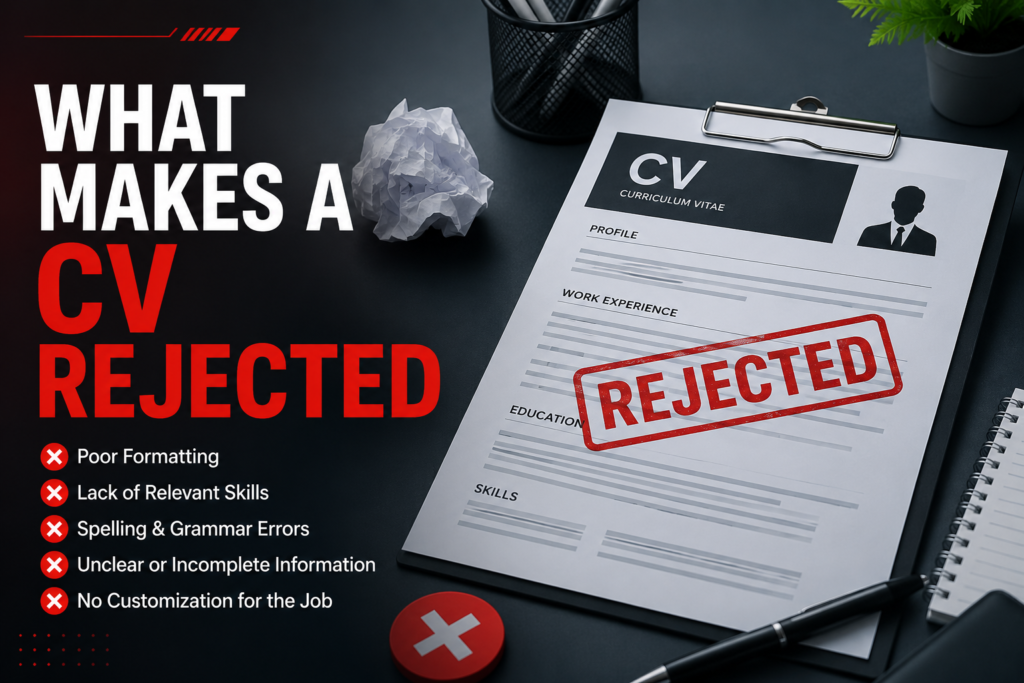
The CV is often the first contact between a job seeker and an employer. Even with all the right qualifications, experience, and achievements, most job applicants do not receive interview invites because their CVs are discarded at the first stage of screening. Learning what not to include in your CV is essential for creating better opportunities in an increasingly competitive job market. To increase your chances of landing an interview, understanding why CVs get rejected can be a game-changer. Let’s explore the top mistakes and see how to avoid them.
Not Related to the Job Position
One of the main reasons a CV is rejected is poor relevance. Employers seek experienced, knowledgeable employees with strong resumes and cover letters. A resume sent to numerous employers will almost never market itself to a specific job opening, according to that job opening.
Recruiters want to see things specific to the role. If your CV doesn’t show any of the key requirements of the job vacancy, then it is going to get ignored.
Poor Formatting and Presentation
First impressions matter. A cluttered layout gives an unprofessional impression, making a CV difficult to read and instantly putting off recruiters. Lengthy paragraphs fonts that don’t match, and no spacing to speak of add up to a less-than-legible and professional look.
Clean, easy-to-read, well-formatted CVs with simple bullet points and well-defined headings enable the recruiter to skim through and shortlist your profile. Even if your content is brilliant, sloppy formatting may be reason enough to reject it.
Spelling and Grammatical Errors
Typos and Punctuation Errors: Typos and poor grammar are among the reasons your CV may be rejected. Those kinds of mistakes point to a lack of precision and care. Employers may presume that if you were careless with your writing, you’ll be irresponsible on the job.
Proofreading is essential. A single typo on a resume can harm your chances, especially in positions that demand strong communication abilities.
With little professional experience or who need guidance on content, structure, and style, CV Writing services are available to help ensure you have a professionally written document tailored to the job.
Lack of Achievements and Impact
In most CVs, one is more likely to find responsibilities listed rather than achievements. Employers are looking to see the impact you had in your last job, not just what was in your job description.
Without a CV that sells your achievements, not much is going to help you get out of the “no” pile.
Overly Long or Too Short CVs
Length matters. A CV that’s too long can be overwhelming for recruiters, and one that’s too short may seem like a work in progress. The recruiters will find it more convenient if you provide them with short and beneficial information about your skills and achievements.
Too much information is not good; too little leaves you begging for more. It is essential to maintain balance for clarity and interest.
Isn’t Optimized for Applicant Tracking Systems (ATS)
Companies often have their CVs screened by a machine before a human reads them. Similarly, non-ATS-friendly CVs might be filtered out by ATSs as incorrectly formatted or lacking required keywords.
These systems can get confused by overly designed graphics, tables, or unusual fonts. The more keywords you can match and the simpler your layout, the greater the chance that your CV will make it through the first phase of selection.
Unclear Career Progression
“Employers want to see some progressive and linear career path. Suspected stints of unemployment, frequent job hopping, or an ambiguous portrayal of career transition can give the wrong impression if not addressed.
Career gaps and field switches are commonplace, but if you don’t address them effectively, your resume is likely to get rejected. It helps that it is transparent and easy to follow so that recruiters can put your career path into context.
Weak Personal Summary
The same goes for a personal summary, which would appear at the top of your CV. A generic or dull summary doesn’t catch someone’s attention. It could make recruiters tune out far sooner.
A good summary is essential because it represents you and appears at the top of your resume. Apart from your CV, you wouldn’t have an effective way to stand out among the large number of applicants.
Irrelevant or Outdated Information
Outdated, irrelevant information won’t help you. Employers want to know what you’ve done most recently, and that is relevant, and that you possess the skills needed for the position.
Old certifications, unrelated jobs, or too many personal details can detract from your qualifications and the power of your CV.
Lack of Customization
It is often a mistake to send the same CV for each job you apply for—a standard application. Whilst completing a standard application can be tiresome and time-consuming, it will allow you to stand out from other generic applications. No customization is code for no effort, no interest.
Downloading a specific CV for each job you apply for shows recruiters how much you care about getting hired. “CV Writing” is a professional creation programmer aimed at helping you write your CV in a manner and style that puts the other candidates to one side!
Unprofessional Contact Information
It can really harm your application to use unprofessional email addresses or outdated contact methods. An employer looks for clear, professional contact information that makes it easy to get in touch.
Have a professional, easy-to-read email address and relevant phone numbers to instill confidence.
Missing Keywords and Skills
If your resume is missing key terms related to your job title, an ATS won’t detect it, and recruiters won’t find it relevant. Keywords help employers quickly determine whether your profile aligns with their requirements.
By reading job descriptions and weaving in relevant terms, you’ll ensure your CV is not only competitive but also answerable to many employers.
Final Thoughts
Knowing why a CV is rejected is the starting point for successful applications. You actually omitted the most common reasons for recruiters to bypass resumes: poor layout, not addressing your skills in the summary, dumb misspellings, bland summary summaries, and no keywords… non-highlighted accomplishments. Even minor errors can result in rejection amid today’s competitive hiring landscape.