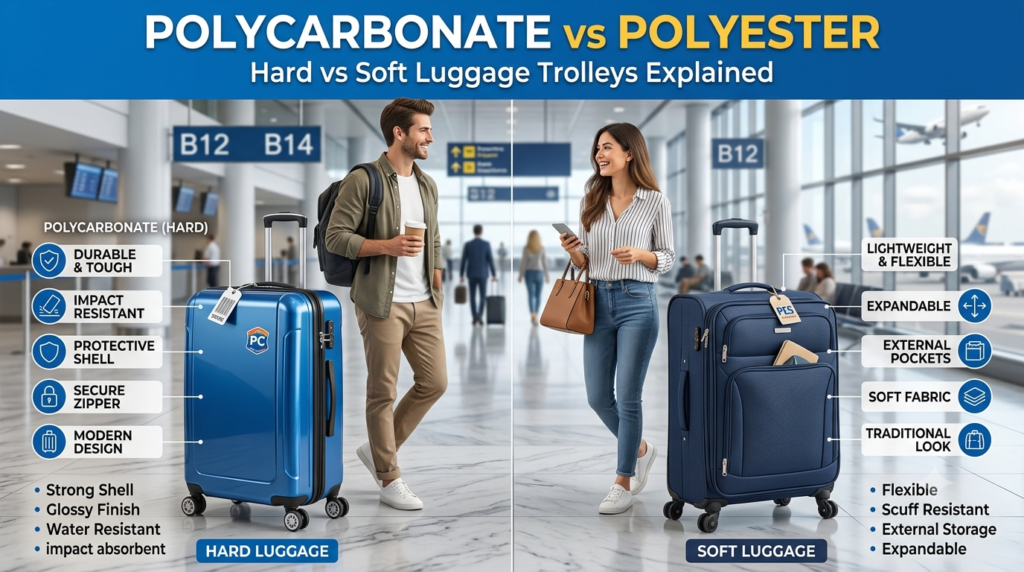
When you’re standing in front of a luggage shop or scrolling through online collections, the first decision stares you in the face: hard shell or soft? And behind that choice sits a material question most travelers never think about—polycarbonate versus polyester. But these materials matter more than you’d expect. They shape how your luggage travels with you, how it protects your belongings, and how it holds up after five years of airport terminals and hotel floors.
Let’s break this down.
Understanding the Materials: Polycarbonate and Polyester
Polycarbonate is a thermoplastic polymer. Think of it as engineered plastic that’s incredibly tough—the same material they use in aircraft windows and riot shields. It’s lightweight but hard, which is why it became the standard for modern hard-shell suitcases.
Polyester, by contrast, is a synthetic fiber. It’s the fabric used in everything from winter jackets to backpacks. In luggage, it’s usually woven tightly and sometimes layered with nylon or canvas for reinforcement. It’s soft, flexible, and surprisingly durable.
The choice between these materials doesn’t just affect what your luggage looks like. It changes how you pack, how you move through airports, and how long your investment lasts.
Hard Trolleys: The Polycarbonate Advantage
Hard trolley Luggage made from polycarbonate have dominated premium luggage for good reason. They excel at one thing: protection. Your laptop, camera, or fragile souvenirs get a rigid shell barrier between them and baggage handlers who, let’s be honest, don’t always treat luggage like it’s made of gold.
The Protection Factor
Polycarbonate’s rigid structure means your luggage absorbs impact without deforming. Drop a hard trolley and the contents stay protected. The shell might get scuffed, but it distributes force across its surface rather than crumpling inward. For frequent flyers or anyone transporting delicate items, this matters.
Weight and Durability
Modern polycarbonate trolleys are surprisingly light. They’re heavier than soft bags but often weigh less than you’d expect for something this protective. And they last. A quality polycarbonate trolley from a good brand typically outlasts soft luggage by years, even with heavy use. They resist scratches better too—maintenance is as simple as wiping them down.
The Trade-Off: Rigidity
Here’s what hard shell owners sacrifice: flexibility. A packed hard trolley doesn’t squeeze into tight overhead bins or compress under pressure. If your storage space is limited, or you frequently pack carry-ons into crowded compartments, rigid shells can frustrate.
Water resistance also requires attention. While polycarbonate repels water, zippers and seams are the weak points. You’ll want to keep zippers maintained and consider adding a rain cover for prolonged exposure.
Soft Trolleys: The Polyester Flexibility
Soft trolleys made from polyester offer a different promise: adaptability. They bend, compress, and conform to available space. Pack them nearly full, and they still squeeze into overhead bins. Their flexibility is their superpower.
Practical Advantages
Soft trolleys usually feature multiple exterior pockets—something hard shells can’t offer. This means easier access to documents, medications, or snacks without opening the main compartment. For business travelers who need frequent access to items, this convenience adds up.
Polyester bags are also gentler on surrounding luggage and people. They won’t dent adjacent bags at baggage claim or scrape shins in narrow aisles. If you’re traveling with family or sharing storage space, this matters more than you’d think.
The Durability Question
Quality polyester luggage lasts longer than people assume. Premium brands use multi-ply fabrics and reinforce stress points like corners and handle attachments. However, wear patterns differ from hard shells. Instead of scratches, you see gradual fabric breakdown and zipper issues over time.
Water resistance varies. Some polyester trolleys are treated with water-repellent coatings, but they’re not as naturally resistant as polycarbonate. Extended exposure to moisture poses more risk.
The Limitation: Less Impact Protection
Soft luggage protects belongings through padding, not rigidity. This works fine for clothing but offers less protection for delicate items. Your laptop compartment might be padded, but there’s nothing preventing external pressure if your bag gets crushed in baggage.
Which One Should You Choose?
The honest answer: it depends on how you travel.
Choose hard polycarbonate trolleys if:
- You fly frequently and check bags regularly
- You transport expensive or fragile items
- You value durability over everything else
- You don’t mind restricted packing flexibility
- You appreciate a sleek, professional appearance
Hard shells suit business travelers, people on long trips, and anyone who wants luggage that’ll last a decade.
Choose soft polyester trolleys if:
- You pack carry-on frequently and need squeeze-ability
- You value exterior pockets and accessibility
- You prefer lighter weight for hand-carrying
- You want easy maneuverability in tight spaces
- You travel shorter distances or pack light
Soft bags suit casual travelers, city explorers, and people who move between hotels without checking bags.
The Middle Ground: Hybrid Options
Some travelers don’t need to choose. Hybrid trolleys combine soft bodies with polycarbonate reinforced corners and bases. They offer partial impact protection without complete rigidity. Laptop overnighter trolleys—featuring soft construction but structured compartments—bridge this gap nicely for business travel.
Materials Matter, But So Does Build Quality
Here’s what matters as much as the material itself: construction quality. A poorly made polycarbonate trolley with weak zippers fails before a well-constructed polyester bag. Check seams, handle attachments, and zipper quality. These details determine real-world durability more than the base material alone.
Premium brands invest in reinforced stress points, dual-wheel systems for smooth rolling, and TSA-compatible locks. These features work regardless of whether you choose hard or soft.
Final Thoughts
Polycarbonate and polyester represent two legitimate philosophies of luggage design. Hard shells prioritize protection and longevity. Soft trolley luggage prioritizes flexibility and accessibility. Neither is universally “better”—they’re better for different travelers.
Consider your actual travel patterns. How often do you fly? What do you pack? How much luggage do you manage simultaneously? The material and construction style that answer these questions will be the right choice.
Most seasoned travelers end up with both—a hard trolley for long trips and delicate items, a soft one for quick getaways and carry-on flexibility. Your luggage should adapt to how you travel, not the other way around.
The material you choose today shapes years of journeys ahead. Make it count.
If you’re ready to upgrade your luggage collection, explore premium options in hard trolley luggage and soft trolley luggage to find the perfect fit for your travel style.