If you’ve ever sat in a hiring meeting or a vendor pitch and heard “Data Engineering” vs “Data Science” used interchangeably, you’re not alone. It’s one of the most common points of confusion for US businesses building out their first data team or evaluating outsourced data engineering services. The two roles sit on the same team, often work off the same datasets, and both show up on LinkedIn with near-identical buzzwords in their headlines. But they solve different problems, require different skill sets, and if you’re building a hiring plan or a project budget need to be understood separately.
This guide breaks down what each discipline actually does, where they overlap, what the job market in the US looks like for each, and how to decide which one your business needs first.
What Is Data Engineering?
Data engineering is the practice of designing, building, and maintaining the systems that move and store data reliably. Data engineers build pipelines that pull raw data from applications, APIs, sensors, and third-party sources, then clean, transform, and load it into a warehouse or lake where it can be used. Think of it as the plumbing: if the pipes leak or clog, nothing downstream works.
A typical data engineer’s day involves writing ETL (extract, transform, load) or ELT jobs, managing cloud data infrastructure on platforms like AWS, Azure, or Google Cloud, optimizing database performance, and enforcing data governance so the numbers everyone relies on are accurate and secure. Without solid data engineering, even the smartest data scientist is working with unreliable inputs.
What Is Data Science?
Data science is the practice of extracting insight from data — using statistics, machine learning models, and domain knowledge to answer business questions and predict outcomes. A data scientist takes the clean, well-structured data a data engineer has made available and builds models that forecast demand, detect fraud, personalize recommendations, or explain why a metric moved.
Where data engineering is about infrastructure, data science is about interpretation. A data scientist might spend their day training a model in Python, running A/B tests, or presenting predictive analytics to a marketing team so they can make a data-driven decision about next quarter’s budget.
Data Engineering vs Data Science: Key Differences
| Data Engineering | Data Science | |
|---|---|---|
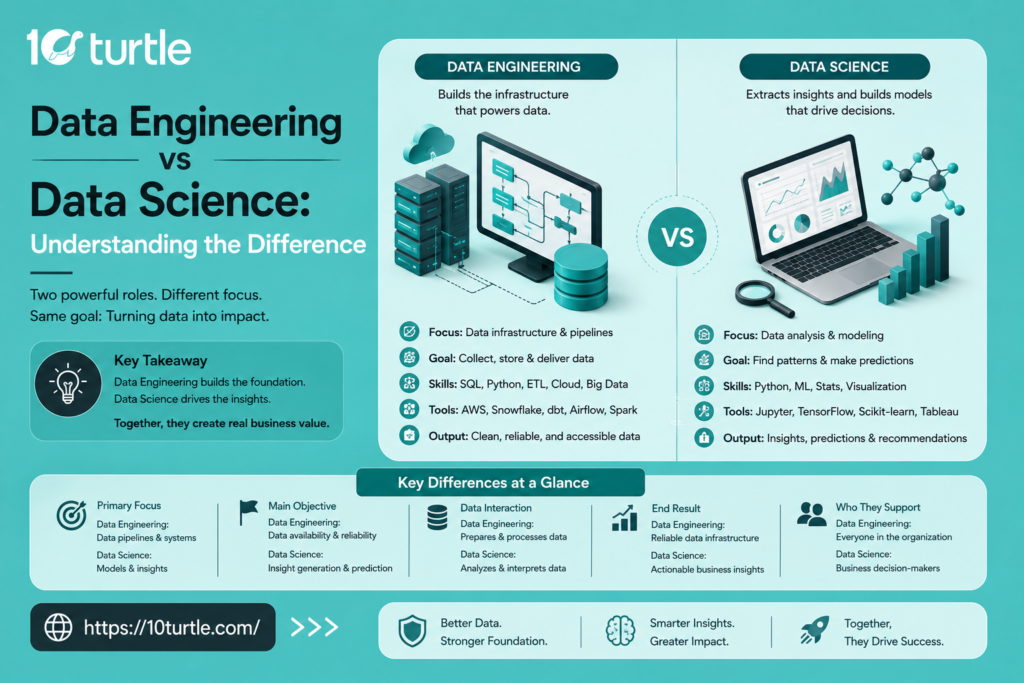
| Primary goal | Build and maintain reliable data infrastructure | Extract insights and predictions from data |
| Core tools | SQL, Spark, Airflow, cloud data warehouses | Python/R, scikit-learn, TensorFlow, statistics |
| Output | Clean, structured, accessible datasets | Models, forecasts, dashboards, recommendations |
| Mindset | Systems and architecture | Experimentation and analysis |
| Typical background | Software engineering, database architecture | Statistics, applied math, machine learning |
The Data Engineering vs Data Science ultimately comes down to this: engineers make data usable, and scientists make data useful for decision-making. Most mature data teams need both — a data scientist vs data engineer debate isn’t really about which is better, it’s about sequencing. You generally can’t do meaningful data science without engineering the pipelines first.
Where the Roles Overlap of Data Engineering vs Data Science
In smaller US companies, especially startups, one person often wears both hats. A “data scientist” at a 20-person company might spend 70% of their time building pipelines because there’s no dedicated data engineer yet. This is one reason job titles alone are a poor guide it’s worth asking what a candidate or vendor actually does day to day, not just what their title says.
There’s also a growing hybrid role: the analytics engineer, who sits between the two, using engineering practices to build clean, analysis-ready datasets that analysts and scientists can query directly.
US Market Snapshot of Data Engineering vs Data Science
The demand for both roles has held strong across US industries finance, healthcare, retail, and logistics in particular. According to the U.S. Bureau of Labor Statistics, employment for data scientists and mathematical science occupations is projected to grow significantly faster than the average for all occupations through the next decade, driven largely by the volume of data companies now collect and the compute available to process it. Data engineering roles have grown alongside this trend, as more companies realize that scaling a data science team is impossible without first scaling the infrastructure underneath it.
For US businesses, this has practical budget implications: many organizations are now hiring or contracting data engineers before their first data scientist, precisely because clean, governed data infrastructure is the prerequisite for everything else.
Which One Does Your Business Need First of Data Engineering vs Data Science?
- If your data lives in five different tools and nobody trusts the numbers — start with data engineering.
- If your infrastructure is solid but you’re not using the data to make decisions — start with data science.
- If you’re not sure — an experienced provider offering full-spectrum data engineering services can assess your current data maturity and recommend the right starting point, rather than selling you a role you don’t need yet.
FAQs
Is data engineering harder than data science?
Neither is inherently harder — they require different strengths. Data engineering leans on software architecture and systems thinking, while data science leans on statistics and modeling. Many professionals find one more natural depending on their background.
Can a data scientist become a data engineer, or vice versa?
Yes, and it’s common. The disciplines share a data foundation, so professionals frequently cross over, especially analytics engineers who blend both skill sets.
Do I need both roles on my team?
Most growing US companies eventually need both, but rarely on day one. Early-stage teams typically prioritize data engineering to establish reliable pipelines before investing in dedicated data science talent.
What pays more, Data Engineering vs Data Science?
Compensation varies by city, industry, and experience level, but both roles command strong salaries in the current US market, with senior positions in either track often reaching six figures in major tech hubs.
Is data engineering a good career path in the USA right now?
Yes. As more US companies migrate to cloud data platforms and lean on AI-driven products, demand for engineers who can build and maintain that infrastructure continues to rise.
Final Thoughts
Data Engineering vs Data Science aren’t competing disciplines they’re sequential ones. Engineering builds the foundation; science builds on top of it. Understanding this difference helps US businesses hire the right talent in the right order and avoid the common mistake of investing in advanced analytics before the underlying data infrastructure can support it.