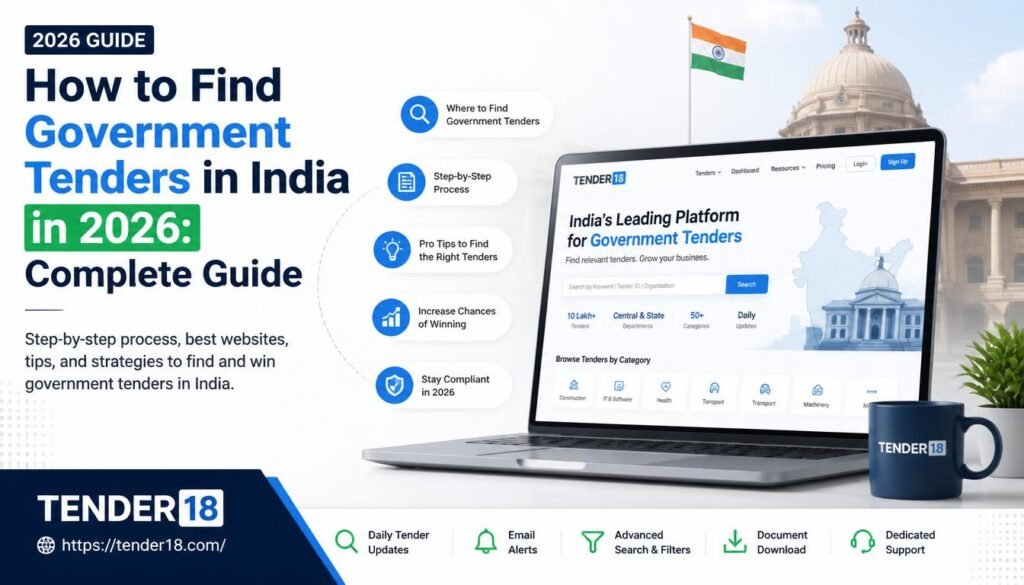
How to Find Government Tenders in India in 2026 Complete Guide
How Small Businesses Can Find and Win Government Tenders in India in 2026
Government procurement can open a significant new market for Indian businesses. Manufacturers, contractors, service providers, distributors, startups and MSMEs can all find opportunities to supply products or services to government departments and public-sector organisations.
However, finding a tender is only the beginning. Businesses also need to understand eligibility requirements, study tender documents, calculate realistic pricing, prepare the required paperwork and submit bids correctly before the deadline.
For companies exploring new ways to generate revenue, government procurement can become part of a broader business development strategy. Just as a company needs a structured approach to identify better business opportunities, tender participation works best when businesses focus on opportunities that genuinely match their capabilities.
What Is a Government Tender?
A government tender is a formal procurement process through which a government department, public-sector organisation or other procuring authority invites eligible suppliers, contractors or service providers to submit bids.
Government tenders may cover requirements such as:
- Construction work
- Electrical equipment
- IT products
- Office supplies
- Medical equipment
- Machinery
- Transportation
- Maintenance services
- Manpower services
- Professional services
- Infrastructure projects
Each tender normally contains specific technical, commercial and eligibility requirements that bidders must review before participating.
Why Government Tenders Matter for Small Businesses
Government procurement can provide businesses with another potential sales channel beyond ordinary retail customers and private companies.
For an MSME or growing business, this can be particularly useful because a company does not necessarily need to depend on a single customer segment.
The important point is to approach tendering strategically.
Submitting bids for every available contract is rarely efficient. Businesses should instead identify opportunities that match their products, experience, operational capacity and financial resources.
This principle is similar to conventional sales qualification. Businesses perform better when they spend their resources pursuing suitable opportunities rather than every possible lead.
Where Can Businesses Find Government Tenders?
India has a large digital procurement ecosystem. Opportunities can originate from GeM, eProcurement portals, the Central Public Procurement Portal, railway procurement systems and various state and departmental platforms.
For a business owner, manually checking multiple sources every day can become difficult.
Businesses therefore need an organised tender-discovery process. One option is to use a consolidated resource for researching latest government tender opportunities across different procurement sources, categories and locations.
Tender18 currently covers GeM, eProcurement, Indian Railway and CPPP tender information, along with tender-related services.
The objective should not be to collect hundreds of tender notices. It should be to find a smaller number of relevant opportunities that the business can realistically pursue.
Understand GeM and eProcurement
Digital procurement has changed how businesses discover and participate in public-sector opportunities.
GeM, or Government e-Marketplace, facilitates online procurement of eligible goods and services, while other eProcurement systems are used by government authorities for different tendering processes.
For businesses entering this market, digital readiness is therefore increasingly important.
A reliable computer, organised digital documents, internet connectivity and familiarity with online platforms can make routine tender work considerably easier. Businesses purchasing equipment for these activities should focus on their actual requirements rather than specifications alone; this practical laptop buying guide explains the same use-case-first approach when selecting business technology.
Don’t Apply for Every Tender You Find
One of the easiest mistakes to make is assuming that more bids automatically mean more business.
A better approach is to establish a bid/no-bid process.
Before investing time in a tender, ask:
- Does the company satisfy the eligibility conditions?
- Does the requirement match the company’s products or services?
- Can the required quantity or scope be delivered?
- Is the project location practical?
- Are the required documents available?
- Is there enough time to prepare a compliant bid?
- Are the payment and commercial conditions acceptable?
- Can the company execute the contract profitably?
If several answers are negative, pursuing another opportunity may be more productive.
Read the Complete Tender Document
Never decide whether to bid based only on a tender title.
The detailed tender document may contain eligibility criteria, technical specifications, delivery conditions, declarations, financial requirements and other important contractual terms.
A single overlooked condition can affect the bid.
Careful document analysis is therefore essential. The same principle appears in professional legal analysis, where contracts and rules must be interpreted precisely rather than relying on assumptions about what a document probably means.
Tender documents should receive the same disciplined attention.
Create a checklist and classify each requirement as:
- Available
- Needs preparation
- Needs clarification
- Not applicable
- Cannot be fulfilled
This immediately makes the tender easier to evaluate.
Keep Your Business Documents Organised
Businesses frequently participating in tenders should maintain an organised digital document repository.
The exact documentation varies from tender to tender, but commonly requested information may relate to company registration, financial credentials, technical capabilities, previous experience, product specifications and declarations.
Instead of searching through emails and folders every time a deadline approaches, create separate folders for different document categories.
Use clear filenames and keep track of expiry dates where relevant.
This reduces administrative work and makes future bid preparation faster.
Pay Attention to Corrigenda and Tender Updates
Tender documents are not always static.
An authority may publish a corrigendum or amendment changing a specification, deadline, quantity or another requirement.
This makes continuous monitoring important.
A similar issue occurs in construction bidding, where revised drawings and addenda can change quantities and costs. WikiNewsPortal’s guide to accurate construction estimation and bid preparation highlights why contractors need to monitor revisions instead of relying exclusively on the original documents.
The same discipline should be applied to government tenders.
Once a tender has been shortlisted, continue checking it until the relevant submission process has been completed.
Avoid Last-Minute Bid Submission
Do not treat the official deadline as your internal deadline.
Bid preparation can involve document review, calculations, approvals, file preparation and online submission.
Unexpected problems can also occur.
A file may need correction. An attachment may be missing. A document may have been uploaded in the wrong format. An online portal may take longer than expected.
Create an internal deadline before the official closing time.
If a tender closes on Friday, for example, try to have the commercial and technical documentation reviewed before Friday.
The additional time provides a buffer for corrections.
Calculate Your Bid Price Carefully
Price is one of the most important parts of a commercial bid, but quoting the lowest possible amount without calculating actual costs can be dangerous.
Before deciding a price, consider all relevant expenses associated with fulfilling the requirement.
These may include:
- Product or raw-material costs
- Labour
- Packaging
- Transportation
- Installation
- Equipment
- Administrative expenses
- Taxes and applicable charges
- Financing costs
- Maintenance obligations
- Contingencies
- Desired profit margin
Accurate estimation is especially important for contractors.
As explained in WikiNewsPortal’s article on profitable construction project estimation, underestimating costs can damage project margins, while excessive pricing can make a bid uncompetitive.
The same basic commercial principle applies to many types of tender bidding.
Winning a contract that cannot be executed profitably is not necessarily a successful business outcome.
Create a Daily Tender Monitoring Routine
Tender discovery should become a routine rather than an occasional activity.
Start by identifying keywords related to the products or services your company provides.
Then determine:
Target products/services: What exactly can the business supply?
Target locations: Which states or cities can the company serve economically?
Target departments: Which government organisations regularly purchase those products or services?
Tender value: What contract size can the business realistically handle?
Eligibility: What qualifications frequently appear in relevant tenders?
Once these criteria are defined, monitoring becomes more focused.
A simple daily workflow can be:
Step 1: Check newly published tenders.
Step 2: Remove obviously irrelevant opportunities.
Step 3: Review eligibility for shortlisted tenders.
Step 4: Download relevant documents.
Step 5: Record submission deadlines.
Step 6: Assign responsibility for documentation and pricing.
Step 7: Conduct a final review.
Step 8: Submit before the internal deadline.
Build a Tender Opportunity Pipeline
Tender bidding should be managed similarly to a sales pipeline.
A business-development team does not simply collect leads; it qualifies them and tracks their progress. WikiNewsPortal’s discussion of building a consistent sales process explains why structured opportunity management becomes increasingly important as a business grows.
Tender teams can apply a similar approach.
Create a spreadsheet or management system containing:
| Tender | Department | Value | Deadline | Eligibility | Bid Status | Result |
|---|---|---|---|---|---|---|
| Tender A | Department A | — | Date | Qualified | Preparing | — |
| Tender B | Department B | — | Date | Reviewing | Review | — |
| Tender C | Department C | — | Date | Qualified | Submitted | Pending |
Over time, this provides useful information about the company’s tender activity.
Common Government Tender Bidding Mistakes
Many tender problems are preventable.
Common mistakes include:
- Applying without checking eligibility
- Missing required documents
- Ignoring technical specifications
- Overlooking corrigenda
- Incorrect cost calculations
- Waiting until the deadline to submit
- Pursuing tenders outside the company’s capabilities
- Failing to review the final bid
- Poor internal coordination
Another mistake is treating tendering as purely administrative.
Tendering combines sales, commercial analysis, documentation, compliance, operations and financial planning.
Can Startups and MSMEs Participate in Government Tenders?
Small businesses should evaluate each opportunity according to its specific requirements rather than assuming government procurement is only for large companies.
Eligibility varies between tenders.
A smaller company may be perfectly capable of executing one contract while being unsuitable for another.
New bidders can begin by identifying opportunities closely related to products or services they already provide.
This reduces operational uncertainty and allows the company to develop tendering experience gradually.
Technology Can Make Tender Management Easier
A growing tender operation can involve large amounts of information.
Businesses may need to track tender notices, documents, deadlines, eligibility requirements, prices, amendments and previous bid results.
Digital tools can help organise this information.
Even basic spreadsheets, cloud storage and structured folders can significantly improve the process.
For teams working primarily online, choosing appropriate hardware is also important. The WikiNewsPortal guide covering laptops for office and business users notes that reliability, memory, storage, battery life and connectivity can matter more to business users than simply purchasing the highest-performance machine.
Review Every Bid Before Submission
Create a final review procedure.
Before submitting, verify:
- Tender reference
- Eligibility
- Technical specifications
- Required documents
- Commercial calculations
- Declarations
- File formats
- Required signatures or authentication
- Latest corrigenda
- Submission deadline
Where possible, have someone other than the original preparer perform the final review.
A second review can identify mistakes that the person working on the bid repeatedly may no longer notice.
Measure Tender Performance
Businesses should eventually measure whether their tender strategy is producing worthwhile results.
Useful metrics include:
- Relevant tenders identified
- Tenders shortlisted
- Bids submitted
- Qualification rate
- Contracts awarded
- Total value of bids
- Total value of contracts won
- Bid preparation cost
- Profitability of completed contracts
Do not evaluate performance solely by the number of tenders submitted.
Twenty carefully selected bids may produce better commercial results than one hundred poorly qualified applications.
Final Thoughts
Government procurement can provide Indian businesses with another route to finding commercial opportunities, but tender bidding requires discipline.
Businesses should build a repeatable system for discovering relevant tenders, evaluating eligibility, reading documents, monitoring amendments, calculating prices, preparing documentation and submitting bids on time.
Most importantly, companies should focus on relevant opportunities rather than simply increasing the number of bids they submit.
A well-organised tender strategy combines opportunity discovery with the same principles used elsewhere in successful business development: qualification, accurate costing, document control, risk assessment and consistent follow-up.
For startups, MSMEs, contractors, manufacturers and service providers considering government procurement in 2026, building that system can be a more sustainable approach than treating every new tender notice as an opportunity worth pursuing.
Frequently Asked Questions
What is a government tender?
A government tender is a formal procurement process through which a government department or public-sector organisation invites eligible businesses to bid for goods, services or works.
Where can businesses find government tenders in India?
Tender opportunities may be published through GeM, CPPP, eProcurement systems, railway procurement systems and state or department-specific portals. Businesses may also use tender-information platforms to consolidate opportunity discovery.
What should I check before bidding?
Review eligibility conditions, technical requirements, documentation, commercial terms, delivery requirements, amendments and the submission deadline.
Should a small business apply for every government tender?
No. A business should focus on tenders that match its capabilities, eligibility, financial resources, delivery capacity and commercial objectives.
Why is accurate tender pricing important?
A bid needs to be competitive while still covering the actual cost of fulfilling the contract. Underpricing can damage profitability, while excessive pricing may reduce competitiveness.
How can businesses manage multiple tender opportunities?
Maintain a tender pipeline containing the opportunity, authority, deadline, eligibility status, estimated value, preparation stage and final result. This makes tendering easier to manage as bid volume increases.