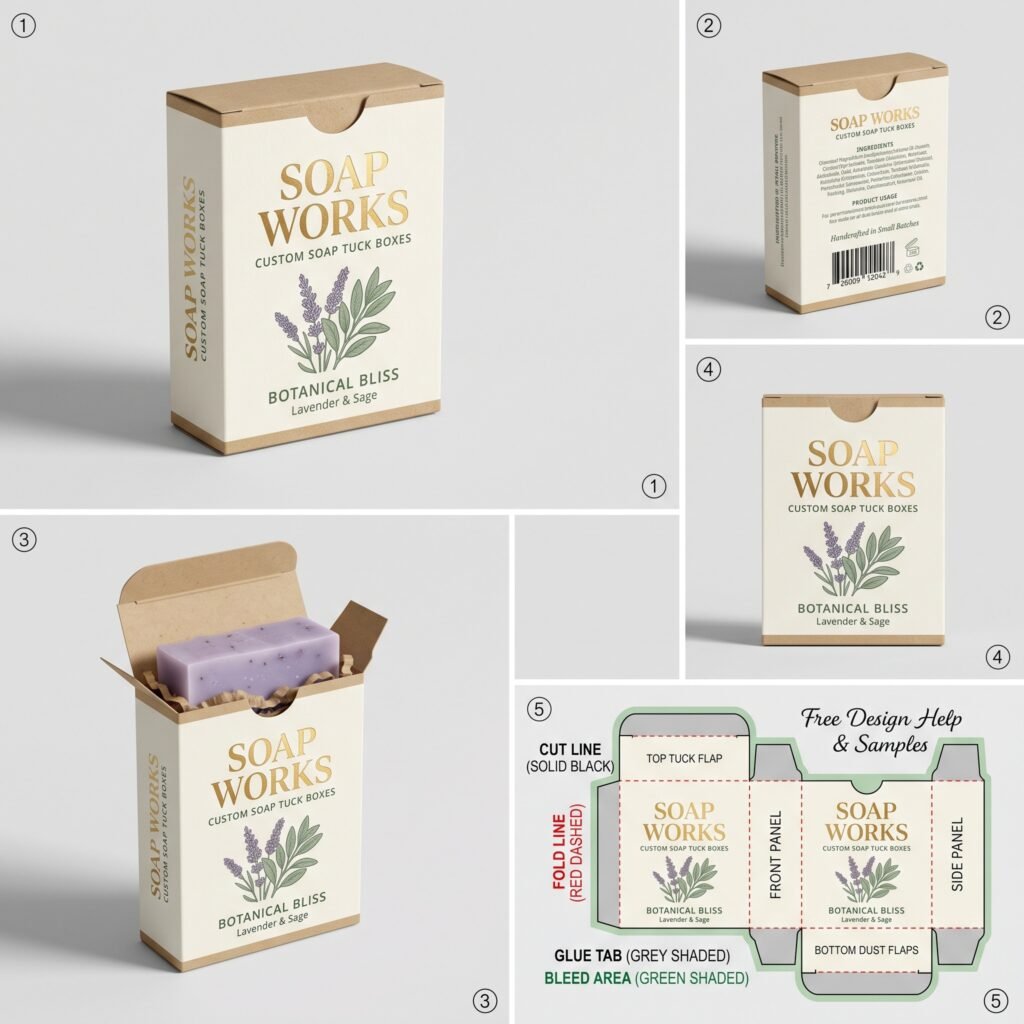
When a packaging order runs late, the cause is usually not the factory. It’s the artwork.
A file that fails prepress goes back to the designer, gets corrected, gets resubmitted, gets checked again. Each cycle takes days. Two or three cycles and a three-week timeline becomes six.
Almost all of it is avoidable. Here are the errors that come up repeatedly.
1. Designing without the supplier’s dieline
The most fundamental mistake. Someone designs a box based on approximate measurements, then asks the printer to make it work.
Dielines are specific to the equipment and the material. Fold allowances differ. Glue tab dimensions differ. Tuck flap geometry differs. A generic dieline from a template site will not match what your supplier’s cutting die actually produces.
Request the dieline first. Design onto it. This one habit eliminates more delay than anything else on this list.
2. Artwork placed over fold lines
Text and critical graphics that cross a crease will distort. The board compresses on the inside of a fold and stretches on the outside, and fine detail breaks up.
Keep type at least 3mm from any fold line. Keep logos entirely within a single panel. Background colors can cross folds; details should not.
3. Missing or insufficient bleed
If a color runs to the edge of a panel, the artwork must extend past the cut line typically 3mm, though this varies by supplier.
Cutting has tolerance. Without bleed, a fractional shift produces a white sliver along the edge. On a dark box this is glaringly visible and there is no fix short of reprinting.
4. RGB color and low-resolution images
Files supplied in RGB will be converted to CMYK during prepress, and the conversion frequently shifts colors noticeably especially bright blues and greens.
Convert to CMYK yourself so you see the shift before production rather than after. Where exact color matters, specify Pantone.
On resolution: raster images should be 300 DPI at final print size. An image that looks sharp on screen at 72 DPI will print soft. Vector artwork avoids the issue entirely and is preferable for logos and line work.
5. Unoutlined fonts
If fonts aren’t converted to outlines or properly embedded, the prepress system will substitute whatever it has. Your carefully chosen typeface becomes something generic, and sometimes nobody notices until the proof.
Convert type to outlines before submitting. Keep an editable copy for yourself.
6. Ignoring the glue tab
Every folding carton has a glue tab, and printing on it is a problem adhesive doesn’t bond reliably to ink, and boxes come apart.
Leave the glue tab unprinted. It’s marked on the dieline. Designers new to packaging routinely run a background color across it without realizing.
The mistake underneath all six
Most of these come from treating packaging like print design. It isn’t. Packaging is a manufacturing process with physical tolerances, and the file is a set of instructions to machinery.
Designers who work regularly with a packaging supplier like Printed Soap Boxes or any category specialist tend to internalize this quickly, because the prepress feedback is direct and specific. Designers coming from a purely digital or flat-print background usually need one painful project before it clicks.
A pre-submission checklist
Before sending artwork, verify:
- Supplied on the supplier’s dieline, at 100% scale
- Dieline on its own clearly-named layer, set to non-printing
- All artwork in CMYK, with any spot colors named correctly
- Raster images at 300 DPI or higher at final size
- 3mm bleed on all edges that print to the trim
- Type at least 3mm from folds and trim
- All fonts outlined
- Glue tab clear of artwork
- A flattened PDF proof included so the supplier can see intended output
Ten minutes of checking against that list routinely saves a week.
Ask for a physical proof
Even with perfect files, request a physical sample before the full run a printed, cut, and folded box you can hold.
Screen previews don’t reveal how a color reads on your specific board, how the fold sits, or whether the type is actually legible at size. A physical proof does. The cost is trivial compared with reprinting five thousand boxes.