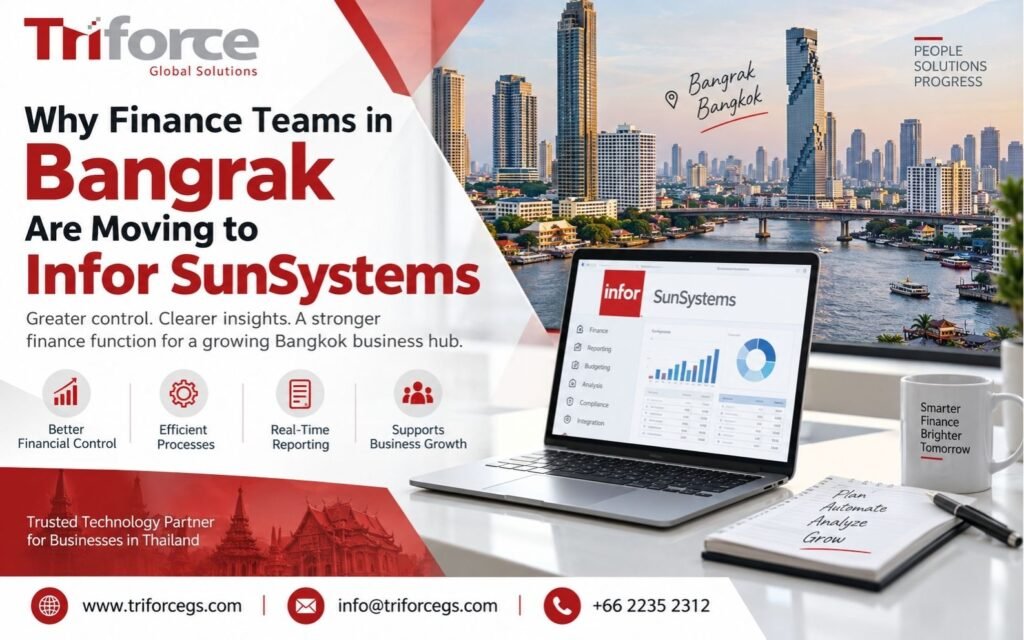
If you run finance for a business near Silom, Charoenkrung, or the river side offices of Bangrak, you already know the problem. Your books close late, your reports live in three different spreadsheets, and every audit season feels like a fire drill. This is exactly the gap that Infor SunSystems was built to close, and it is why so many finance leaders in Bangkok are looking at it right now.
Triforce Global Solutions has spent years implementing financial systems for companies across Thailand, and one pattern keeps repeating. Businesses outgrow their accounting software long before anyone admits it out loud. The signs are quiet at first. Month end takes an extra day, then two, then a full week. Then someone asks a simple question about regional profitability and nobody can answer it without pulling three reports and reconciling them by hand.
What Infor SunSystems Actually Does
Infor SunSystems is a financial management platform designed for organizations that operate across multiple currencies, multiple entities, or multiple countries. It was originally built for companies that needed a general ledger flexible enough to handle complex reporting structures without forcing accountants to rebuild their chart of accounts every time the business changed shape.
For a company based in Bangrak with branches in Chiang Mai, a regional office in Singapore, or suppliers billing in US dollars, this flexibility matters. Infor SunSystems lets finance teams manage multiple ledgers, multiple currencies, and multiple reporting standards from a single system rather than stitching together separate tools for each country or department.
The platform handles the core work every finance department needs.
- General ledger and multi currency accounting
- Accounts payable and accounts receivable
- Fixed asset management
- Cash book and bank reconciliation
- Multi dimensional reporting by cost center, project, or business unit
What sets it apart from many legacy systems is how it treats reporting dimensions. Instead of bolting on extra fields later, Infor SunSystems is built from the ground up to tag every transaction with multiple attributes at once. A single invoice can be tracked by department, project, region, and currency without extra manual coding.
Why Bangkok Businesses Are Paying Attention
Bangrak sits at the center of Bangkok’s commercial district, home to trading houses, logistics firms, hospitality groups, and regional headquarters for companies doing business across Southeast Asia. These are exactly the organizations that feel the pain of outgrown accounting software first.
A hotel group with properties in Phuket and Pattaya needs consolidated reporting that still shows performance property by property. A trading company importing from China and exporting to Vietnam needs multi currency handling that does not create reconciliation headaches every month. A logistics firm managing dozens of vendors needs accounts payable that scales without adding headcount.
Infor SunSystems was designed with this kind of complexity in mind. Companies switch to it not because their old system stopped working entirely, but because it stopped scaling. The reports still come out eventually. They just take longer, need more hands, and carry more risk of error with each manual step.

Infor EPM and the Planning Gap Most Companies Ignore
Accounting tells you what already happened. Planning tells you what happens next, and this is where Infor EPM comes in. Infor EPM stands for Enterprise Performance Management, and it covers budgeting, forecasting, consolidation, and management reporting in one connected environment.
Many finance teams in Bangkok still build their annual budget in a spreadsheet that gets emailed around the office, edited by five different people, and eventually breaks because someone changed a formula without telling anyone. Infor EPM replaces that process with a structured system where budgets, forecasts, and actuals sit side by side.
When Infor SunSystems handles the transactional accounting and Infor EPM handles the planning and analysis layer on top, finance leaders get a complete picture. Actual results flow from Infor SunSystems into Infor EPM, where they get compared against budget and forecast automatically instead of through a manual export and reformat exercise every month.
This pairing matters most for companies with multiple business units or subsidiaries. Infor EPM lets a finance director consolidate results across entities, apply currency translation, and produce group level reports without waiting on each subsidiary to send its numbers in a separate format. For a Bangrak based head office overseeing regional operations, that consolidation speed can turn a two week close into a matter of days.
What a Real Implementation Looks Like
A good implementation of Infor SunSystems or Infor EPM does not start with software. It starts with a review of how the finance team actually works today, where the manual steps sit, and which reports leadership actually reads versus which ones just get produced out of habit.
Triforce Global Solutions typically approaches an implementation in stages.
- Assess the current chart of accounts and reporting structure to identify what needs to change versus what can carry over.
- Map out the required reporting dimensions, whether that is by project, region, department, or entity.
- Configure Infor SunSystems for the core financial processes, then test with real transaction data before going live.
- Layer in Infor EPM for budgeting and consolidation once the transactional side is stable.
- Train the finance team properly, not just on where buttons are but on how the new close process should actually run.
Skipping steps almost always causes trouble later. A rushed chart of accounts redesign, for example, tends to show up six months later as a reporting limitation nobody planned for.
Building an Interface Finance Teams Actually Want to Use
Software only helps if people use it well, and that depends heavily on the interface. A cluttered screen with too many fields visible at once slows people down and increases the chance of data entry mistakes. The best implementations of Infor SunSystems configure role based views so an accounts payable clerk sees a simple, focused entry screen while a finance director sees dashboards built around the metrics that matter to them.
Clean navigation matters just as much as raw functionality. Menus organized around how a finance team actually works, rather than how the software vendor originally structured its modules, cut down on training time and reduce errors. The same principle applies to Infor EPM dashboards, where visual clarity in variance reports and forecast comparisons makes it far easier for non-finance stakeholders to understand the numbers at a glance.
Triforce Global Solutions builds these interfaces around the daily habits of the team using them, not around a generic template. A finance team in Bangrak that closes books weekly for multiple hotel properties needs a different screen layout than a trading company reconciling shipments against letters of credit. Getting that interface right on day one saves months of frustration later.
Choosing the Right Partner in Bangkok
Bangrak has no shortage of software vendors, but implementation quality varies enormously. The difference between a smooth rollout and a painful one usually comes down to whether the implementation partner actually understands finance operations, not just the software.
Triforce Global Solutions works directly with finance teams across Bangkok to implement Infor SunSystems and Infor EPM in a way that fits how the business actually operates, not a one size fits all template pulled from another industry. That means realistic timelines, honest conversations about what the software can and cannot do, and training that leaves the team confident rather than confused.
For a company weighing whether to move forward, the right first step is usually a conversation about where the current process breaks down, not a sales pitch about features. That conversation, more than any brochure, tends to make clear whether Infor SunSystems and Infor EPM are the right fit.
Frequently Asked Questions
Is Infor SunSystems suitable for small businesses, or only large enterprises?
Infor SunSystems works well for mid sized and larger organizations, particularly those managing multiple currencies, entities, or complex reporting needs. A very small single entity business with simple accounting requirements may not need its full capability.
How long does a typical Infor SunSystems implementation take?
Timelines vary based on complexity, but a standard implementation for a mid-sized company usually runs between three and six months, covering configuration, data migration, testing, and training.
Can Infor EPM work with accounting systems other than Infor SunSystems?
Yes. Infor EPM can integrate with various source systems, though pairing it with Infor SunSystems creates a more seamless data flow since both are part of the same Infor ecosystem.
Does Infor SunSystems support Thai regulatory and tax reporting requirements?
Infor SunSystems can be configured to support local statutory and tax reporting requirements in Thailand, including VAT reporting, as part of the implementation process.
What is the main difference between Infor SunSystems and Infor EPM?
Infor SunSystems handles day to day financial transactions such as the general ledger, accounts payable, and accounts receivable. Infor EPM focuses on budgeting, forecasting, and consolidated performance reporting built on top of that transactional data.