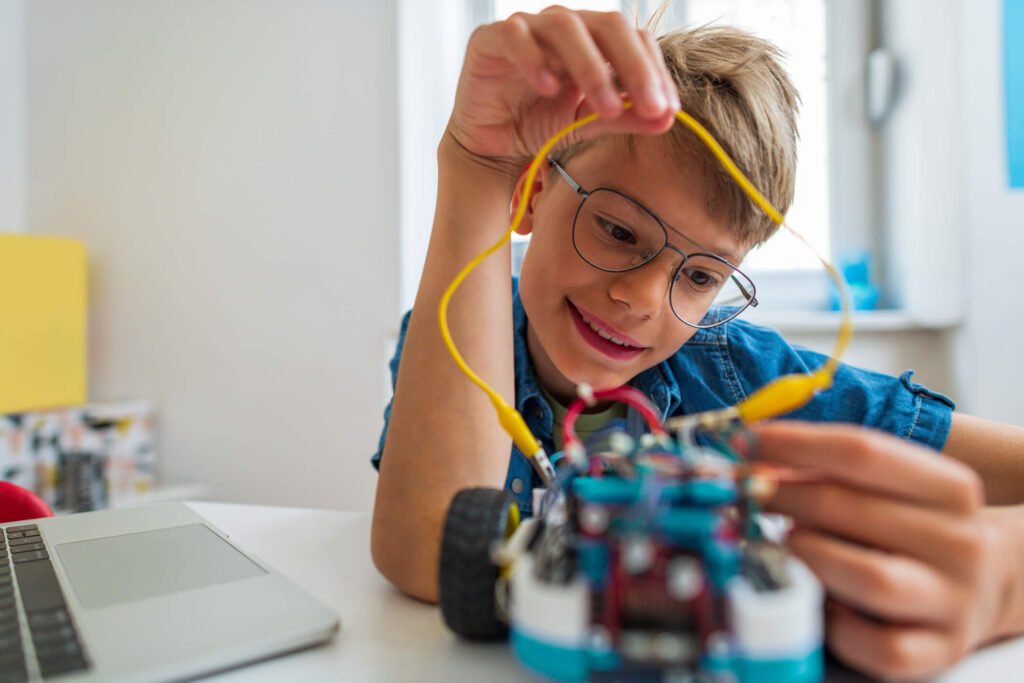
Robotics is no longer something children only see in science-fiction movies or school exhibitions. Today, kids can learn how robots work, build their own machines, write code, solve engineering challenges, and explore artificial intelligence through practical learning programs. That is why Robotics courses for kids are becoming increasingly popular among parents who want their children to develop future-ready technical skills.
But with so many programs available, how do you choose the right one? Should you look for robotics classes near me, a specialized training institute, a summer camp, or an online program? More importantly, how can you tell whether a course actually provides meaningful learning instead of simply keeping children busy with robotics kits?
The right program should feel less like memorizing textbook definitions and more like entering a workshop where children can experiment, make mistakes, ask questions, and create something of their own.
For families searching for quality STEM education in New Jersey, Brainy n Bright offers STEM and robotics learning opportunities designed to introduce children to robotics, coding, problem-solving, and technology through practical and engaging activities.
Why Robotics Education Matters for Kids
Robotics combines several areas of learning into one exciting subject. Children can encounter engineering, programming, mathematics, electronics, design thinking, and problem-solving while working on a single robotics project.
Instead of simply learning that a motor turns when electricity is supplied, a child can build a project that uses a motor and then figure out how to control it. That difference between reading about an idea and actually using it can make learning much more memorable.
Robotics Encourages Problem-Solving
Every robotics project presents a challenge. Maybe the robot does not move correctly, the sensor gives an unexpected result, or the code does not produce the desired action.
Children learn to identify the problem, test possible solutions, and improve their designs. These habits can become useful far beyond the robotics classroom.
Robotics Builds Creativity and Curiosity
A good robotics environment gives children room to experiment. They can ask, “What happens if I change this?” or “Can I make the robot do something different?”
That curiosity is valuable because technology is constantly changing. Rather than simply learning one tool, children begin developing the confidence to explore unfamiliar problems.
What Should You Look for in Robotics Courses for Kids?
Not every robotics program offers the same learning experience. Two courses may both advertise robotics, yet their teaching methods, project work, age groups, instructors, and curriculum can be completely different.
Before enrolling your child, look beyond the course title. Think about what your child will actually do during each session and what skills they will develop by the end.
Choose a Course Based on Your Child’s Age
Age is one of the first factors parents should consider when comparing best robotics courses for kids. A curriculum created for a six-year-old should not be identical to one designed for a teenager.
Younger learners may benefit from visual programming, simple mechanical construction, guided challenges, and introductory STEM activities. Older students may be ready for more advanced programming, sensors, electronics, autonomous robots, and engineering concepts.
Beginner Robotics for Younger Children
For beginners, robotics should be approachable rather than overwhelming. Children need opportunities to understand basic concepts through activities that match their developmental level.
Hands-on construction, simple coding commands, movement challenges, and guided projects can help young learners develop an early interest in technology.
Advanced Robotics for Older Students
Older children can gradually move toward more complex programming and engineering tasks. They may work with multiple sensors, logic-based programming, automation, and increasingly independent projects.
The goal should not simply be to finish a project. The learning process should help students understand why their robot behaves in a particular way and how they can improve it.
Look for Hands-On Robotics Projects
One of the most important characteristics of effective Robotics courses for kids is hands-on learning.
Imagine teaching someone how to ride a bicycle only by showing them pictures. They may understand the theory, but they still need to get on the bike. Robotics works in a similar way.
Children should have opportunities to build, test, modify, troubleshoot, and rebuild projects rather than spending every class listening to explanations.
Projects Should Encourage Experimentation
A strong robotics project does not always have one rigid solution. Children should be encouraged to test different approaches and understand why certain designs work better than others.
This approach can turn a simple robotics activity into an engineering lesson where children learn through trial and improvement.
Check the Robotics Curriculum
Before choosing a robotics course in New Jersey, ask what the curriculum actually includes.
Does the program cover only basic robot construction, or does it also introduce coding, sensors, automation, engineering principles, and problem-solving? A well-structured curriculum should progress naturally from foundational concepts toward more challenging activities.
Parents should also check whether the course is organized by age and experience level. A beginner-friendly structure can make it easier for children to develop confidence before moving into advanced topics.
Consider the Instructor’s Teaching Approach
Even an excellent curriculum can become ineffective if it is delivered poorly. The instructor plays an important role in shaping how children experience robotics.
Look for instructors who encourage questions and allow children to participate actively. Kids should feel comfortable saying, “I don’t understand this,” or “Can I try another way?”
Teachers Should Guide Rather Than Do Everything
When a child’s robot fails, the instructor should not immediately fix it for them. Instead, the teacher can ask questions that help the child identify the issue.
For example, asking what changed between the working and non-working versions can encourage logical thinking. That small conversation can teach more than simply providing the correct answer.
Search for Robotics Classes Near Me
Many parents begin their search with the phrase robotics classes near me because convenience matters. A nearby program can make regular attendance easier and reduce the travel burden for families.
However, location should not be the only deciding factor. A course that is five minutes away may not provide the same curriculum, project experience, or learning environment as another program that is slightly farther away.
When searching locally, compare the curriculum, age groups, class format, instructor experience, practical activities, schedules, and learning objectives.
How to Find Robotics Courses Camp New Jersey Programs
If your child enjoys seasonal learning, a robotics courses camp New Jersey program can be an engaging option.
Robotics camps can give children the opportunity to spend concentrated time exploring STEM concepts while working on projects with other students. The camp format can also make learning feel different from a conventional classroom.
What Makes a Robotics Camp Valuable?
A useful robotics camp should have a clear educational purpose. Children should not simply assemble a kit and move on to the next activity without understanding what they created.
Look for camps that combine building, coding, experimentation, teamwork, and problem-solving. These elements can make the experience both educational and enjoyable.
Compare Robotics Courses Center for Kids in New Jersey
Parents searching for a robotics courses center for kids in New Jersey should compare several practical factors before making a decision.
Start by checking whether the center offers programs appropriate for your child’s age and current skill level. Then look at the curriculum, project structure, class size, learning format, and opportunities for progression.
It can also help to ask whether children work individually, in pairs, or in groups. Different formats can support different learning styles, but students should still receive enough hands-on participation.
Evaluate Class Size and Student Attention
Class size can influence the amount of individual support a child receives. In robotics, this can be especially important because students may encounter different technical problems while building or programming.
A very large class can make it difficult for one instructor to monitor every student’s project. A structured small-group environment can provide more opportunities for questions, feedback, and troubleshooting.
The ideal setup depends on the program, but parents should always ask how instructors provide individual guidance when students get stuck.
Look Beyond the Robot Kit
A robotics kit is only a tool. The educational value comes from what children learn while using it.
When comparing best robotics training institute for kids options, ask whether the program teaches transferable skills such as logical reasoning, computational thinking, engineering design, communication, creativity, and collaboration.
A colorful robot may attract a child’s attention, but the deeper goal should be helping the child understand how technology works and giving them the confidence to create with it.
Check Whether Coding Is Part of the Program
Robotics and coding often work hand in hand. A robot becomes much more interesting when children can program it to respond to inputs and perform specific actions.
Depending on age and course level, children may be introduced to visual programming or text-based programming. The important thing is that coding should be taught as a practical problem-solving tool rather than as a collection of confusing commands.
Robotics and Coding Create a Strong STEM Foundation
When children build a robot and then program it, they can see a direct connection between software and hardware.
That connection can make abstract programming concepts easier to understand. Instead of asking why a particular coding command matters, children can see its effect in the physical world.
Why Parents in New Jersey Can Consider Brainy n Bright
For families looking for a robotic training center for kids in NJ, Brainy n Bright provides STEM-focused learning opportunities that bring robotics, coding, technology, and practical problem-solving together.
Brainy n Bright focuses on helping children explore technology through engaging learning experiences rather than treating STEM as a purely theoretical subject. Its programs are designed to encourage curiosity, creativity, logical thinking, and hands-on exploration.
For parents comparing robotics training center for kids in nj options, Brainy n Bright can be considered as one of the local STEM education providers to explore.
Brainy n Bright’s Approach to STEM and Robotics Learning
The strongest STEM programs are not only about teaching children how to operate technology. They should encourage children to understand, question, experiment, and create.
Brainy n Bright’s STEM-oriented approach connects robotics with broader technology skills. This gives children opportunities to explore how different technical concepts can work together.
Learning Through Projects
Project-based learning can make robotics more engaging because children have a clear objective to work toward.
Rather than simply completing isolated exercises, students can work through a sequence of tasks where they build knowledge while developing a functional project. This can make the learning experience feel more purposeful.
What Parents Should Ask Before Enrolling
Before choosing any robotics program, parents can ask a few straightforward questions.
What age groups does the program serve? Is the course suitable for beginners? How much hands-on project work is included? What programming concepts are taught? How are students supported when they face difficulties?
It is also useful to ask how students progress after completing the introductory level. A good learning pathway should give children opportunities to continue developing their skills instead of reaching a dead end after one course.
Online vs. In-Person Robotics Classes
Parents may also need to decide between online and in-person learning. Both formats can work when the program is designed properly.
In-person classes can provide direct access to physical robotics equipment and face-to-face collaboration. Online programs may offer flexibility and allow students to learn from home.
The better fit depends on your child’s learning preferences, available schedule, equipment, and the structure of the specific course.
How Much Should You Focus on Certificates?
Certificates can be useful for documenting participation, but they should not be the main reason for choosing a robotics program.
Think about what your child will actually know and be able to create after completing the course. A certificate may sit in a folder, but the ability to solve a problem, write a program, design a robot, or explain how a sensor works can become a lasting skill.
Parents should therefore prioritize learning outcomes, project experience, curriculum quality, and student engagement.
Signs of a Good Robotics Program
A strong program generally has a clear curriculum, age-appropriate teaching, practical projects, supportive instructors, and opportunities for students to solve problems independently.
Children should be encouraged to experiment instead of being afraid of mistakes. In robotics, failure is often part of the process. A robot that does not work correctly can become the starting point for a valuable lesson.
Common Mistakes Parents Should Avoid
One common mistake is choosing a robotics course only because it is close to home. Convenience matters, but educational quality matters too.
Another mistake is choosing a program based only on advertisements or impressive-looking robotics equipment. Ask what students actually learn and how much time they spend actively building and programming.
Parents should also avoid selecting an advanced course simply because it sounds impressive. If the material is far beyond the child’s current level, frustration can replace curiosity.
How to Choose the Best Robotics Courses for Kids
Choosing among the best robotics courses for kids becomes easier when you focus on your child’s needs rather than simply looking for the most popular program.
Consider age, experience level, interests, learning style, curriculum, practical projects, instructor support, class size, schedule, and progression opportunities.
If you’re searching for a robotics training center for kids in NJ, compare these factors carefully and then choose a program that gives your child room to learn at a comfortable but challenging pace.
Why STEM and Robotics Skills Matter for the Future
Technology is becoming part of almost every professional field. Children who develop an early understanding of coding, automation, robotics, and computational thinking can build a useful foundation for future learning.
That does not mean every child needs to become a robotics engineer. The bigger benefit is learning how to think through problems, test ideas, collaborate with others, and turn an idea into something tangible.
These skills can support students whether they eventually pursue engineering, computer science, design, entrepreneurship, science, or another field entirely.
Conclusion: Finding the Right Robotics Program for Your Child
Finding the right Robotics courses for kids is about much more than finding a place that teaches children how to build robots. The right program should create an environment where children can explore technology, make mistakes, solve problems, and develop confidence through hands-on learning.
For families in New Jersey, it is worth comparing curriculum quality, instructors, project-based activities, class structure, age suitability, and learning progression before enrolling.
Parents looking for a robotic training center for kids in nj can explore Brainy n Bright as a STEM and robotics training provider for children in New Jersey, with a focus on technology-oriented learning, practical activities, and skill development.
Whether you begin your search with robotics classes near me, robotics course in New Jersey, or robotics courses center for kids in new jersey, remember that the best choice is ultimately the program that fits your child’s age, interests, learning needs, and long-term goals.
FAQs About Robotics Courses for Kids
1. What age is best to start robotics courses for kids?
Children can begin introductory robotics activities at a young age when the lessons are designed appropriately for their developmental level. Younger students can start with simple construction, movement, visual programming, and STEM challenges before progressing toward more advanced robotics and coding.
2. How do I find robotics classes near me?
You can search online for robotics classes near me and then compare nearby providers based on curriculum, age groups, hands-on projects, instructor support, class size, schedules, and progression options. Location is useful, but the quality and structure of the course should also be considered.
3. What should I look for in a robotics course in New Jersey?
Look for an age-appropriate curriculum, practical projects, coding opportunities, experienced instructors, problem-solving activities, and a clear learning pathway. You should also check whether the program is suitable for beginners or requires previous robotics experience.
4. Are robotics courses camp New Jersey programs useful for beginners?
Yes, a well-designed robotics courses camp New Jersey program can introduce beginners to robotics through concentrated hands-on activities. Before enrolling, check whether the camp provides structured learning rather than focusing only on entertainment or basic kit assembly.
5. Why consider Brainy n Bright for robotics training?
Brainy n Bright focuses on STEM-oriented learning for children and provides opportunities to explore robotics, coding, technology, and problem-solving. Parents looking for a robotics training center for kids in nj can explore its programs to determine whether the curriculum and learning format match their child’s needs.