Every chart tells a story, but new traders often struggle to read it. Prices jump, indicators flash, and social media fills up with conflicting calls. As a result, many beginners either freeze or chase every move. The fix is simpler than it looks. Instead of learning fifty indicators at once, you should master a small set of proven tools first.
In this guide, we break down the top trading signals that experienced traders still rely on after decades in the market. You will learn what each signal means, how to read it, and where it tends to fail. In addition, we cover the main types of trading signals and show how TradingView trading signals alerts can save you hours of screen time.
Keep one idea in mind as you read. No signal is a guarantee. Signals simply tilt the odds in your favor when you combine them with risk control and patience.
What Are Trading Signals?
A trading signal is a trigger that suggests a possible entry or exit. It can come from a price pattern, an indicator, a news event, or a mix of these. In short, a signal turns raw market data into a clear question: should I act now, or should I wait?
Good signals share three traits. First, they are objective, so two traders looking at the same chart see the same thing. Second, they repeat across many trades. Third, they come with a clear invalidation point, which tells you when the idea is wrong. Once you understand these traits, the top trading signals become much easier to learn.
Types of Trading Signals
Before you study individual tools, it helps to know the main types of trading signals. Each type answers a different question about the market.
- Technical signals come from price, volume, and indicators on the chart. Most beginners start here because the data is visual and easy to test.
- Fundamental signals come from earnings, economic data, or central bank decisions. They often drive the larger trend.
- Sentiment signals measure crowd behavior, such as funding rates, put/call ratios, or extreme headlines.
Signals also differ by timing. Leading signals, such as RSI divergence, try to predict a turn before it happens. Lagging signals, such as moving average crossovers, confirm a move after it starts. Leading signals give earlier entries but more false alarms. Lagging signals are slower, yet they tend to be more reliable. Therefore, many traders pair one of each.
Finally, signals can be manual or automated. You can spot them yourself, or you can let software scan charts and notify you. Both approaches work, provided you understand the logic behind each alert.
The Top Trading Signals Every New Trader Should Learn
The six tools below are the top trading signals that most professional traders learned first. Each one is simple to read, widely available, and useful across stocks, forex, and crypto.
1. Moving Average Crossovers
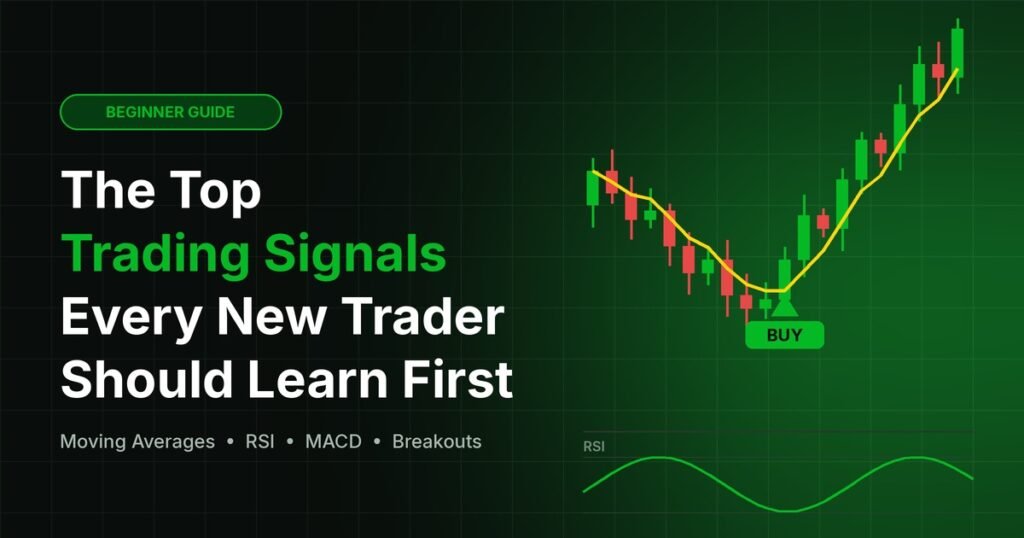
A moving average smooths out price noise and shows the underlying trend. A crossover occurs when a faster average crosses a slower one. For example, when the 50-day average moves above the 200-day average, traders call it a “golden cross.” The opposite move is known as a “death cross.”
Crossovers work best in trending markets. However, they produce many false signals when price moves sideways. To filter them, check whether price is making higher highs and higher lows before you act. Also, remember that crossovers lag. By the time they appear, part of the move is already gone. That delay is the price you pay for confirmation.
2. RSI Overbought and Oversold Levels
The Relative Strength Index (RSI) measures the speed of recent price changes on a scale from 0 to 100. Readings above 70 suggest overbought conditions, while readings below 30 suggest oversold conditions.
Here is the trap many beginners fall into. Overbought does not mean “sell now.” In a strong uptrend, RSI can stay above 70 for weeks. Instead, watch for RSI to cross back below 70 or back above 30. That shift shows momentum is actually changing. Even more useful is divergence. When price makes a new high but RSI makes a lower high, buying pressure is fading. For this reason, divergence ranks among the top trading signals for spotting early reversals.
3. MACD Crossovers
The Moving Average Convergence Divergence (MACD) tracks the gap between two exponential moving averages. It has three parts: the MACD line, the signal line, and the histogram.
A bullish signal appears when the MACD line crosses above the signal line. A bearish signal appears when it crosses below. Moreover, crossovers above the zero line carry more weight in uptrends, while crossovers below zero matter more in downtrends. The histogram adds another layer. Shrinking bars warn that momentum is slowing, often before the actual crossover. Because MACD blends trend and momentum, it pairs well with support and resistance.
4. Support and Resistance Breakouts
Support is a price zone where buyers have stepped in before. Resistance is a zone where sellers have taken control. These levels matter because thousands of traders watch them at the same time.
A breakout happens when price closes decisively beyond one of these zones. Still, not every breakout holds. Fake breakouts are common, especially in quiet sessions. A practical approach is to wait for a retest. If old resistance turns into new support, the breakout gains credibility. In our experience, this single habit filters out a large share of bad trades for beginners.
5. Volume Confirmation
Volume shows how many shares or contracts change hands. In many ways, it acts as a lie detector for price. A breakout on rising volume suggests real conviction. A breakout on thin volume suggests the move may fade.
Volume is rarely a standalone signal. Instead, it confirms or questions the other top trading signals on this list. For instance, a golden cross backed by a volume surge is far stronger than one that appears quietly. Likewise, a sharp drop on extreme volume can mark the end of a selloff rather than the start of a new one.
6. Candlestick Reversal Patterns
Candlestick patterns reveal the battle between buyers and sellers within a single period. Three patterns deserve your attention first:
- Bullish and bearish engulfing: a large candle fully covers the previous candle’s body, which signals a shift in control.
- Pin bar (hammer or shooting star): a long wick shows that price was rejected at a level.
- Doji: the open and close are nearly equal, which shows indecision.
On their own, these patterns are unreliable. Yet when they form at key support or resistance, with volume behind them, they become far more meaningful. In trading, context is everything.
How to Use TradingView Trading Signals Alerts
TradingView is one of the most widely used charting platforms, and its alert system is a real help for beginners. Rather than staring at screens all day, you can set conditions for the top trading signals and let the platform notify you when they appear.
Here is a simple workflow to get started:
- Pick one setup. For example, choose an RSI cross back above 30 near a support zone.
- Create the alert. Right-click the chart or indicator, choose “Add alert,” and define the condition.
- Set the frequency. Use “Once per bar close” so you avoid alerts on unfinished candles.
- Choose delivery. Alerts can arrive by app notification, email, or webhook.
- Review before acting. Treat each alert as an invitation to analyze, not an order to trade.
TradingView trading signals alerts also work with custom Pine Script indicators and third-party tools. That flexibility is useful. However, it also means you should understand what each script measures. An alert you cannot explain is an alert you cannot trust.
One more tip: keep a log of every alert you act on. Over time, this record shows which signals suit your style and which ones drain your capital.
Common Mistakes New Traders Make With Signals
Knowing the top trading signals is only half the job. Using them well is the other half. Watch out for these common errors:
- Indicator overload. Stacking ten indicators creates conflicting signals and analysis paralysis. Two or three tools that complement each other are enough.
- Ignoring the trend. Buying every oversold reading in a downtrend is a fast way to lose money.
- Skipping the stop-loss. Every signal needs an exit plan in case it fails.
- Trading every alert. Quality beats quantity, so wait for setups where several signals agree.
- Never backtesting. A signal that looks great on one chart may fail across hundreds of trades.
Building a Simple Learning Routine
Mastery comes from repetition, not from collecting tools. So rather than chasing every signal at once, start with one trend signal, such as a moving average crossover, and one momentum signal, such as RSI. Next, study them on a single market and timeframe for at least a month. Then mark every signal you find on past charts and note the outcome.
After that, move to paper trading. Practice entering, managing, and exiting trades without real money at stake. Only when your results stay consistent should you risk small amounts of capital.
Meanwhile, keep a trading journal. Record the signal, the context, your emotions, and the result. This feedback loop is what turns signal knowledge into real skill.
Final Thoughts
The top trading signals covered here, from moving average crossovers and RSI to MACD, support and resistance, volume, and candlestick patterns, form a solid base for any new trader. Learn them one at a time, test them carefully, and always respect risk. Over time, these tools will help you read the market with more clarity and less emotion.
As you begin exploring signal tools, judge each one with the same discipline you apply to your own trades. Many beginners ask, “Is GainzAlgo legit?” and the same question applies to any indicator provider. The honest answer for any platform, including GainzAlgo, comes from your own testing. Check whether the logic is clearly explained, review results across different market conditions, paper trade the alerts first, and confirm the tool fits your risk rules. A trustworthy signal tool should support your judgment, never replace it.