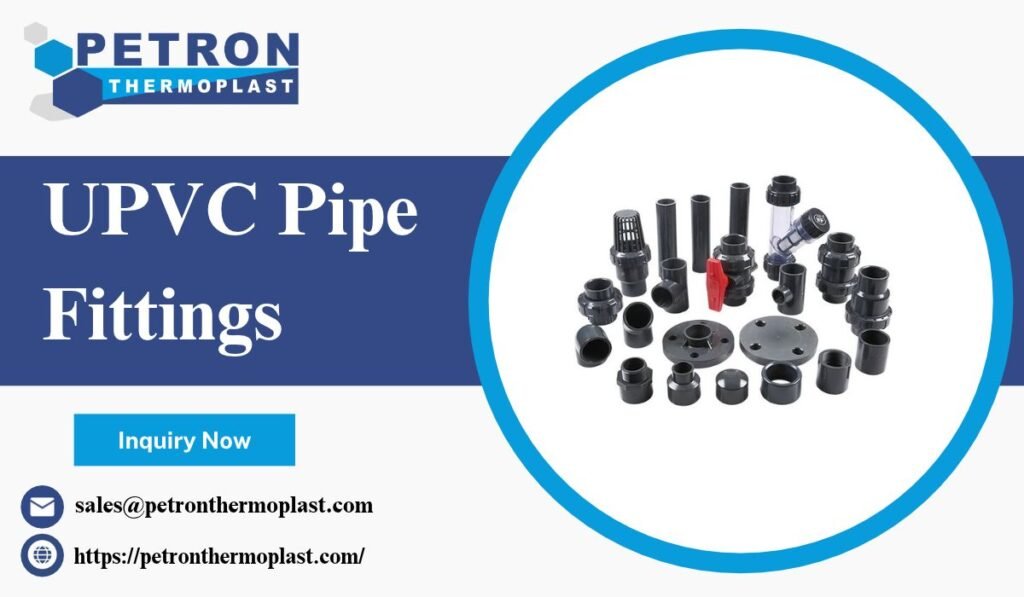
Customized pipeline engineering requires carefully selected materials and components to achieve reliable fluid transportation. Every industrial project has different requirements related to pipe dimensions, flow direction, connection methods, operating pressure and installation space. UPVC pipe fittings are widely considered for applications where corrosion resistance, lightweight construction and easy installation are important. With the right fitting configuration, engineers can design piping systems that suit specific industrial processes and site conditions.
Petron Thermoplast offers UPVC pipe fitting solutions for industrial piping requirements, including different fitting configurations and customized project needs. From chemical processing facilities to water treatment plants, properly selected UPVC fittings help create organized pipeline layouts for different fluid-handling applications.
Understanding UPVC Pipe Fittings in Pipeline Engineering
UPVC stands for Unplasticized Polyvinyl Chloride. It is a rigid thermoplastic material commonly used in piping applications. Unlike flexible PVC, UPVC does not contain added plasticizers to make it soft. This gives the material its rigid structure and makes it suitable for various industrial and utility piping installations.
UPVC pipe fittings connect different pipeline sections and help engineers control the direction, branching and size of a piping network. They are available in several configurations to accommodate different installation layouts.
In customized pipeline engineering, fitting selection depends on the actual application, fluid characteristics, operating temperature, pressure requirements and connection standards. Choosing compatible fittings helps maintain the performance and reliability of the complete piping system.
Why Choose UPVC Pipe Fittings for Customized Pipeline Engineering?
UPVC fittings offer several properties that make them useful in selected industrial piping applications.
Corrosion Resistance: UPVC is resistant to corrosion and does not rust like conventional metallic materials. This property makes it suitable for many water and chemical-handling applications when the fluid compatibility is verified.
Lightweight Construction: UPVC fittings are lighter than many traditional metal alternatives. This can simplify transportation, handling and installation at industrial sites.
Low Maintenance Requirements: Since UPVC does not rust, it can reduce corrosion-related maintenance in suitable operating conditions.
Smooth Internal Surface: Properly manufactured UPVC fittings have smooth internal surfaces that support fluid movement and help limit deposits in suitable applications.
Easy Installation: Compatible UPVC fittings can be joined using approved connection methods. Correct preparation and installation are important for reliable joints.
Design Flexibility: Different fitting configurations allow engineers to develop pipeline layouts according to site conditions and process requirements.
Customized UPVC Pipe Fittings for Different Industrial Requirements
Not every industrial pipeline follows a standard layout. Some projects require specific dimensions, connection arrangements or fitting combinations to match existing equipment and installation conditions.
Customized UPVC pipe fitting requirements may include:
- Project-specific fitting dimensions.
- Different elbow and branch configurations.
- Compatible connections for existing pipelines.
- Special reducer arrangements.
- Flanged connections for equipment integration.
- Fitting combinations for complex pipeline layouts.
- Bulk quantities for industrial installation projects.
Technical Considerations Before Selecting UPVC Fittings
Selecting fittings only by nominal diameter is not sufficient for industrial pipeline engineering. The complete operating environment must be considered.
| Technical Parameter | Selection Consideration |
| Material | Confirm UPVC material suitability for the application |
| Size | Match the fitting dimensions with the pipe system |
| Pressure Rating | Verify the rated pressure at the operating temperature |
| Temperature | Check the manufacturer’s permitted operating range |
| Chemical Compatibility | Confirm resistance to the actual fluid and concentration |
| Connection Type | Select compatible socket, threaded or flanged arrangements |
| Installation | Consider alignment, joint preparation and support |
| Standards | Verify the applicable product and project standards |
Industrial Applications of UPVC Pipe Fittings
Customized UPVC fittings are used in several industrial and infrastructure applications.
Chemical Processing Plants
UPVC fittings may be used in compatible chemical transfer and utility lines. Material selection should always consider chemical concentration and temperature.
Water Treatment Plants
They are used in selected water distribution, filtration and treatment pipeline arrangements.
Wastewater Management
UPVC fittings can be considered for suitable drainage and wastewater lines where the fluid and operating conditions are compatible.
Manufacturing Facilities
Industrial facilities use piping networks to transfer water and other compatible process fluids between equipment and operational areas.
Industrial Cooling Systems
UPVC fittings may be selected for suitable cooling-water circulation and utility pipeline installations.
Infrastructure Projects
Different fitting configurations help develop water supply, drainage and other utility piping networks.
How to Plan a Customized UPVC Pipeline System?
A well-planned pipeline system begins with an understanding of the actual application.
- Identify the Fluid: Determine the liquid or chemical being transported, including its concentration and properties.
- Check Operating Conditions: Establish operating pressure, temperature and expected flow requirements.
- Prepare Pipeline Drawings: Identify pipe routes, equipment connections, branch points and installation restrictions.
- Select Fitting Types: Choose suitable elbows, tees, reducers, couplings, unions and flanges.
- Verify Compatibility: Confirm that all fittings, pipes, valves and joining materials are compatible.
- Review Installation Requirements: Consider jointing methods, pipe supports, alignment and accessibility for maintenance.
- Inspect Before Commissioning: Check connections and carry out appropriate installation inspections and pressure testing.
Why Choose Petron Thermoplast for UPVC Pipe Fittings?
Petron Thermoplast focuses on industrial plastic piping products and customized requirements for different applications. Our UPVC pipe fitting range can be considered for projects requiring different connection configurations and pipeline arrangements.
We understand that industrial buyers often need more than standard fittings. Project specifications, equipment connections, material compatibility and order quantities all influence product selection.
Petron Thermoplast supports customer enquiries for:
- Industrial UPVC pipe fitting requirements.
- Different fitting types and configurations.
- Customized project-based requirements.
- Bulk order enquiries.
- Product information and technical specifications.
- Domestic and international project enquiries.
Conclusion
UPVC pipe fittings are an important part of customized pipeline engineering. Their lightweight construction, corrosion resistance and availability in different configurations make them suitable for several industrial and utility applications. Selecting the correct elbow, tee, reducer, coupling, union or flange helps engineers develop pipeline layouts that match specific project requirements. For customized UPVC pipe fitting enquiries, contact Petron Thermoplast. Our team can assist with product information, configuration requirements and bulk industrial enquiries.