Most people never think about drywall until something looks wrong. It might be a visible seam across a living room ceiling, a crack spreading from a door frame, or a patch that shows up every time the afternoon sun hits the wall.
That’s usually when homeowners search for a “drywall finishing contractor Raleigh NC” and realize how much skill goes into a wall that simply looks smooth. Finishing is the stage that decides whether drywall looks seamless or amateur, and it deserves more attention than it usually gets.
What Drywall Finishing Actually Involves
Hanging drywall is only half the job. Once the panels are screwed into place, a house still has visible joints, screw holes, and corners that need to disappear.
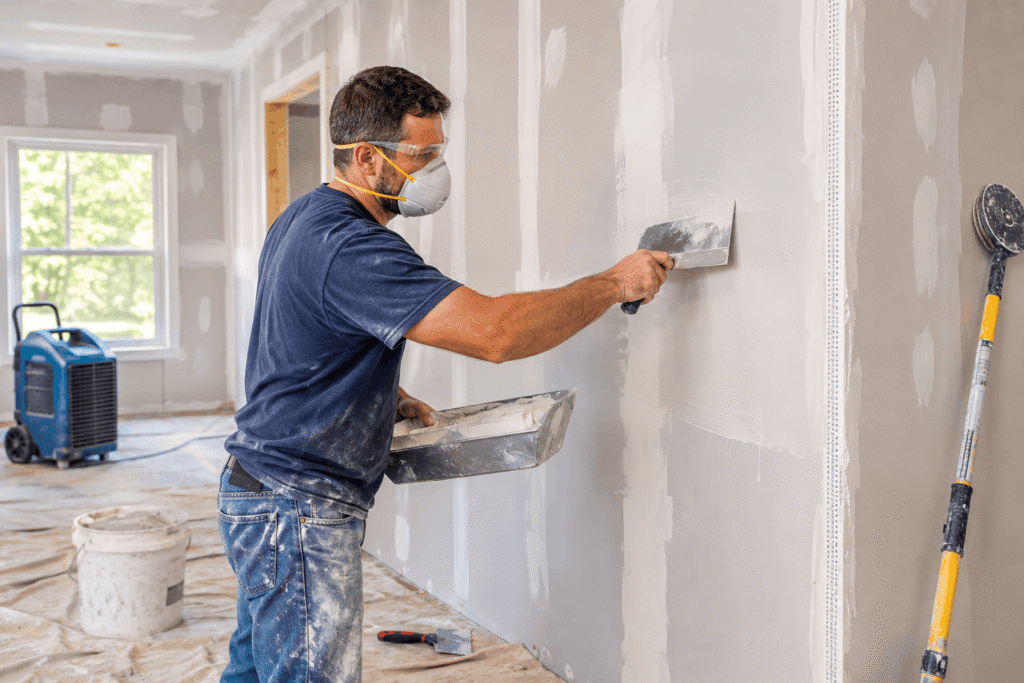
Finishing covers everything that happens next. Tape goes over the seams, joint compound (often called “mud”) is applied in several thin coats, and each layer is sanded before the next one goes on. The goal is a surface that looks like one continuous sheet.
It sounds simple, but it’s one of the more demanding trades in residential construction. Good finishers learn to feather compound so the edges blend gently into the surrounding wall. Thick, uneven coats tend to leave ridges that show through paint.
Understanding the Levels of Finish
The drywall industry uses a scale from Level 0 to Level 5 to describe how polished a wall should be. Level 0 means the drywall is hung with no finishing at all. Level 1 and Level 2 are typically used in garages, attics, or areas hidden behind tile.
Most living spaces receive a Level 4 finish. This includes taped joints, multiple coats of compound, and careful sanding. It works well for flat or eggshell paint and suits the bulk of a typical home.
Level 5 adds a thin skim coat over the entire surface. It’s often recommended for walls with glossy paint, dramatic lighting, or large open spaces where small flaws become obvious. Knowing which level fits a project helps homeowners ask better questions and set realistic expectations.
Why Local Conditions Matter
Climate plays a bigger role in drywall work than many people expect. Central North Carolina has humid summers, and moisture in the air slows down how fast joint compound dries.
When coats are applied before the previous layer has fully cured, problems tend to show up weeks later. Seams may shrink, bubble, or crack. Experienced finishers in Raleigh NC usually adjust their timing, use fans or dehumidifiers, or switch to setting-type compounds that harden chemically instead of by air drying.
Homes in the area also settle, especially newer builds on clay-heavy soil. That’s one reason hairline cracks around windows and doorways are so common in the first year or two after construction.
Common Situations That Call for Finishing Work
Drywall finishing isn’t only for brand-new construction. Plenty of projects come up during normal homeownership.
A family might finish a basement and need the new walls to match the rest of the house. Someone else might remove an old wallpaper border and find torn paper and gouges underneath. Plumbers and electricians often cut access holes that need to be patched and blended in afterward.
Then there are the slow-moving problems. Nail pops appear as small round bumps along walls. Ceiling seams start to show after a roof leak. Corner bead gets dented by furniture during a move. Each of these needs a bit of taping, mudding, and sanding to look right again.
The Real Value of Skilled Finishing
The biggest benefit of quality finishing is that nobody notices it. When it’s done well, a wall simply looks clean and flat, and the paint goes on evenly.
Poor finishing, on the other hand, is hard to hide. Paint actually tends to highlight flaws, especially in rooms with large windows or recessed lighting that throws light across the wall at a low angle. Contractors call this “critical lighting,” and it exposes every ridge and dip.
Good finishing also affects long-term durability. Properly embedded tape is less likely to bubble or peel. Well-feathered joints hold up better as a house expands and contracts with the seasons. That means fewer touch-ups and repaints down the road.
There’s a resale angle, too. Buyers may not know the terminology, but they notice wavy ceilings and visible seams during a walkthrough. Smooth walls quietly signal that a home has been cared for.
What Homeowners Typically Look For
When people evaluate a drywall finishing contractor Raleigh NC area residents might call on, a few practical points come up again and again. Experience with both new construction and repair work is useful, since patching an older wall requires matching an existing texture and finish.
It also helps to ask how a finisher handles dust. Sanding produces a fine powder that travels through a house quickly. Many professionals now use vacuum-attached sanders, plastic sheeting, and careful cleanup to keep the mess contained.
Timeline is another fair question. Because each coat needs to dry, drywall taping and mudding Raleigh projects often take several days even when the room is small. A rushed schedule is sometimes a warning sign rather than a bonus.
A Few Real-World Examples
Picture a couple in North Raleigh who just closed off a formal dining room to create a home office. The new wall framing went up fast, but the finishing had to blend into an existing knockdown texture on the ceiling. Matching that texture took more time than hanging the drywall itself.
Or consider an older bungalow near downtown with plaster-and-lath walls. After an electrical upgrade, the owners were left with a dozen small openings. Drywall patches had to be built out to sit flush with thicker plaster, then skimmed so the repairs disappeared.
Then there’s the common new-build scenario. A family moves in, and by the first winter they notice cracks along the ceiling where the walls meet. Settling is normal, and a skilled finisher can retape and refinish those joints so they’re less likely to reopen.
Local repair-focused companies, such as Very Handy Wall and Ceiling Repairs, often see these kinds of everyday projects, which shows how much finishing work happens outside of major renovations.
DIY or Professional?
Small repairs, like filling a nail hole or a minor dent, are well within reach for most homeowners. A putty knife, lightweight spackle, and a sanding sponge can handle a lot.
Larger jobs are a different story. Taping long seams, finishing ceilings, and producing a true Level 5 surface take practice that’s hard to pick up in one weekend. Many people who try drywall taping and mudding Raleigh projects on their own end up sanding away half their work or living with visible joints.
A reasonable rule of thumb is that anything larger than a dinner plate, anything overhead, or anything in a high-visibility room is often worth handing off to someone who does it every day.
Final Thoughts
Drywall finishing is easy to overlook, but it shapes how every painted surface in a home looks. Understanding finish levels, local climate effects, and common repair scenarios makes it easier to plan projects and talk with professionals.
Whether the job is a full basement or a single cracked seam, the right drywall finishing contractor Raleigh NC homeowners choose can make the difference between a wall that looks patched and one that looks like it was always that way.
FAQs
How much does drywall finishing cost in Raleigh?
Costs vary based on square footage, finish level, and whether the work is new construction or repair. Small patches may be priced per job, while larger projects are usually priced per square foot.
How long does drywall mud take to dry?
Standard joint compound typically needs about 24 hours per coat, though high humidity can stretch that longer. Setting-type compounds can harden in as little as 20 to 90 minutes.
What is the difference between Level 4 and Level 5 drywall finish?
Level 4 includes taping and several coats of compound over joints and fasteners. Level 5 adds a thin skim coat over the entire surface for a smoother look under bright or angled light.
Why do drywall cracks keep coming back?
Recurring cracks are often caused by house settling, seasonal movement, or tape that wasn’t fully embedded. Retaping the joint properly usually works better than simply filling the crack.
Can drywall finishing be done in an occupied home?
Yes, many repairs happen in lived-in homes. Dust control methods like plastic barriers and vacuum sanders help keep the mess limited to the work area.