Percutaneous Coronary Intervention Guide With Types of Stents and Precautions After Angioplasty
If you’ve ever sat in a cardiology waiting room, you’ll notice something right away. Nobody is there casually. People look worried, families whisper, phones keep buzzing.
Heart procedures sound scary. And honestly, they can be.
But here’s the thing — percutaneous coronary intervention isn’t as dramatic as it sounds. In real life, it’s one of the most routine, life-saving procedures cardiologists do every single day.
I’ve seen patients walk in anxious and walk out the next day feeling lighter, breathing easier, chest pain gone. It’s not magic. It’s just good medicine done through a tiny tube.
Let’s talk about it in plain language.
So what exactly is percutaneous coronary intervention?
Most people know it by another name — angioplasty with stent.
In simple terms, when the heart arteries get narrow or blocked because of cholesterol deposits (plaque), blood can’t flow properly. That’s when you feel chest pain, pressure, or sometimes nothing… until a heart attack happens.
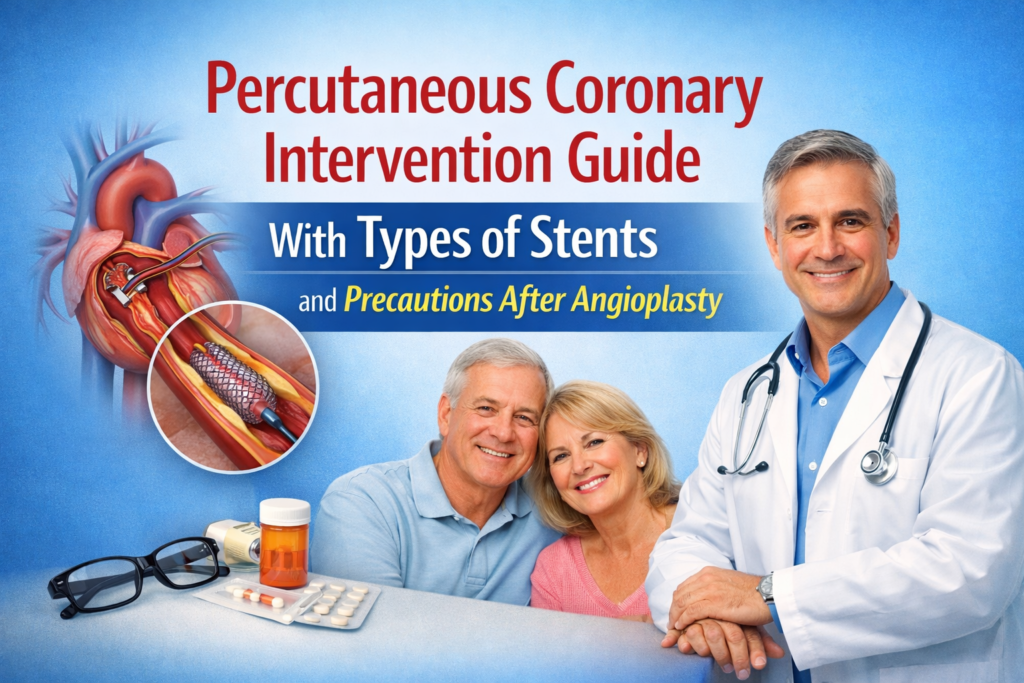
During percutaneous coronary intervention (PCI), the doctor:
-
inserts a thin tube (catheter) through the wrist or groin
-
guides it to the heart artery
-
inflates a tiny balloon to open the blockage
-
often places a stent to keep the artery open
No big cuts. No open-heart surgery. You’re usually awake.
People are surprised when they hear that. They expect something much bigger.
In practice, many patients go home within 24–48 hours.
What it feels like during the procedure
Patients often ask this first.
Honestly? Mostly boring.
You lie down. There’s local anesthesia. You might feel some pressure in the wrist or groin. Sometimes a warm flush when dye is injected. That’s about it.
The weirdest part is knowing someone is working inside your heart while you’re chatting with the nurse.
But pain? Usually minimal.
Types of stents doctors use
Now let’s talk about Types of stents, because not all stents are the same.
This part confuses a lot of people.
1. Bare metal stent
This is the older, simple metal mesh.
It props the artery open like scaffolding.
Problem is, tissue can grow over it too much, which may narrow the artery again. That’s called restenosis.
Still used sometimes, but not as common today.
2. Drug-eluting stent (most common)
These release medication slowly.
The medicine prevents scar tissue from growing too aggressively.
This lowers the chance of re-blockage.
In my experience, most cardiologists prefer these now. They’re kind of the standard choice.
3. Bioresorbable or dissolving stent
Sounds futuristic, right?
These slowly dissolve after a few years.
Idea is — support the artery for a while, then disappear.
Still evolving. Not used everywhere yet. Results are mixed.
But interesting technology.
Doctors choose the stent based on:
-
blockage size
-
patient age
-
diabetes
-
bleeding risk
-
cost and availability
It’s not one-size-fits-all.
Life after angioplasty feels normal… almost too normal
This is where many people get careless.
After PCI, chest pain disappears. Energy comes back. You feel “fixed.”
And that’s dangerous thinking.
Because the stent fixes one spot. Not the whole disease.
The rest of your arteries still have the same lifestyle, same cholesterol, same habits.
What surprises many is how quickly people go back to junk food and skipping medicines.
Then they’re back in the hospital a year later.
Precautions after angioplasty that actually matter
Doctors give a long list. But let me keep it practical.
These precautions after angioplasty are the ones that really make a difference.
Take your medicines seriously
This is non-negotiable.
Especially blood thinners like:
-
aspirin
-
clopidogrel/ticagrelor
Stopping them early can clot the stent. And that can cause a heart attack fast.
I’ve seen this happen. It’s scary and avoidable.
If cost or side effects bother you, talk to your doctor. Don’t just stop.
Move, but don’t overdo it
Light walking after a few days is good.
Actually recommended.
But don’t lift heavy weights or do intense workouts for a few weeks.
Your artery needs time to heal.
Think “steady recovery,” not “gym comeback.”
Eat like you care about your heart
Not perfect. Just better.
Less:
-
fried food
-
packaged snacks
-
sugary drinks
More:
-
vegetables
-
fruits
-
home-cooked meals
-
simple food
You don’t need a fancy diet plan. Just common sense.
What to avoid after stent placement
This question comes up every single time.
So let’s be direct about what to avoid after stent.
Avoid smoking
Even one cigarette tightens arteries.
It basically cancels out the benefit of the stent.
Harsh truth, but true.
Avoid skipping follow-ups
Feeling fine doesn’t mean everything is fine.
Regular checkups catch silent issues early.
Many patients disappear after the procedure and only return during emergencies. Not ideal.
Avoid stopping blood thinners without permission
Even dental procedures require discussion first.
Bleeding risk matters. But clotting risk is worse.
Always ask before stopping anything.
Avoid heavy stress
This one gets ignored.
Constant stress raises blood pressure and heart strain.
Simple things help:
-
walking
-
breathing exercises
-
better sleep
-
talking things out
Sounds basic. Works surprisingly well.
Small everyday changes make the biggest difference
Honestly, recovery isn’t about dramatic rules.
It’s small habits.
I’ve seen two types of patients:
One changes diet, walks daily, takes medicines, stays consistent.
Another says “I’m fine now” and goes back to old ways.
Guess who stays out of the hospital?
Heart care is boring consistency. Not heroic efforts.
A quick word for families
If you’re supporting someone after angioplasty, your role matters a lot.
Remind them about medicines. Walk with them. Help with meals.
Recovery is easier when it doesn’t feel lonely.
Patients who feel supported usually do better. I’ve noticed that again and again.
Living with a stent isn’t fragile living
Some people become overly scared.
They avoid travel. Avoid stairs. Avoid normal life.
That’s not necessary.
Once healed, you can work, travel, exercise, live normally.
The stent isn’t a limitation. It’s actually what gives you freedom back.
Just respect your heart a little more than before.
That’s all.
Take the pills. Walk daily. Eat decently. Show up for checkups.
Nothing fancy.
Just steady care.