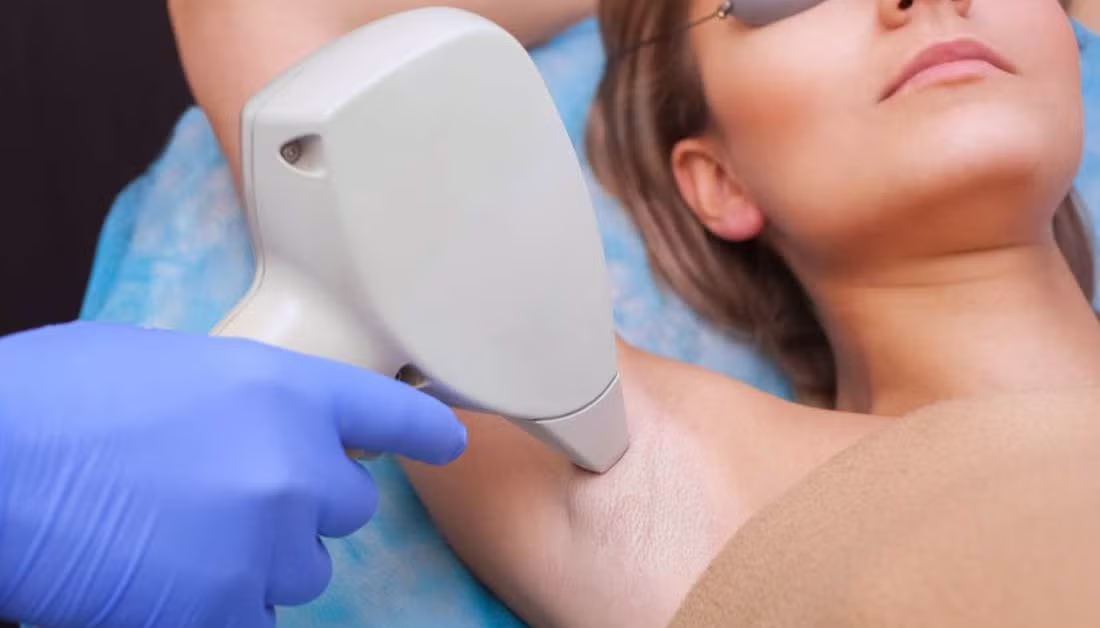
For decades, the quest for smooth, hair-free skin has led many down a path of endless waxing, daily shaving, and painful epilating. As aesthetic technology reaches new heights in 2026, a specific question dominates the consultations at top-tier dermatology centers: Is Laser Hair Removal Permanent? While the allure of never picking up a razor again is strong, understanding the scientific reality behind the term “permanent” is essential for managing expectations and achieving long-term satisfaction. In clinical terms, the FDA classifies this popular procedure as “permanent hair reduction” rather than a total, lifelong elimination of every single hair follicle. This distinction is crucial because while the laser effectively destroys the majority of active hair follicles, our bodies are biological machines capable of repair and hormonal shifts that can occasionally trigger new growth. However, for the vast majority of patients in Islamabad, “permanent reduction” translates to a 80% to 90% decrease in hair density, leaving the remaining hair so fine and light that it becomes virtually invisible. By diving into the mechanics of the hair growth cycle and the precision of modern light-based therapy, we can uncover exactly how this treatment transforms your grooming routine from a daily chore into a once-a-year maintenance touch-up.
The Science of Selective Photothermolysis
To answer the question, Is Laser Hair Removal Permanent, we must first look at how the laser interacts with your body. The process is based on a principle called Selective Photothermolysis.
The laser emits a concentrated beam of light that is absorbed by the pigment (melanin) in the hair. This light energy converts to heat, which travels down the hair shaft to the “bulb” and the “bulge”—the areas responsible for regenerating hair. When these germinative cells are thermally destroyed, the follicle loses its ability to produce a new hair. If the follicle is completely destroyed, that specific hair will never grow back. However, if the follicle is only damaged, the hair may eventually return, albeit much thinner, lighter, and slower than before.
Why Multiple Sessions Are Mandatory
A common source of confusion regarding whether Is Laser Hair Removal Permanent stems from the need for 6 to 10 sessions. This isn’t a marketing tactic; it is a biological necessity dictated by the Hair Growth Cycle.
Your hair goes through three distinct phases:
-
Anagen (Growth Phase): The hair is actively attached to the bulb. This is the only phase where the laser can effectively destroy the follicle.
-
Catagen (Transitional Phase): The hair begins to detach from the base.
-
Telogen (Resting Phase): The hair is dead and eventually falls out.
At any given time, only about 15% to 20% of your body hair is in the Anagen phase. This is why a single session will never result in permanent clearance. Multiple treatments, spaced 4 to 6 weeks apart, are required to “catch” every hair follicle in its active growth stage.
Factors That Influence “Permanence”
Not everyone’s journey toward permanent smoothness is the same. Several variables dictate how long your results will last:
1. Hair Color and Skin Tone
The laser seeks out contrast. In the past, laser hair removal worked best on dark hair and light skin. In 2026, advanced lasers like the Nd:YAG have made it safe and effective for darker skin tones, but the “permanence” still relies on the hair having enough pigment to absorb the heat. Laser is generally ineffective on white, grey, or very light blonde hair.
2. Hormonal Fluctuations
Hormones are the “engine” of hair growth. Conditions such as Polycystic Ovary Syndrome (PCOS), pregnancy, or menopause can trigger dormant follicles to start producing hair. For individuals with hormonal imbalances, “permanent” results may require more frequent maintenance sessions to keep new growth at bay.
3. The Area Being Treated
Different parts of the body respond differently. Underarms and bikini lines usually see the fastest and most “permanent” results because the hair there is typically coarse and dark. Facial hair, which is often influenced by hormones, may require more sessions to achieve the same level of reduction.
Comparison: Laser vs. Other Methods
MethodPermanence LevelMechanism2026 TrendShavingZero (24–48 hours)Cutting the shaftDeclining usageWaxingTemporary (3–4 weeks)Mechanical pullingReplaced by LaserElectrolysisTrue PermanentChemical/Heat per hairUsed for white hairsLaser Hair RemovalPermanent ReductionLight-based destructionGold Standard
What to Expect After Your Full Cycle
Once you have completed your initial 6–8 sessions, you will notice a dramatic transformation.
-
The “Clearance” Phase: For several years, you may experience totally smooth skin.
-
The “Peach Fuzz” Phase: If hair does return, it usually appears as “vellus hair”—fine, soft, and light-colored hair similar to what is on a baby’s cheek.
-
Maintenance: Most clinical experts in Islamabad recommend one maintenance session every 12 to 18 months. This “top-up” ensures that any follicles that have repaired themselves or were previously dormant are neutralized again.
Common Myths About Permanence
Myth 1: “One session and it’s gone forever.”
As explained, biology doesn’t work that way. Expecting permanent results from one session is the leading cause of dissatisfaction.
Myth 2: “Laser hair removal causes more hair to grow.”
This is extremely rare and usually only happens if the wrong laser settings are used on fine facial hair (a phenomenon called paradoxical hypertrichosis). At a professional clinic like Cozmetika, our dermatologists use precise settings to prevent this.
Myth 3: “It’s too painful to be worth it.”
With 2026’s integrated cooling technologies (like sapphire cooling tips), the sensation is often described as a “cold snap” or a rubber band flick, far less painful than a full-body wax.
Pre-Care and Post-Care for Best Results
To ensure that your Is Laser Hair Removal Permanent query ends with a resounding “Yes,” you must follow a strict protocol:
-
Before Treatment: Do not wax or pluck for 4 weeks before your session. The laser needs the hair root to be present in the follicle to work. Shaving is allowed (and encouraged) 24 hours before the appointment.
-
After Treatment: Avoid sun exposure and tanning beds. Sun-damaged skin cannot be safely treated with a laser, which could delay your sessions and interrupt the growth cycle “catch.”
Conclusion: The Verdict on Permanence
So, Is Laser Hair Removal Permanent? If your definition of permanent is “never seeing a single hair again for the rest of your life without any effort,” then the answer is a technical “no.” However, if your definition is “liberation from the daily cycle of shaving, the elimination of ingrown hairs, and having 90% less hair that is barely visible,” then the answer is a resounding YES.
In 2026, laser hair removal remains the most effective, safe, and scientifically proven method for long-term hair reduction. It is an investment in your time, your skin health, and your confidence. By committing to a full treatment plan at a reputable clinic, you can achieve the silky-smooth skin you’ve always wanted and leave the razors in the past where they belong.