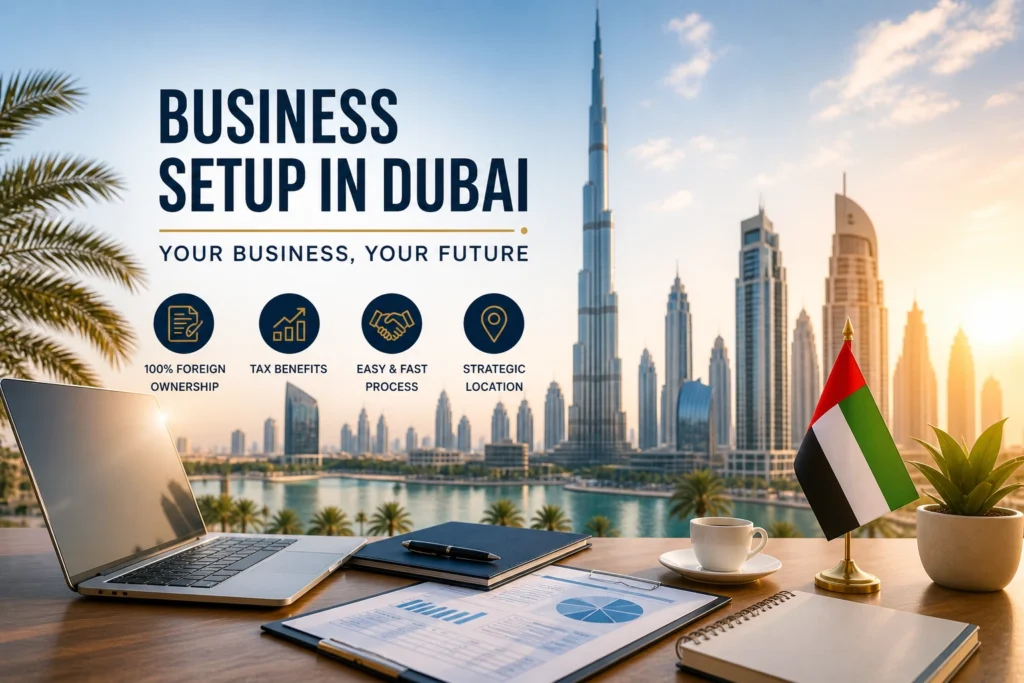
Dubai secured 1,117 greenfield FDI projects in 2024 the highest in its history and attracted AED 52.3 billion in foreign direct investment, a 33.2 percent year-on-year increase, according to the Dubai Department of Economy and Tourism. These figures tell a clear story: entrepreneurs worldwide are not just watching Dubai from a distance. They are committing to it.
Whether you are a startup founder, an established business owner, or a professional considering a move to the Middle East, business setup in Dubai has become more accessible than ever. Yet many newcomers still find themselves tangled in confusing terminology, conflicting advice, and overlooked regulatory details. The goal of this guide is to cut through the noise offering clear, practical, and up-to-date information to help you determine what type of company fits your goals.
Why Dubai Remains One of the World’s Most Attractive Business Destinations
Dubai’s appeal is not accidental. The emirate has deliberately built an environment that rewards ambition and removes traditional barriers to entry.
Zero personal income tax remains a major draw. Whether you earn a salary, reinvest profits, or sell shares, you keep what you earn. There is no withholding tax on repatriated profits, and capital can be transferred in and out freely.
Strategic location adds another layer of advantage. With over three billion people reachable within a four-hour flight, Dubai serves as a natural gateway between East and West, supported by world-class infrastructure including Jebel Ali Port and Dubai International Airport.
The introduction of corporate tax in 2023 at 9 percent above AED 375,000 of profit has added a new compliance layer, but it remains one of the lowest rates globally. For qualifying free zone entities, the 0 percent rate still applies on eligible income, provided substance requirements are met.
Perhaps the most significant recent shift has been the removal of the local sponsor requirement. Today, 100 percent foreign ownership is available on the mainland for most commercial activities, subject to regulatory approvals and activity classification.
Understanding the Three Business Setup Jurisdictions in Dubai
Dubai offers three distinct legal frameworks for business setup in Dubai: mainland, free zone, and offshore. Each has its own rules on where you can trade, how much compliance costs, and what visas you can sponsor. Choosing the wrong structure is one of the most expensive mistakes an entrepreneur can make.
Mainland Company Setup
A mainland company is registered with the Department of Economy and Tourism (DET) and is licensed to trade anywhere in the UAE government clients, retailers, and service providers included. There are no geographical restrictions, and you can bid on government contracts.
Best for: businesses that need a local presence retail, construction, restaurants, professional services firms, and any company whose customers are primarily within the UAE.
Free Zone Company Setup
Free zones are special economic areas designed to attract foreign investment. There are over 45 free zones across the UAE, ranging from DMCC for commodities trading to Dubai Internet City for technology firms and Dubai Media City for content businesses.
When you register a free zone company, you get 100 percent foreign ownership, zero customs duties on imports and exports within the zone, and for qualifying income, 0 percent corporate tax. Setup is fast typically five to ten working days and flexible office options such as flexi-desks keep costs manageable.
However, free zone companies cannot trade directly with the UAE mainland without appointing a local distributor or obtaining a special permit. This restriction is the single most important factor to understand before you commit.
Best for: international trading, e-commerce, digital services, consulting firms with clients outside the UAE, and startups that do not need a physical presence on the mainland.
Offshore Company Setup
Offshore companies are registered in Dubai but conduct no business within the UAE. Popular jurisdictions include RAK ICC, JAFZA Offshore, and ADGM. These entities are used for holding assets, managing intellectual property, international invoicing, and wealth structuring. No physical office in the UAE is required, and there is no access to the UAE market or residence visas through this structure alone.
Best for: asset protection, international holding companies, and investment vehicles where the UAE market is not involved.
Cost Breakdown for Business Setup in Dubai
The cost of business setup in Dubai varies significantly by jurisdiction, license type, visa requirements, and office needs. UAE incorporation costs typically range from AED 12,000 to AED 50,000 or more for the first year, depending on these factors.
Free zone entry points start at approximately AED 5,750 for basic packages that include a trade license, flexi-desk, and one investor visa. At the higher end, DMCC packages begin around AED 12,000 for year one, including a flexi-desk and one visa.
Mainland trade license fees alone vary by activity category. Commercial licenses typically range from AED 10,000 to AED 15,000, professional licenses from AED 7,000 to AED 12,000, and industrial licenses from AED 12,000 to AED 18,000. These are base government fees before office rent, visa costs, and professional service fees are added.
Ongoing costs beyond year one include annual trade license renewal, office rent, visa renewals, mandatory audit fees (required for almost all UAE companies), and corporate tax registration and filing fees if applicable.
Actionable tip: When comparing cost estimates, ask what is included. A low headline figure often excludes visa costs, medical tests, Emirates ID fees, and the mandatory establishment card registration.
Visas and Residency Through Business Setup
In Dubai, you do not get residency first you get it through the right business structure. Your company setup directly determines visa eligibility, duration, and approval success.
For those seeking longer-term security, the five-year Green Visa offers self‑sponsored independence from a single employer sponsor, requiring genuine investment in an active licensed entity without a fixed capital threshold.
High-net-worth investors with a capital investment of at least AED 2 million can qualify for the five-to-ten-year Golden Visa, which offers independence from company sponsorship and is particularly advantageous for family and banking relationships.
Most free zones allow up to one to six visas under a basic package, while mainland companies can scale visas based on office space and business size. One visa typically costs between AED 3,000 and AED 7,000 in government fees, plus medical tests, insurance, and Emirates ID processing.
Step-by-Step Business Setup Process in Dubai
For a professional guide to navigating each stage, many entrepreneurs turn to experienced consultants who handle the entire formation process from start to finish. A reliable business setup in Dubai service can make the difference between a smooth launch and months of administrative delays.
Once you have engaged the right support, a typical business setup in Dubai follows these six core stages:
| Stage | Key Actions | Typical Timeline |
|---|---|---|
| 1. Activity & Jurisdiction Selection | Define business activities, match activities to permitted jurisdictions (mainland or free zone), identify visa needs and growth plans | Day 0–3 |
| 2. Trade Name Reservation | Submit 3–5 name options, verify availability, reserve approved name (AED 620–2,000 fee) | 1–2 days |
| 3. Initial Approval | Apply to DET (mainland) or free zone authority, submit business plan and passport copies, pay initial approval fee | 2–5 days |
| 4. Legal Documentation | Draft Memorandum of Association (MoA), notarise documents (AED 1,500–5,000), sign shareholder agreements | 3–7 days |
| 5. Office Lease & Ejari | Lease physical space (mainland) or flexi-desk/shared office (free zone), register tenancy (Ejari AED ~220) | 3–10 days |
| 6. License Issuance & Visas | Pay license issuance fees, open immigration establishment card, apply for investor visas, complete medical and biometrics | 5–15 days |
Common Mistakes to Avoid During Business Setup in Dubai
Even experienced entrepreneurs encounter avoidable setbacks. Here are the most frequent pitfalls and how to avoid them.
Mistake 1: Choosing structure on cost alone. A cheap free zone package becomes expensive if you later discover you need to trade directly with the mainland. Map your market first, then choose jurisdiction.
Mistake 2: Assuming the trade licence grants residency. It does not. You must separately open the immigration establishment card and apply for an investor visa after licence issuance.
Mistake 3: Ignoring prohibited or restricted activities. Some activities require third-party approvals or are not permitted in certain free zones. Verify activity codes before you pay.
Mistake 4: Delaying corporate tax registration. All licensed entities must register for corporate tax with the Federal Tax Authority. Missing deadlines triggers penalties starting at AED 1,000.
Mistake 5: Overlooking bank account requirements. UAE banks require physical presence in some cases, audited documents, and clear ultimate beneficial ownership declarations. Structure your company with banking in mind from day one.
Frequently Asked Questions About Business Setup in Dubai
Q1: Can I operate a free zone company anywhere in the UAE?
No. A free zone company cannot trade directly with the UAE mainland market without a local distributor or a special mainland branch permit. However, free zone companies can now establish mainland branches via the Department of Economy and Tourism while retaining full ownership a significant recent update.
Q2: What is the minimum capital requirement for a mainland LLC in Dubai?
As of the 2021 Commercial Companies Law, there is no mandatory minimum share capital for most mainland LLC activities in Dubai.
Q3: Can a single person set up a company in Dubai?
Yes. Free zone allows single-shareholder entities (Free Zone Establishment), and mainland permits sole proprietorships and single-shareholder LLCs as well.
Q4: Do I need to visit Dubai to set up a company?
Many free zones now support fully remote company formation with digital portals. Mainland setup typically requires in-country presence for documentation and biometrics, but some processes can be managed remotely through authorised service providers.
Q5: What is the corporate tax rate for free zone companies?
Qualifying free zone entities that meet substance requirements pay 0 percent corporate tax on qualifying income. Non-qualifying income (including certain mainland sales) is subject to the standard 9 percent rate. If annual revenue is below AED 1 million, the entity may be exempt from tax registration altogether.
Conclusion
Business setup in Dubai has evolved from a complex, sponsor‑dependent process to a clear, accessible pathway for global entrepreneurs. The key to success lies in understanding the trade-offs between mainland, free zone, and offshore structures, then matching those trade-offs to your actual market, budget, and growth plans.
For professional guidance tailored to your specific industry and goals, working with an experienced business setup consultant can save months of research and prevent costly structural mistakes. For a seamless and compliant process, explore a trusted business setup in Dubai service to help you navigate licensing, office registration, and investor visas from start to finish.