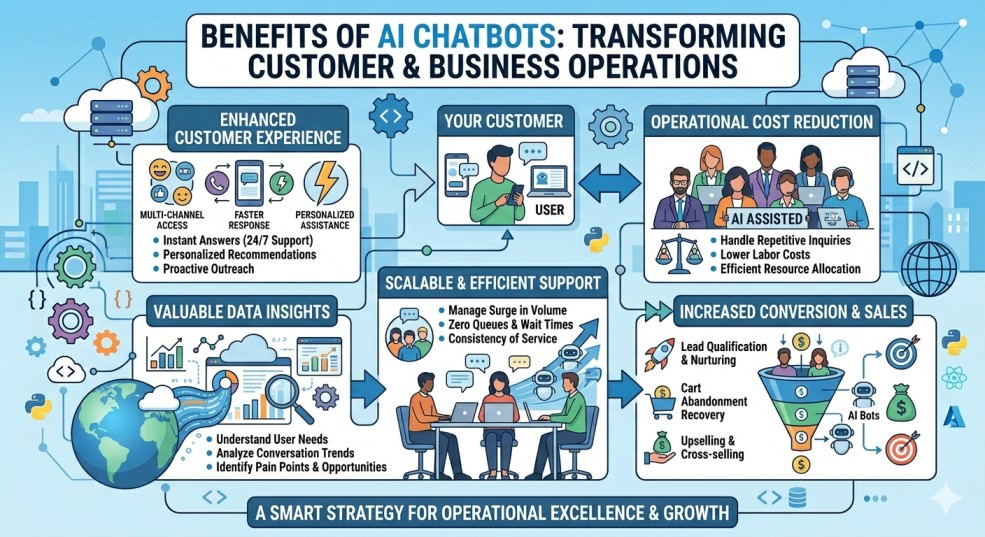
benefits of AI chatbots
AI chatbots have evolved from simple scripted response systems into sophisticated conversational agents capable of reasoning, learning, and delivering genuine value across complex workflows. But this evolution is far from over. The future of AI chatbots holds even greater promise — driven by advances in generative AI, multimodal capabilities, emotional intelligence, and deep enterprise integration. For businesses investing in this technology today, understanding where chatbots are headed is essential for making smart, future-proof decisions.
Generative AI Is Redefining What Chatbots Can Do
The arrival of large language models (LLMs) like GPT-4 and their successors has fundamentally changed the chatbot landscape. Generative AI chatbots do not just retrieve pre-written answers — they generate contextually appropriate, nuanced responses from scratch. This capability enables conversations that are far more natural, flexible, and useful than anything that was possible just a few years ago.
The generative AI chatbot benefits extend beyond conversation quality. These models can summarize complex documents, draft personalized responses, generate reports, and even write code — making them useful far beyond traditional customer-facing roles.
AI Chatbot Trends 2025: Multimodal Conversations
One of the most exciting AI chatbot trends in 2025 is the shift toward multimodal capabilities. Next-generation chatbots can process and respond to text, images, voice, and video simultaneously. A customer can photograph a damaged product and send the image directly to a chatbot, which analyzes the damage and initiates a return — without any form-filling or human intervention.
Voice-enabled AI chatbots are also gaining traction, particularly in automotive, healthcare, and smart home environments where hands-free interaction is essential. The convergence of text, voice, and visual AI is creating a new category of intelligent assistant that is far more capable and intuitive.
Emotional Intelligence and Empathetic AI
Traditional chatbots were criticized for feeling cold and mechanical. The next generation of AI chatbots is addressing this through emotional intelligence. Sentiment analysis technology enables chatbots to detect frustration, confusion, or satisfaction in customer messages and adjust their tone and response strategy accordingly.
When a customer is clearly upset, an emotionally intelligent chatbot can express empathy, soften its language, and prioritize rapid resolution over efficiency — behaviors that feel human and build trust. This capability is particularly valuable in high-stakes interactions like complaint handling, healthcare support, and financial hardship conversations.
Proactive and Predictive Chatbot Engagement
Today’s chatbots largely respond to inbound queries. The conversational AI future involves chatbots that initiate contact proactively based on predictive intelligence. By analyzing user behavior, purchase patterns, and real-time data, chatbots will anticipate needs before customers even express them.
For example, a chatbot monitoring a customer’s account might proactively alert them to a suspicious transaction before they notice it themselves. A retail chatbot might reach out to inform a loyal customer about a restock of their favorite product. This shift from reactive to proactive engagement will make AI chatbots feel less like tools and more like trusted advisors.
Deep Enterprise Integration and Workflow Automation
The next wave of AI chatbot business transformation involves deep integration with enterprise systems — ERP, CRM, HRMS, supply chain platforms, and proprietary databases. Rather than answering questions from a static knowledge base, future chatbots will pull live data, trigger workflows, update records, and coordinate multi-step processes across business systems.
An HR chatbot might handle a leave request end-to-end: checking the policy, verifying leave balance, updating the HR system, notifying the manager, and sending a confirmation — all within a single conversation. This level of integration transforms chatbots from information tools into action-taking agents.
Hyper-Personalization Through Continuous Learning
Future AI chatbots will build increasingly detailed models of individual users over time. By remembering past interactions, preferences, communication styles, and needs, they will deliver hyper-personalized experiences that feel genuinely tailored to each person.
This continuous learning will be balanced carefully with privacy regulations, but within compliant frameworks, it promises to make AI chatbot interactions feel more like conversations with a trusted colleague than transactions with a system.
What Businesses Should Do to Prepare
To take full advantage of the next generation of AI chatbots, businesses should take several strategic steps now. First, invest in high-quality data infrastructure — the fuel that powers intelligent AI. Second, choose chatbot platforms with open APIs and strong integration capabilities, so future upgrades do not require complete replacements. Third, define clear success metrics for your chatbot deployments, so you can measure progress and justify continued investment. Fourth, train your teams to work alongside AI tools, building a culture of human-AI collaboration.
The businesses that will benefit most from next-generation chatbots are those that start building their foundations and capabilities today.
Conclusion
The future of AI chatbots is rich with possibility. Generative AI, multimodal capabilities, emotional intelligence, proactive engagement, and deep enterprise integration are converging to create a new generation of intelligent digital agents. For businesses that embrace this evolution thoughtfully, AI chatbots will become not just a customer service tool, but a core pillar of competitive strategy, operational excellence, and customer relationship management.


