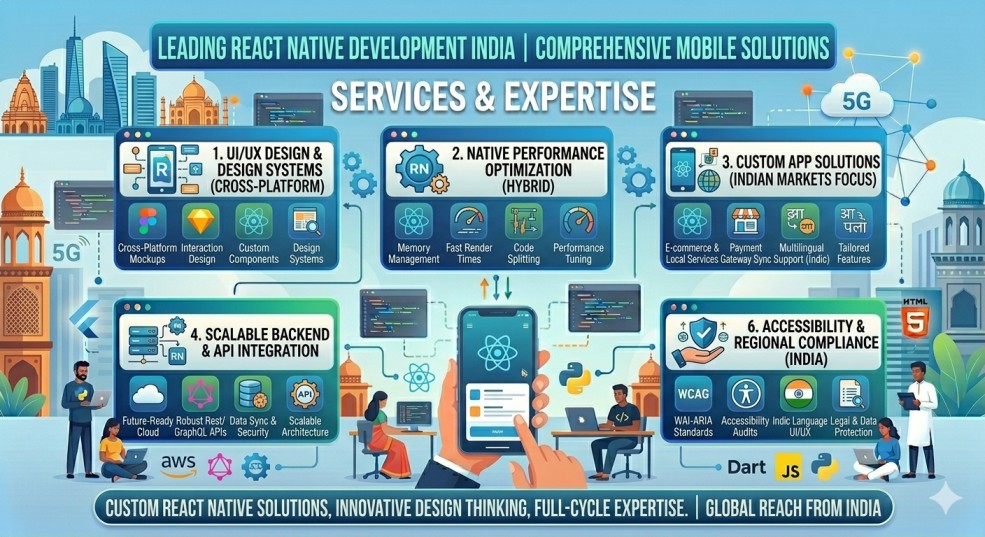
react native development india
Hiring React Native developers from India fails more often at the process level than at the talent level. The talent exists. India has more experienced React Native engineers than any other market globally. The failures happen when businesses skip the brief-writing phase, evaluate portfolios by looking at screenshots instead of using live apps, mistake fluency in React Native documentation for production experience, or commit to a full engagement before validating the partner through a trial sprint.
This guide gives you the hiring process that actually filters for production-quality React Native engineers in India — from writing the brief that attracts the right candidates to the contract terms that protect your IP before development starts.
Step 1: Write a Brief That Filters Automatically
The quality of the brief determines the quality of the proposals. A vague brief — ‘we need a React Native app for our e-commerce platform’ — attracts every React Native developer in India indiscriminately. A specific brief filters for the ones with relevant experience before the first conversation.
Before contacting any development company or individual developer, define:
- Target platforms: iOS only, Android only, both — and whether web or desktop coverage is in scope
- Industry vertical: e-commerce, healthcare, fintech, logistics, EdTech, SaaS, or other — this filters for domain experience
- Real-time requirements: does your app need WebSocket connections, live GPS tracking, collaborative features, or real-time data sync?
- Offline requirements: does the app need to function without network connectivity, and if so, what data must be accessible offline?
- Third-party integrations you already know about: payment gateways, analytics platforms, CRM systems, EHR platforms, maps, authentication providers
- Performance requirements: does your app need to perform on mid-range Android hardware, or is it targeting premium devices only?
- Architecture preference: new architecture (JSI, Fabric, TurboModules) — this is the only correct answer for new projects in 2026
A brief that answers these questions produces proposals from teams with relevant experience. It also immediately signals to strong development partners that you are a serious client who understands what they are building — which changes the quality of the partner you attract.
Step 2: Evaluate Portfolios the Right Way
Screenshots are the portfolio format that tells you the least. Every React Native developer can produce screenshots. The only portfolio evidence that tells you anything real is live apps in the App Store or Google Play that you can download and use right now.
Ask every candidate or agency: show me three React Native apps you shipped to production in the last 24 months that are currently live. Then download them. Use them. Evaluate specifically:
- Scroll performance on lists with large datasets on mid-range Android hardware — does it maintain 60fps or does it stutter under data load?
- Navigation transitions — are they smooth and consistent across platforms, or do they feel slightly off on one platform?
- Cold start time — how long does the app take to become interactive from a cold launch?
- Offline behaviour — what happens when you switch to airplane mode mid-session? Does the app fail gracefully or crash?
- Memory behaviour — does extended use cause the app to slow down, indicating memory leak issues that QA did not catch?
These are the things that reveal architectural quality under real conditions. An app that scores well on all five of these was built by an engineer who understands React Native’s performance characteristics in production. An app that fails any of these tells you something important about what will happen to your product.
Step 3: Technical Assessment — Architecture Reasoning, Not Syntax
React Native syntax questions — ‘what is the difference between useMemo and useCallback?’ — filter for documentation familiarity. They do not filter for production experience. The technical assessment for a senior React Native developer should focus on reasoning under realistic constraints.
State Management Scenario
Present this scenario: a social commerce app with a product feed that updates in real-time, a shopping cart that persists across sessions, and a user profile that multiple screens read from concurrently. The app needs to work on mid-range Android devices with 3GB RAM. Ask: how would you approach state management, and what are the trade-offs between Redux Toolkit, Zustand, and React Query for this specific scenario?
A strong answer describes specific trade-offs — Redux Toolkit’s predictability and devtools at the cost of boilerplate, Zustand’s simplicity at the cost of structured middleware patterns, React Query’s superiority for server state at the cost of not handling local UI state as cleanly — and makes a specific recommendation with reasoning tied to the constraints of the scenario. A weak answer lists all three options without committing to a recommendation.
Performance Profiling Scenario
Describe this situation: a product catalog screen with 500 items is stuttering on a Snapdragon 680-class Android device. List scroll drops to 35fps when items with images load. Ask: how would you diagnose and resolve this?
A strong answer describes a specific diagnostic process: React Native DevTools performance overlay to identify frame drops, Flipper with the React Native plugin to profile component renders, identification of unnecessary re-renders through why-did-you-render, then specific solutions — FlashList to replace FlatList, React Native Fast Image to replace the default Image component, image dimension normalisation to prevent layout recalculation on load. A weak answer says ‘we would optimise the component rendering’ without describing the diagnostic process.
Step 4: Evaluate Communication Quality as a First-Class Criterion
In a cross-timezone engagement with an Indian development team, communication quality is not a nice-to-have. It is the operational infrastructure that makes the engagement function. An engineer who cannot explain an architectural decision in plain language to a non-technical stakeholder creates communication debt that compounds across every sprint.
During the assessment conversation, listen for:
- Does the developer answer the question asked, or do they answer an easier adjacent question?
- When the scenario is ambiguous, do they ask clarifying questions before proceeding, or do they proceed with assumptions?
- Can they explain why they would make a specific technical choice in one sentence, without acronyms?
- When they do not know something, do they say so directly, or do they construct a plausible-sounding answer?
The last one is the most revealing. A developer who says ‘I am not familiar with that specific package, but the approach I would take is…’ is a developer you can work with at a distance. A developer who constructs an answer they are not confident about is a developer who will hide blockers until they become missed deadlines.
Step 5: Run a Paid Pilot Sprint
Interviews evaluate potential. Pilot sprints reveal actual. A two-week paid engagement — $2,000 to $5,000 for a senior developer — on a real task from your actual product backlog reveals more about a partner’s fit than any combination of portfolio review and interview questions.
A pilot sprint reveals:
- How quickly the developer understands your codebase, coding conventions, and existing architecture
- Communication cadence: do they send daily async updates, or do they disappear for days between check-ins?
- Estimate accuracy: does the task take the time they estimated, or was the estimate disconnected from the actual scope?
- How they handle a blocker: do they raise it immediately with proposed solutions, or do they surface it on the deadline?
- Code quality under real delivery conditions: PR descriptions, commit message quality, inline documentation
A pilot sprint that reveals a misaligned partner costs $2,000 to $5,000. Discovering the same misalignment at month three of a full engagement costs $30,000 to $60,000 and a product launch delay. The math is straightforward.
Step 6: Contract Terms That Must Be Non-Negotiable
| Contract Term | Why It Is Non-Negotiable |
|---|---|
| Full IP assignment clause | All code produced in the engagement belongs to you — no conditions, no licensing fees, no exceptions |
| Code repository in your accounts | GitHub/GitLab/Bitbucket account owned by you from day one — not transferred after completion |
| NDA signed before product discussion | Your business logic, architecture, and commercial plans are protected from the first conversation |
| Milestone-based payment terms | Payments tied to accepted deliverables — not to calendar dates or hours logged |
| All credentials and signing keys held by you | App Store certificates, Play Store keystores, API credentials — held by your team, not the agency’s |
| Post-launch support model documented | SLA for critical bug response time, maintenance retainer pricing, escalation path — in writing before signing |
These are the terms that SpaceToTech’s react native development India page reflects in their engagement model: ‘Weekly Sprint Reviews and Demos, Rigid Timelines and Milestones, Direct Access to Your Developers, IP Protection and Security Protocols.’ Any partner that pushes back on standard IP assignment or NDA terms before development begins is signalling a business model that depends on leverage over your product. That leverage should not be extended.
Red Flags That End the Process
- Cannot produce three live App Store / Play Store apps — redirects to screenshots or NDA-protected references that cannot be verified
- Resists or deflects a paid pilot sprint — ‘let’s start with the full project and see how it goes’
- State management answers do not include a specific recommendation with reasoning
- Communication is slow or evasive during the assessment process itself
- Pushes back on IP assignment or delays NDA signing
- Timeline estimates do not change regardless of scope complexity
- Recommends bridge architecture for a new project in 2026
Conclusion
Hiring React Native developers from India in 2026 rewards preparation and penalises shortcuts. Write a specific brief. Evaluate live apps, not screenshots. Test architecture reasoning, not syntax knowledge. Prioritise communication quality as a first-class evaluation criterion. Run a paid pilot sprint before any full commitment. Lock down IP and milestone terms in writing before development starts. The Indian React Native talent pool is deep and genuinely capable. The process above finds the teams worth engaging. Skipping steps in that process is how the capable teams get filtered out in favour of the ones who test well in sales conversations.