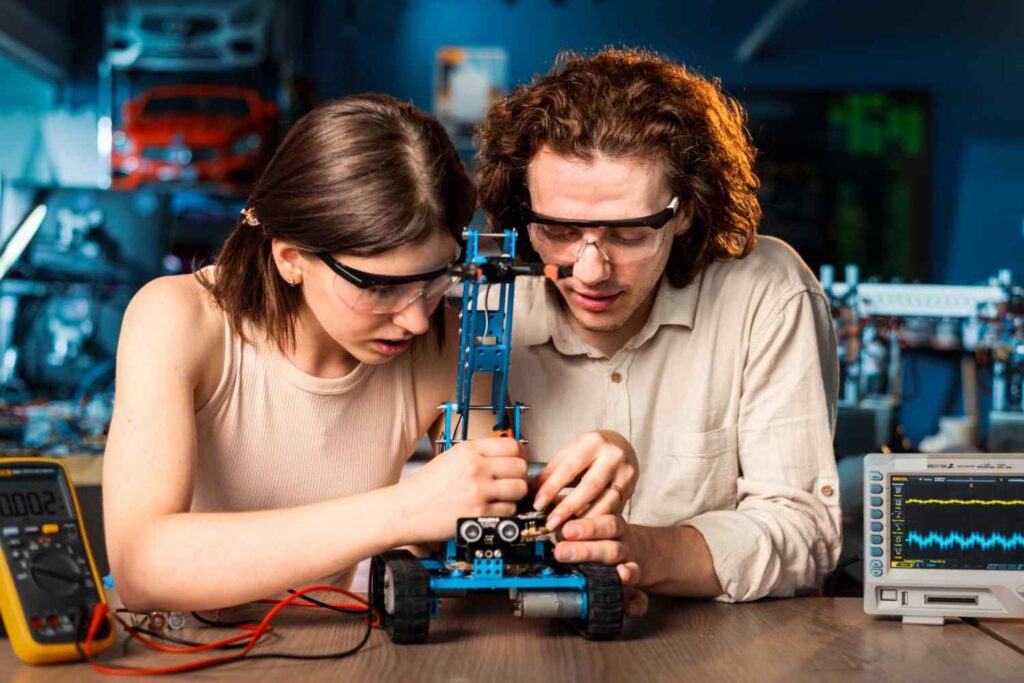
Factories in India are moving fast. Automotive plants in Pune and Chennai now run welding cells with six-axis robots. Pharma plants in Hyderabad are using cobots for packaging. Logistics hubs in Delhi NCR have started deploying autonomous mobile robots on their floors. The people running and maintaining these systems did not pick up the skills by accident. They went through proper training, and that is exactly why robotics engineering courses in India are getting more attention in 2026 than they ever have before.
What industry actually wants from a robotics candidate
Before picking a course, it helps to know what hiring managers are asking for. Most manufacturing, automotive, and logistics companies want people who can work with robot programming environments, handle sensor integration, troubleshoot motion faults, and write basic control logic.
The tools that come up most in real job descriptions are Python, C++, ROS (Robot Operating System), MATLAB, and embedded platforms like Arduino and Raspberry Pi. CAD for mechanical layout and basic computer vision round out the skill set that gets candidates past the first filter.
Salaries for freshers range from ₹3.5 to ₹6 LPA, and that climbs quickly with hands-on experience. Mid-level engineers are averaging ₹6 to ₹15 LPA, and experienced professionals in specialised roles are going well above that.
The IIT Delhi executive programme for working professionals
If you are already working and want to shift into robotics, the IIT Delhi Executive Programme in Robotics is one of the most structured options available right now. It runs for five months with 120 hours of live online instruction, split roughly 40% theory and 60% practical work.
The curriculum covers fundamentals, sensing, actuators, motion control, AI/ML integration, and embedded systems across six modules. Each participant builds a functional robot from scratch using CAD, Arduino, Raspberry Pi, 3D printing, and ROS. There is also one campus immersion day at IIT Delhi, which puts you in a real lab environment even if the rest runs online. The fee is ₹1,99,420 including GST with instalment options.
That Sunday schedule matters more than people realise. If you have a Monday-to-Friday job, losing your Sunday for five months is a real commitment, so be honest about that before enrolling.
Degree programmes worth looking at
For students at the undergraduate level, robotics engineering courses in India are now available across more than 220 colleges, though quality varies widely.
The institutions that consistently produce good placements include:
- IIT Guwahati and IIT Mandi for their robotics and automation research labs tied to real projects
- Amrita School of Engineering for a dedicated B.Tech in Robotics with strong lab infrastructure
- Chandigarh University for practical-first training with industry tie-ups in automation and mechatronics
- GGSIPU Delhi’s USAR for its dedicated University School of Automation and Robotics, one of the few dedicated university departments of its kind
M.Tech or M.E. in Robotics and Automation is also open to engineers who come from mechanical, electrical, electronics, or computer science backgrounds. That lateral entry route is worth knowing if you have a B.Tech in an adjacent discipline.
IITM Pravartak’s course for the shop floor
For people already in manufacturing who want Industry 4.0 exposure rather than a full degree, the IITM Pravartak course on Robotics and Digitalization in Manufacturing is practical and focused. It covers industrial automation and how digitalization applies on actual production lines, not in theory.
This one suits automation engineers, maintenance supervisors, and manufacturing professionals who need structured training without taking a long break from work.
What separates a good programme from a paper one
Not every college with “robotics” in the course name has the equipment to back it up. The gap shows up clearly when you look at placement records and project output rather than brochure copy.
Before committing to robotics engineering courses in India, check for three things:
- Does the programme have a working ROS environment or industrial robot arm for practice, not just a simulator?
- Do students complete at least one end-to-end project where a robot is programmed, tested, and debugged?
- Are internships part of the structure or just listed as optional add-ons?
A course that ticks all three is doing something real. One that cannot answer the first question is unlikely to produce candidates who clear technical rounds.
Which industries are hiring right now?
Manufacturing and automotive are the biggest consumers of robotics talent in India right now, but healthcare, defence, logistics, and agriculture are also building out automated systems.
The roles that come up most often are robotics engineer, automation engineer, embedded systems engineer, and control systems engineer. AI and computer vision roles within robotics are growing fastest, particularly in companies building inspection systems for quality control.
Matching the course to your current stage
A student fresh out of class 12 should look at B.Tech programmes at Amrita, IIT Guwahati, Chandigarh University, or GGSIPU based on rank and location. A graduate engineer switching careers should look at IIT Delhi’s executive programme or an M.Tech route at a good NIT or private university. A professional already on the shop floor should explore IITM Pravartak’s short programme or similar continuing education options.
Robotics engineering courses in India are only getting more relevant. The demand is not speculative. Plants are being built, robots are being installed, and the gap between the machines arriving and the people who can run them is real. A course that gives you ROS skills, project experience, and at least some lab time puts you directly in front of that gap, and that is a decent place to be in 2026.