Face wash
Almost every Asian skin has a sunscreen failure story. The one that left them looking ashy in their photos. The one that piled under foundation so badly they wiped it off before leaving the house. The one that felt so heavy in July humidity they genuinely couldn’t tell where the sunscreen ended, and the sweat began.
These aren’t overreactions. They’re legitimate product failures. And they’re the reason so many people decided sunscreen wasn’t for them, which is an understandable conclusion to reach and also one that the skin pays for quietly, over years, in pigmentation and fine lines and uneven tone that no brightening serum fully corrects because the source of the damage never stopped.
The problem was never sunscreen for face as a category. It was always the wrong sunscreen cream for the wrong skin type in the wrong climate.
What’s Actually Happening Without SPF
UVB burns. Most people know this one; it’s the redness, the peeling, the immediate evidence of too long in the sun. UVA is the one that operates without visible warning. It penetrates deeper into the skin, breaks down collagen slowly and consistently, and drives the kind of pigmentation that shows up years after the exposure that caused it.
For South Asian skin, which produces melanin in response to almost any irritation, not just sun exposure, this is particularly relevant. The dark spot from a breakout that’s been fading for three months gets re-darkened by every unprotected morning outside. The best sunscreen for face isn’t doing something exotic. It’s just stopping something that keeps happening from continuing to happen.
Oily Skin and the Texture Problem
Most Asian women and men with oily skin have tried at least one best sunscreen gel that ended their relationship with the category for a period of time. It broke them out. It made the shine worse. It piled. It felt like applying a second skin on top of already-complicated skin.
None of that is inevitable. It’s a formula problem.
The right best SPF face moisturizer for oily skin absorbs completely; no residue, no film, nothing sitting on the surface contributing to congestion. SPF 50 face protection in a gel or water-gel format should feel closer to a light serum than anything traditionally cream-textured. Fast absorption, no white cast, no shine amplification.
White cast is worth addressing directly here because it affects darker South Asian skin disproportionately. Purely mineral sunscreens- zinc oxide, titanium dioxide- leave visible white or greyish tones on deeper complexions that make daily wear genuinely impractical. Hybrid formulas or well-designed chemical filter systems solve this. The absence of white cast on medium-to-deep skin tones is a design decision, not a lucky accident. Formulas built for diverse skin tones do it deliberately.
Combination Skin: The Two-Zone Challenge
Sunscreen for combination skin is genuinely harder to formulate than single skin-type products. The T-zone needs something that won’t amplify oiliness. The cheeks and drier areas need something that won’t feel tight or stripping. Most sunscreens optimize for one and make the other uncomfortable.
Gel-cream textures navigate this better than anything sitting fully at either end of the spectrum; enough hydration for drier zones, light enough that oily areas don’t become a problem before 10 am.
The best sunscreen for this skin type is something that absorbs quickly, leaves no trace, and doesn’t require any mental preparation before applying. Sunscreen SPF 50 that feels like nothing is the one that actually becomes a daily habit rather than an occasional intention.
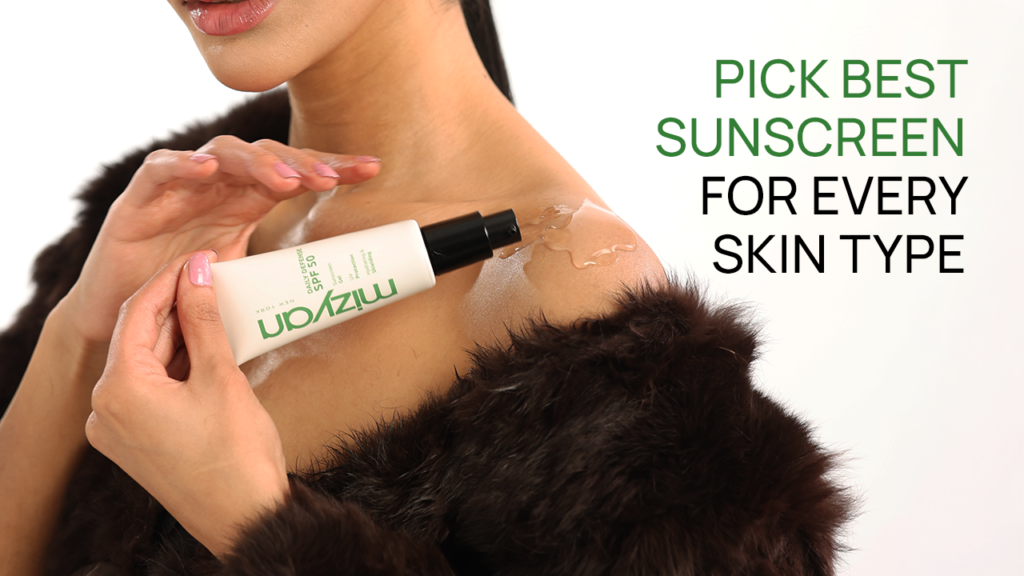
Mizyan’s Daily Defence is genuinely worth mentioning here because it solves most of what makes sunscreen annoying in this climate. Broad-spectrum SPF 50, gel formula, zero white cast on South Asian skin tones, absorbs fast enough to not disrupt a morning routine. The Antioxidant Complex: Glutathione, Oat Kernel Extract, Chlorella Vulgaris addresses pollution-generated free radical damage alongside the UV protection, which for Pakistani city skin is the combination that actually makes sense. Hyaluronic Acid keeps things comfortable through the day without adding weight.
Dry Skin: Different Needs Entirely
Everything above: the lightweight, fast-absorbing, near-invisible formula is the wrong direction for dry skin.
Dry skin needs the best face cream with SPF; a formula that protects and genuinely moisturises at the same time, because applying something stripping on top of skin that’s already depleted is a routine that lasts about a week before being abandoned.
The right SPF face cream for dry skin should feel like a moisturiser wearing SPF rather than a sunscreen that happens to be slightly hydrating. Ceramides, Hyaluronic Acid, Glycerin in the formula. A texture that feels comfortable rather than bracing. Applied as the final morning step, it replaces the need for a separate daytime moisturiser and stops the constant layering that dry skin routines can turn into.
Reading the Label Without Getting Lost
Three things worth actually checking:
Named UV filters: Phenylbenzimidazole Sulfonic Acid, Terephthalylidene Dicamphor Sulfonic Acid, Tinosorb S; these are indicators of a formula built for real broad-spectrum protection rather than just the words “broad spectrum” on the front with nothing to back them up inside.
Antioxidants. Vitamin C, Glutathione, Green Tea Extract; these address the oxidative damage that UV and pollution create even when the SPF is filtering the rays. A sunscreen without antioxidants is handling one side of the damage equation and ignoring the other.
Alcohol placement: Some alcohol in sunscreen is normal and functional. Alcohol in the first five ingredients of a formula going on bare skin daily is a different situation, particularly relevant for dry or sensitive skin types.
Sunscreen isn’t a seasonal consideration. The UV index doesn’t cooperate enough for that. Applied to South Asian skin that’s already navigating heat, pollution, and a pigmentation response that activates faster than most; it’s the one step that protects the investment of everything else in the routine.
The right formula for the right skin type takes thirty seconds. That’s genuinely the whole barrier to entry.