Digital AOX (All-on-X) workflows continue to transform modern implant dentistry by improving efficiency, communication, and restorative predictability. As more clinicians transition away from traditional analog processes, there is increasing demand for technologies that help maintain accuracy throughout the treatment workflow.
One technology receiving growing attention is OptiSplint®, a digital verification system designed to support full-arch implant restorations. Many implant dentists are incorporating OptiSplint® dental workflows because verification remains one of the most important factors influencing restorative fit, laboratory efficiency, and overall treatment predictability.
As digital AOX treatment becomes more common, verification technologies are playing a larger role in helping clinicians reduce workflow variability and improve consistency.
Why Verification Remains Critical in AOX Dentistry
Digital workflows have improved many aspects of implant treatment, but the need for accurate implant position verification has not disappeared.
Regardless of how implant positions are captured, clinicians still need confidence that restorative records accurately reflect the patient’s clinical situation before final prosthetic fabrication begins.
Without proper verification, potential challenges may include:
- Implant position discrepancies
- Passive fit complications
- Additional chairside adjustments
- Laboratory remakes
- Framework modifications
- Increased treatment time
This is one reason verification continues to be considered a critical quality-control step in modern AOX workflows.
The Growing Shift Toward Fully Digital Implant Workflows
Over the past decade, implant dentistry has seen significant growth in digital technology adoption.
Many full-arch treatment workflows now incorporate:
- Digital treatment planning
- Guided surgery
- Intraoral scanning
- Photogrammetry
- Digital verification
- CAD/CAM prosthetic fabrication
The objective is not simply to digitize treatment but to create more predictable and repeatable outcomes throughout the restorative process.
Research published through the National Library of Medicine highlights the expanding role of digital technologies in implant treatment planning, communication, and restorative workflow management.
Why Implant Dentists Are Prioritizing Verification Accuracy
As implant workflows become increasingly digital, clinicians are paying closer attention to the accuracy of the data being transferred between surgical, restorative, and laboratory stages.
Small inaccuracies introduced during data acquisition can affect the final restoration, especially in full-arch cases involving multiple implants.
Verification helps clinicians:
- Confirm implant position records
- Improve restorative predictability
- Reduce workflow uncertainty
- Strengthen communication with laboratories
- Identify discrepancies before fabrication
For many implant teams, verification is becoming just as important as scanning and treatment planning.
How OptiSplint® Supports Digital AOX Workflows
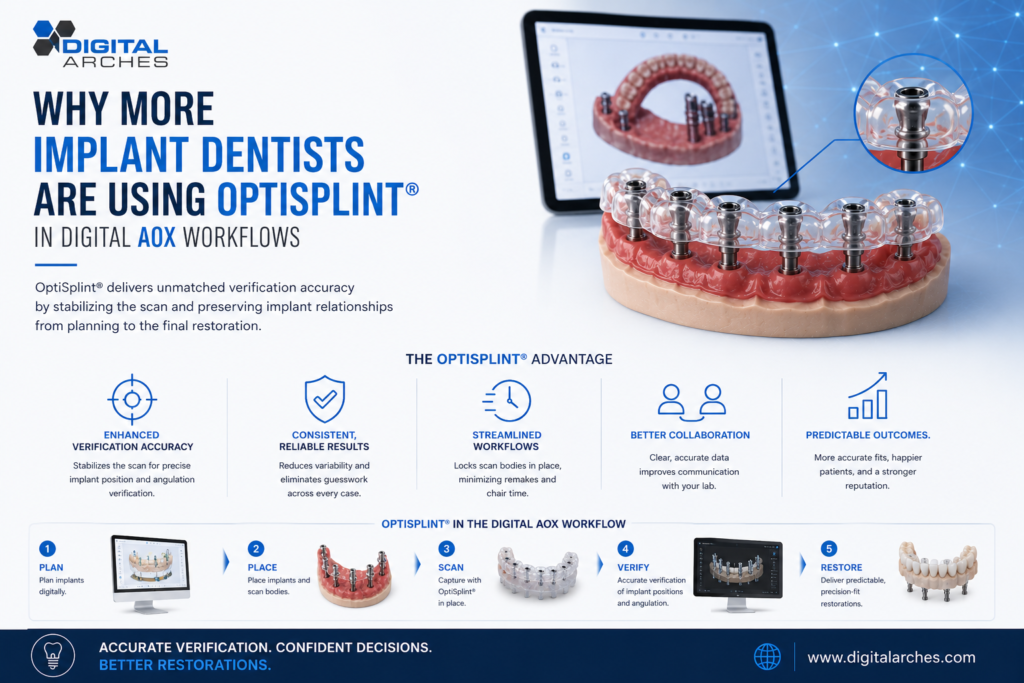
OptiSplint® functions as a digital scannable verification jig that helps maintain the spatial relationship between implants during data acquisition.
Rather than capturing implant positions as separate elements, the system creates a unified structure that can be scanned and verified as a single assembly.
Potential workflow advantages include:
- Improved implant position stability
- Reduced scan body movement
- Better digital record consistency
- Enhanced communication with laboratories
- Greater workflow predictability
These benefits are particularly relevant in AOX cases where multiple implants must work together within a single prosthetic framework.
Supporting More Predictable Restorative Outcomes
One reason clinicians are adopting OptiSplint® dental workflows is the desire for more consistent restorative outcomes.
Even highly advanced digital workflows can encounter challenges if implant position records are inaccurate.
Verification systems help reduce the risk of:
- Restorative misfit
- Framework stress
- Prosthetic adjustments
- Additional appointments
- Manufacturing delays
By improving confidence in restorative records before fabrication begins, verification technologies support a more predictable treatment process.
Improving Communication Between Clinics and Dental Labs
Successful AOX treatment depends heavily on collaboration between clinicians and laboratory teams.
When implant records are incomplete or inconsistent, laboratories may face challenges during framework design and prosthetic fabrication.
Digital verification workflows help improve communication by providing more standardized information throughout treatment.
Potential communication benefits include:
- Reduced interpretation errors
- Faster case review
- Improved restorative planning
- Better workflow coordination
- Greater laboratory confidence
As digital workflows become more integrated, communication quality often becomes a major factor influencing overall efficiency.
Why Passive Fit Still Matters in Digital Dentistry
One common misconception is that digital workflows automatically eliminate the need for passive fit verification.
In reality, passive fit remains one of the most important objectives in full-arch implant prosthetics.
Potential complications associated with poor passive fit include:
- Prosthetic screw loosening
- Framework strain
- Increased maintenance requirements
- Restorative instability
- Long-term prosthetic complications
Because verification directly influences restorative accuracy, many implant dentists continue prioritizing technologies that support passive fit objectives.
Organizations such as the American Academy of Implant Dentistry (AAID) continue emphasizing restorative accuracy and treatment predictability as essential components of successful implant therapy.
How OptiSplint® Fits Alongside Photogrammetry
Modern AOX workflows rarely rely on a single technology.
Instead, clinicians often combine multiple digital tools to improve efficiency and accuracy throughout treatment.
Many workflows incorporate:
- Guided surgery
- Intraoral scanning
- Digital photogrammetry systems
- Verification technologies
- CAD/CAM manufacturing
Photogrammetry helps capture implant positions digitally, while verification systems help confirm the accuracy of restorative records before final fabrication. Together, these technologies contribute to a more reliable digital workflow.
As part of the broader Digital Arches digital implant workflow ecosystem, OptiSplint® supports clinicians seeking greater accuracy within modern full-arch treatment protocols.
Why Adoption Continues to Grow
The growing adoption of OptiSplint® reflects a larger trend within implant dentistry: the pursuit of workflow predictability.
Clinicians are increasingly looking for technologies that help:
- Reduce workflow variability
- Improve restorative accuracy
- Strengthen laboratory communication
- Support passive fit goals
- Increase treatment consistency
Verification systems align closely with these objectives, making them a valuable component of many digital AOX workflows.
Educational organizations such as the Academy of Osseointegration continue supporting research and education related to digital workflow integration and restorative predictability.
Frequently Asked Questions
What is OptiSplint® used for?
OptiSplint® is a digital verification system designed to help clinicians maintain implant position relationships and improve verification accuracy within full-arch implant workflows.
Why are implant dentists using OptiSplint® more frequently?
Many clinicians are adopting OptiSplint® because verification remains an important step for improving restorative accuracy and workflow predictability.
Does OptiSplint® replace photogrammetry?
No. Photogrammetry and verification systems serve different functions and are often used together within comprehensive digital AOX workflows.
Why is verification important in AOX cases?
Verification helps confirm that implant position records accurately represent the clinical situation before final prosthetic fabrication begins.
Final Insight
As digital AOX workflows continue to evolve, implant dentists are increasingly focusing on technologies that improve workflow consistency and restorative predictability. While scanning, photogrammetry, and treatment planning remain important, verification continues to play a critical role in ensuring that implant position records accurately support final prosthetic fabrication.
The growing adoption of OptiSplint® reflects the profession’s broader shift toward more reliable and integrated digital workflows. By supporting implant position verification, improving communication, and helping clinicians identify discrepancies before fabrication begins, OptiSplint® has become an increasingly valuable tool within modern full-arch implant dentistry.