In the modern era of 2026, where aesthetic technology is seamlessly integrated into our daily grooming routines, many Muslims face a common dilemma regarding the intersection of faith and beauty. As we strive to maintain the high standards of cleanliness and hygiene encouraged by the Sunnah, the question frequently arises: Is It Haram to Do Laser Hair Removal? While the desire for smooth, maintenance-free skin is universal, practicing Muslims must navigate the specific boundaries set by Sharia regarding modesty, the exposure of private parts (Awrah), and the prohibition of permanently altering the body in a way that “changes Allah’s creation.” This comprehensive guide explores the contemporary scholarly consensus, the conditions for permissibility, and the nuances of undergoing laser treatments while remaining steadfast in one’s religious devotion.
1. The Sunnah of Fitrah: Cleanliness and Hair Removal
To understand the ruling on laser technology, we must first look at the core Islamic teachings on hair removal. Islam places a profound emphasis on Taharah (purification) and Fitrah (natural disposition).
The Prophet Muhammad (peace be upon him) explicitly mentioned five acts that are part of the Fitrah, two of which involve hair removal:
-
Removing pubic hair.
-
Plucking the hair of the armpits.
Scholars agree that removing hair from these areas is not only permissible but highly recommended (Mustahabb), provided it is done within a 40-day window to maintain optimal hygiene. Therefore, the act of removing hair is intrinsically Halal. The debate around laser treatments primarily focuses on the method and the modesty involved.
2. Does Laser Treatment “Change Allah’s Creation”?
One of the most frequent concerns when asking, Is It Haram to Do Laser Hair Removal?, is whether the permanent or semi-permanent nature of the treatment violates the prohibition against altering the body.
In Islamic jurisprudence, a distinction is made between:
-
Prohibited Alteration: Such as tattooing or filing teeth for cosmetic reasons, which are viewed as a deceptive and permanent change to the natural state.
-
Permissible Maintenance: Such as cutting nails, trimming the mustache, or removing body hair.
Scholarly Consensus: Most contemporary scholars and fatwa councils (including Al-Azhar and the Permanent Committee in Saudi Arabia) argue that laser hair removal is simply a modern method of doing what is already permitted. Because it targets the hair follicle and not the anatomical structure of the body, it is generally considered a form of “prolonged grooming” rather than a forbidden change to creation.
3. The Challenge of “Awrah” (Modesty)
The most significant legal hurdle regarding laser hair removal is the concept of Awrah. In Islam, the Awrah refers to the parts of the body that must be covered in front of others.
Guidelines for Women
-
General Body: In front of other women, a woman’s Awrah is generally from the navel to the knee.
-
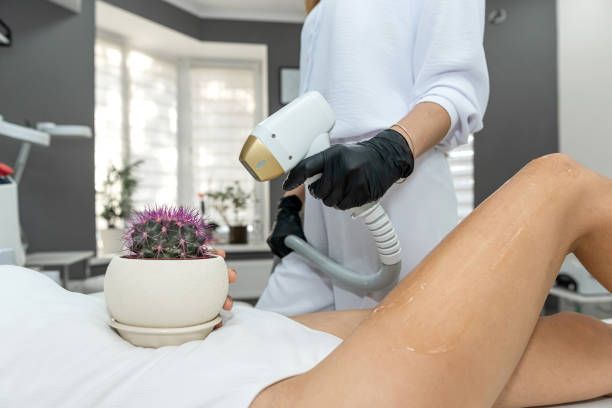
Laser for Legs/Arms: Since these are often outside the primary Awrah in the company of other women, having a female practitioner perform the laser is permissible.
-
The Private Areas: Exposing the area between the navel and the knee to a practitioner (even a female one) for purely cosmetic laser treatment is where the ruling becomes strict. Generally, this is only permitted in cases of necessity (Dharura), such as extreme hirsutism (abnormal hair growth) that causes psychological distress or medical issues.
Guidelines for Men
-
Laser for Chest/Back: Permissible, as these are not part of the primary Awrah (navel to knee).
-
Same-Gender Practitioner: A man should only have laser hair removal performed by another man.
4. Conditions for the Procedure to be “Halal”
For a laser hair removal treatment to be considered permissible, several conditions must typically be met:
| Condition | Description |
| Gender Matching | Women should be treated by women; men should be treated by men. |
| Safety | The procedure must be safe and performed by a professional to avoid self-harm (La Darar wa La Dirar). |
| Modesty | Only the specific area being treated should be exposed. |
| Intention | The intention should be cleanliness or the removal of a burden/hardship. |
5. Specific Rulings: Eyebrows and the Face
The face is a special category in Islamic grooming. The Prophet (PBUH) forbade Nams, which is interpreted as the thinning or plucking of the eyebrows.
-
Eyebrows: Most scholars advise against using laser to thin or reshape eyebrows for purely aesthetic reasons, as this falls under the prohibition of Nams. However, removing hair between the eyebrows (the “unibrow”) is generally permitted.
-
Facial Hair for Women: Removing hair on the upper lip or chin (which is not natural for women) is considered permissible and even recommended to restore a feminine appearance.
6. The Exception of “Dharura” (Necessity)
In Islamic law, there is a principle that “necessity permits the prohibited.” If a person suffers from a medical condition like PCOS (Polycystic Ovary Syndrome), which causes thick, dark facial hair in women, or if they suffer from chronic folliculitis (infected hair follicles) that can only be cured by laser, the rules regarding Awrah are relaxed. In these cases, exposing the area to a professional for treatment is viewed as a medical necessity.
7. Laser Hair Removal for Men: What is Allowed?
Men often wonder about their specific boundaries. In 2026, male grooming has seen a massive surge.
-
Beard: It is generally not permitted for men to use laser to remove the beard entirely, as keeping a beard is a Sunnah and a sign of manhood. However, using laser to “tidy up” the neck area or the cheeks (to define the beard line) is considered permissible by many modern scholars.
-
Chest and Back: If the hair is excessive and causes discomfort or hygiene issues, laser removal is allowed.
8. Summary Table: Area-Specific Rulings
| Area | Ruling | Notes |
| Underarms | Permissible (Halal) | Part of Sunnah hygiene. |
| Legs / Arms | Permissible (Halal) | Ensure same-gender practitioner. |
| Pubic Area | Restricted | Allowed only via self-treatment or necessity. |
| Eyebrows | Restricted | Avoid reshaping; unibrow removal is okay. |
| Female Facial Hair | Permissible (Halal) | Encouraged for femininity. |
Conclusion!
In conclusion, when asking, Is It Haram to Do Laser Hair Removal?, the answer is nuanced but generally positive. Islam is a religion that values beauty (“Allah is Beautiful and Loves beauty”) and hygiene. Laser hair removal is a valid tool for achieving these goals, provided that the sanctity of the Awrah is respected and the procedure is conducted with modesty and professional care.
By choosing a clinic that respects your religious values—such as providing same-gender practitioners and private rooms—you can enjoy the benefits of modern technology while remaining fully aligned with your faith.