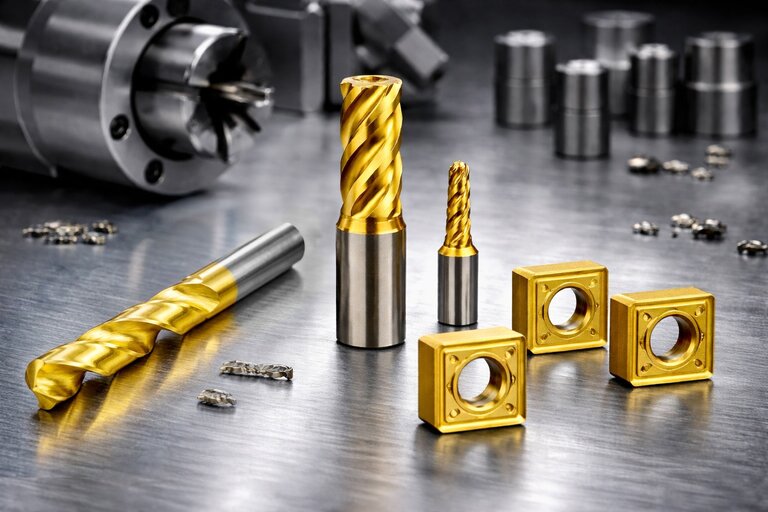
If your shop has been running TiN-coated tools for years, the gold-colored finish is familiar. Titanium nitride coating has been a standard in the cutting tool industry for decades, and for good reason, it works. It adds wear resistance, extends tool life beyond uncoated alternatives, and performs reliably on a wide range of materials. But “works” and “works well enough for what you are cutting today” are not the same thing.
As machining operations push toward higher speeds, harder materials, and reduced coolant use, TiN’s limitations become visible. Understanding where those limits are, and where aluminum titanium nitride coating picks up, helps your team avoid premature tool failure and unnecessary cost per part.
What TiN Gives You
TiN (Titanium Nitride) is a general-purpose PVD coating with a hardness of 2,400 HV, a coefficient of friction of 0.50, and a max working temperature of 600°C (1,100°F). It can be applied in thicknesses from 1–7 µm, making it one of the most flexible coatings in terms of application range.
For moderate-speed machining of steels, cast iron, aluminum, bronze, and copper with adequate coolant, TiN performs well. It reduces flank wear, resists built-up edge to a degree, and extends tool life meaningfully compared to running uncoated. Its gold color also makes wear progression easy to spot visually, which is a practical advantage on the shop floor.
Where TiN falls short is in conditions that exceed its thermal and hardness ceiling. At cutting speeds that push tool-tip temperatures above 600°C, TiN begins to oxidize and lose its protective properties. Its COF of 0.50, the highest among commonly specified PVD coatings, generates more friction at the contact surface, which compounds the heat problem. And at 2,400 HV, it lacks the hardness to resist abrasive wear from hardened steels, superalloys, or abrasive composites.
Where AlTiN Takes Over
AlTiN (Aluminum Titanium Nitride) addresses each of TiN’s limitations with measurable improvements. It reaches 3,400–3,600 HV, handles temperatures up to 700°C (1,300°F), and forms a thin aluminum oxide layer at elevated temperatures that actually improves its protective performance during the cut.
This self-protecting behavior is what separates aluminum titanium nitride coating from its predecessor. Instead of degrading as heat builds, AlTiN adapts. That characteristic makes it particularly well suited for dry machining and high-speed operations on steels and copper alloys, where coolant is reduced or eliminated entirely.
The tradeoff is a higher COF (0.60 compared to TiN’s 0.50), which means AlTiN generates slightly more friction. In cutting applications, this is typically offset by the hardness and thermal advantages. For non-cutting applications where sliding friction matters, other coatings like DLC or TiCN may be more appropriate.
How to Know When TiN Is No Longer Enough
The signs usually show up on the shop floor before they show up in a coating specification review. Watch for these indicators that your operation may have outgrown titanium nitride coating:
- Tools are wearing faster than expected at current speeds, even with coolant
- You are reducing feed rates or spindle speeds to compensate for premature edge breakdown
- Cutting harder materials (above 45 HRC) or more abrasive workpieces than when TiN was originally specified
- Moving toward dry or minimum-quantity lubrication (MQL) strategies to reduce coolant costs and environmental burden
- Scrap rates are climbing due to inconsistent tool life across batches
Any one of these conditions suggests the application has moved beyond TiN’s performance envelope.
Side-by-Side Comparison
The data makes the comparison straightforward:
- TiN: HV 2,400 | COF 0.50 | Max temp 600°C | Color: Gold | Thickness: 1–7 µm | Type: General purpose
- AlTiN: HV 3,400–3,600 | COF 0.60 | Max temp 700°C | Color: Dark grey | Thickness: 1–4 µm | Type: Universal high-performance
For shops cutting steels and copper alloys at moderate speeds with coolant, TiN remains a cost-effective and proven option. For operations running at higher speeds, cutting harder materials, or reducing coolant dependency, AlTiN provides the hardness, thermal stability, and oxidation resistance that TiN cannot match.
Beyond AlTiN
AlTiN is not the end of the line. For applications that exceed even its capabilities — dry milling of hardened steels above 50 HRC, machining aerospace superalloys, or cutting abrasive composites — AlTiSiN (HV 4,500, max temp 1,200°C) and nACO (HV 4,500, max temp 1,200°C) push performance further. The selection framework remains the same: match the coating’s hardness, thermal ceiling, and friction characteristics to the actual conditions at the tool tip.