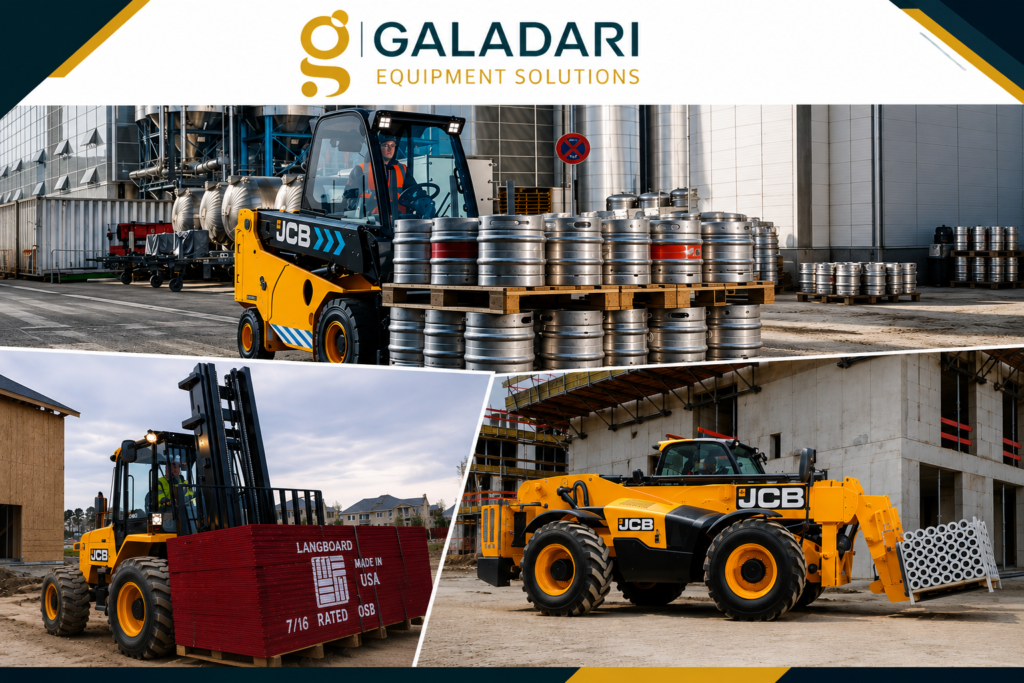
“Forklift” gets treated as a single category more often than it should be. An electric forklift truck built for a smooth warehouse floor and a diesel forklift or rough terrain forklift built for an active outdoor construction site solve different problems, even though they’re often shopped for using the same search term. Specifying the wrong one doesn’t just underperform — on an uneven or unpaved UAE site, it can mean a machine that simply can’t do the job safely.
This guide breaks down where an electric forklift truck genuinely fits, where diesel and rough terrain forklifts take over, and where JCB’s Teletruk range changes the equation entirely.
Where an Electric Forklift Truck Fits
An electric forklift truck is the right choice when the working surface is flat, hard, and indoors — warehouses, distribution centres, and manufacturing floors. The advantages are specific to that environment: zero tailpipe emissions (important in enclosed spaces), lower noise, and lower running costs per hour when the machine is charging overnight and running short indoor cycles during the day.
What an electric forklift truck is not built for is uneven ground, mud, gravel, or the kind of active earthmoving site where a machine needs to travel across rough, unfinished terrain between tasks. Battery-electric drivetrains and standard tyre/wheel setups aren’t matched to that environment, which is exactly where the next two categories take over.
Diesel Forklifts: Power and Runtime for Outdoor Work
A diesel forklift trades the electric truck’s low noise and zero emissions for runtime and power density that outdoor, continuous-duty sites actually need. Diesel forklifts don’t need charging downtime mid-shift, handle higher lift capacities more consistently under load, and are built with drivetrains and ground clearance suited to yards, lumber and steel stockyards, and general outdoor material handling — environments where an electric truck’s flat-floor assumptions don’t hold.
Rough Terrain Forklifts: Built for the Job Site, Not the Warehouse
Where a diesel forklift still assumes a reasonably firm, level yard surface, a rough terrain forklift is engineered specifically for unfinished construction ground — soft, uneven, sloped, or debris-covered sites where a standard forklift’s tyres and clearance would struggle. JCB rough terrain forklifts are built around this exact use case, powered for continuous rehandling work across active job sites rather than warehouse floors, with a chassis and tyre specification designed for traction on ground a standard industrial forklift was never meant to cross.
For UAE contractors moving material across a live construction site — rather than a paved yard — a rough terrain forklift is almost always the more realistic choice than either an electric or standard diesel forklift.
Teletruks: When Reach Matters as Much as Lift
JCB’s Teletruk range takes the forklift concept and changes the fundamental design: instead of a conventional vertical mast, the Teletruk uses a telescopic boom, the same layout JCB pioneered with its telehandler range. That means a Teletruk doesn’t just lift straight up — it can extend forward and up simultaneously, reaching over obstacles, into truck beds, or onto elevated stillages without repositioning the machine.
For sites that need both a forklift’s stacking capability and a telehandler’s reach in one machine, a Teletruk covers ground a conventional electric or diesel forklift can’t, which is why it’s become a standard fixture on UAE construction and logistics sites running mixed material handling tasks.
Choosing the Right Forklift Type
| If your site is… | The right equipment is… |
| Indoor, flat, hard-floored warehouse | Electric forklift truck |
| Outdoor yard, continuous-duty, higher lift loads | Diesel forklift |
| Active construction site, uneven or unpaved ground | Rough terrain forklift |
| Needing both lift height and forward reach | JCB Teletruk |
Many UAE operations end up running a mixed fleet rather than a single forklift type — an electric truck for warehouse put-away and pick, paired with a rough terrain forklift or Teletruk for the active outdoor site, rather than trying to make one machine cover both jobs.
Buying JCB Forklift Equipment in the UAE
Whichever category fits, the same buying questions apply: is the machine backed by genuine parts availability locally, is finance or leasing available rather than requiring outright purchase, and does the supplier provide after-sales service across the emirate the site actually operates in, not just at a single branch.
About the author: This article was contributed by G B Equipment Solutions (GBES), the authorised JCB dealer in the UAE, supplying the full JCB material handling range — rough terrain forklifts, Teletruks, and telehandlers — backed by genuine parts, JCB Finance, and after-sales service across Dubai, Abu Dhabi, Sharjah, and Al Ain.