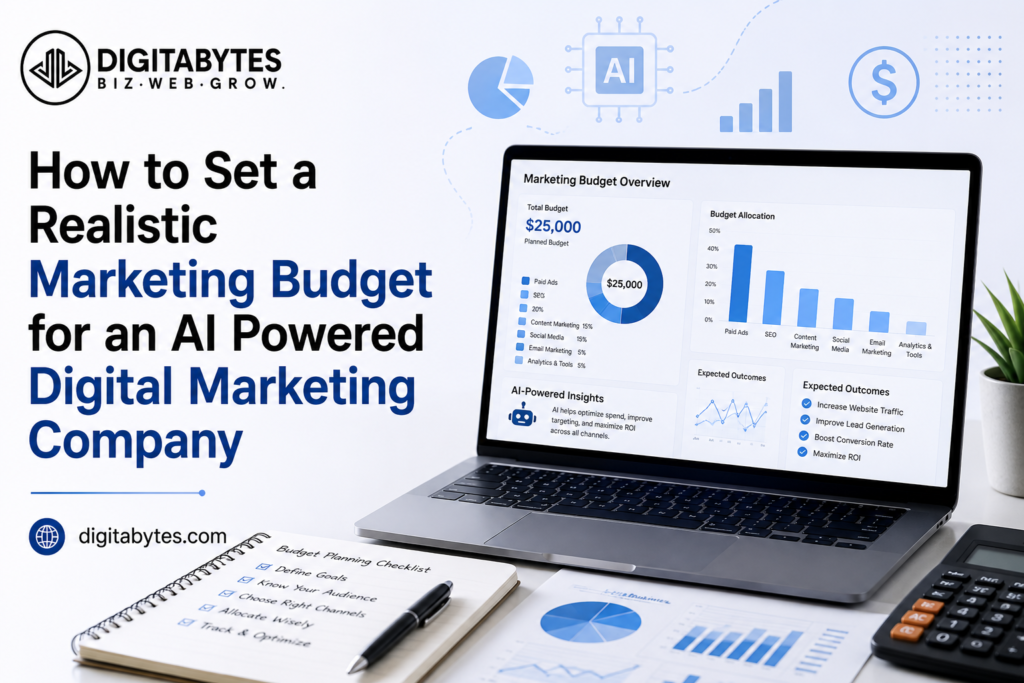
How to Set a Realistic Marketing Budget for an AI Powered Digital Marketing Company
One of the most common questions business owners ask before hiring an agency is simply: how much should this cost? It’s a fair question, and it doesn’t have a single universal answer, since the right budget depends heavily on your industry, goals, and current starting point. Still, there are practical ways to arrive at a reasonable number instead of guessing or picking a figure based purely on what feels affordable.
Start With What You’re Trying to Achieve
Before setting a number, it helps to define what success actually looks like. A business trying to generate 20 new leads a month has different budget needs than one trying to build broad brand awareness over a year. Vague goals like “get more customers” make it nearly impossible to figure out what a reasonable budget should be, since there’s no clear target to work backward from.
Understand Your Current Numbers, Even Roughly
If you already have some data, even limited, on what a new customer is typically worth and roughly how much you’ve spent to acquire customers in the past, that gives you a starting point for what a reasonable marketing investment looks like going forward. Without any baseline, budgeting becomes mostly guesswork, since there’s no reference point for what a reasonable return actually looks like for your specific business.
Factor In the Learning Period
Especially with paid advertising and SEO, initial results usually don’t reflect long-term performance. Campaigns typically need time to gather enough data before targeting and messaging are fully refined. Budgeting only enough for a very short trial period often means stopping right before a campaign would have started performing meaningfully, simply because the timeline wasn’t realistic to begin with.
Separate Ad Spend From Service Fees
It’s worth clearly understanding what portion of a budget goes toward actual ad spend versus the agency’s management or service fees. Some proposals bundle these together in a way that makes it hard to tell how much is actually reaching your target audience versus covering the agency’s work. Asking for this breakdown upfront avoids confusion later and makes it easier to compare proposals from different agencies fairly.
Account for Different Channel Costs
Different marketing channels have very different cost structures. Paid search and social ads have relatively immediate, measurable costs tied directly to spend. SEO and content marketing often involve more upfront investment in time and expertise with results that build more gradually. A realistic budget accounts for these different timelines rather than expecting every channel to show equally fast returns for the same investment.
Avoid Setting a Budget Too Low to Actually Compete
In competitive industries, an unrealistically small ad budget sometimes isn’t enough to generate meaningful data or compete effectively for visibility, regardless of how well a campaign is otherwise managed. This doesn’t mean every business needs an enormous budget, but it’s worth understanding what a competitive minimum realistically looks like in your specific industry before committing to a number that’s too small to produce meaningful results.
Build in Room for Adjustment
A rigid, fixed budget with no flexibility can limit an agency’s ability to shift funds toward what’s actually working once real performance data comes in. Building in some flexibility, even a modest range rather than one fixed number, allows budget to move toward higher-performing channels or campaigns as results become clearer over time.
A Simple Framework for Setting Your Budget
- Define a specific, measurable goal rather than a vague direction.
- Estimate what a new customer or lead is realistically worth to your business.
- Ask any agency you’re considering for a clear breakdown of ad spend versus service fees.
- Set aside enough time and budget for an initial learning period before expecting full results.
- Build in some flexibility rather than locking into a completely fixed number.
The Bottom Line
There’s no single correct marketing budget that applies to every business. A realistic number comes from understanding your specific goals, industry, and starting point, then building in enough time and flexibility for a campaign to actually show what it can do. Rushing this process or picking a number based purely on comfort, rather than actual goals, tends to lead to disappointing results regardless of which agency ends up managing the campaign.
Not sure what a realistic budget looks like for your specific business? Digitabytes can walk you through a straightforward estimate based on your actual goals. Reach out at +91 93159 43766 or sales@digitabytes.com.