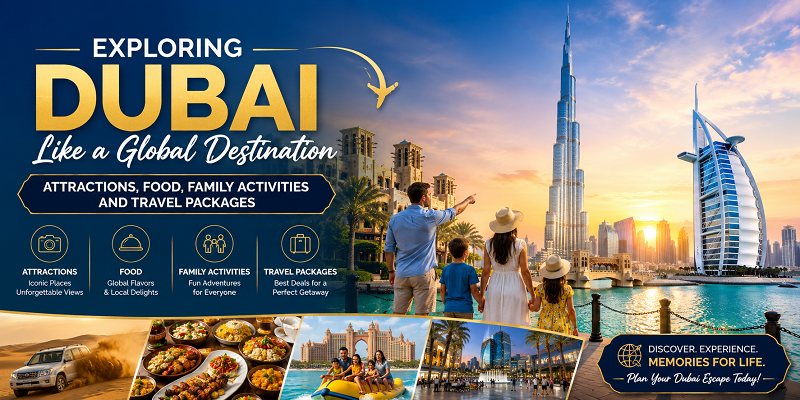
Dubai often gets described as a single kind of trip: skyscrapers, shopping malls, and desert dunes. That description isn’t wrong, but it’s incomplete. The city functions more like a collection of destinations layered on top of each other, each suited to a different kind of traveler.
A food-focused traveler can spend an entire week exploring cuisines from across the world without repeating a single restaurant. A family can fill five days with theme parks, aquariums, and beaches. A culture-focused visitor can spend days in Old Dubai without setting foot near a mall. Understanding Dubai this way, as a multi-layered destination rather than one fixed experience, changes how you plan a trip.
This is part of why Dubai regularly appears among the world’s Top Global Destinations for both leisure and family travel. It draws comparisons not because of one standout feature, but because it combines modern infrastructure, diverse dining, and family-friendly attractions in a single, easily navigable city.
This article breaks down what makes Dubai function as a global destination, covering its major attractions, food landscape, family-friendly options, and how travel packages are typically structured around these different interests.
Key Takeaways
- Dubai offers distinct experiences for culture, food, adventure, and family-focused travelers within the same city.
- The food scene includes global cuisines alongside strong options for vegetarian, Jain, and Indian travelers.
- Family activities range from waterparks to indoor entertainment, suited to different age groups.
- Travel packages vary significantly depending on whether the trip is attraction-focused, food-focused, or family-focused.
- Seasonal timing affects both comfort and pricing across most attractions.
- Understanding Dubai’s zone-based layout helps travelers plan more efficient, less repetitive itineraries.
What Makes Dubai a Global Destination?
Dubai is considered a global destination because it combines modern infrastructure, international cuisine, cultural landmarks, and large-scale entertainment within one compact, well-connected city. Unlike destinations where these elements are spread across an entire country, Dubai concentrates them into a handful of accessible zones.
This concentration is a key reason Dubai attracts such a wide range of travelers, from business visitors extending their trip for leisure to families planning a full vacation around the city’s attractions. The city’s tourism and hospitality industry has developed specifically to serve this variety, offering everything from luxury resorts to budget-friendly family hotels.
Dubai’s Major Attractions: A Quick Overview
Iconic Landmarks
The Burj Khalifa, the world’s tallest building, remains Dubai’s most recognized landmark, offering observation decks with city and desert views. Nearby, the Dubai Mall combines shopping with an aquarium, an ice rink, and dining options in a single complex.
Cultural and Historic Sites
Old Dubai, including the Al Fahidi Historic District and Dubai Creek, offers a contrast to the modern skyline. Traditional souks selling spices, textiles, and gold give visitors insight into the city’s trading history before its rapid modern development.
Desert and Adventure Experiences
The Dubai Desert Conservation Reserve hosts activities like dune bashing, camel riding, and desert safaris, typically ending with a traditional dinner and entertainment under the stars.
Waterfront and Island Attractions
Palm Jumeirah and Dubai Marina offer waterfront dining, boat cruises, and resort access, both popular with couples and families looking for a relaxed pace alongside sightseeing.
Dubai’s Food Scene: A Global Culinary Landscape
Dubai’s food scene reflects its population, which includes residents and visitors from nearly every part of the world. This diversity means travelers can find authentic Middle Eastern, South Asian, East Asian, European, and African cuisine, often within the same neighborhood.
Vegetarian, Jain, and Indian Food Options
Indian travelers, in particular, benefit from Dubai’s large South Asian community, which has led to a wide range of dedicated vegetarian and Jain-friendly restaurants. Many establishments clearly label options for Indian Food in Dubai (Veg/Jain, making it easier for travelers with dietary restrictions to dine without extensive research at every stop.
Street Food and Local Markets
Areas like Old Dubai and the Deira Spice Souk offer more affordable, local dining experiences, contrasting with the higher-end restaurants found in Downtown Dubai and Dubai Marina.
Fine Dining and Skyline Restaurants
Restaurants with views of the Burj Khalifa or the Palm Jumeirah coastline cater to travelers looking for a more premium dining experience, often paired with a special occasion like an anniversary or honeymoon dinner.
Family Activities in Dubai
Theme Parks and Entertainment
Dubai Parks and Resorts, along with IMG Worlds of Adventure, offer large-scale entertainment suited to families with children of varying ages.
Waterparks
Aquaventure Waterpark on Palm Jumeirah and Wild Wadi Waterpark near Jumeirah Beach are among the most popular family attractions, combining water rides with beach access.
Indoor and Educational Attractions
The Dubai Aquarium, Museum of the Future, and Green Planet offer educational, air-conditioned alternatives, particularly useful during Dubai’s hotter summer months.
Family-Friendly Beaches
Public beaches like JBR Beach and Kite Beach offer accessible, family-oriented spaces with nearby dining and rest areas, without requiring resort access.
Benefits of Exploring Dubai as a Multi-Interest Destination
Variety Within a Single Trip
Travelers can combine cultural exploration, food experiences, and family entertainment without needing to travel to multiple countries or cities.
Strong Infrastructure for All Traveler Types
Dubai’s public transport, including the Dubai Metro, and widespread private transfer options make it easier to move between very different types of attractions in a single day.
Dietary Accessibility
Compared to many global destinations, Dubai offers unusually strong support for vegetarian, vegan, and Jain travelers, particularly from India, reducing one of the more common travel stress points.
Seasonal Flexibility
With both indoor and outdoor attractions available, Dubai remains a viable destination across most of the year, even during hotter months when outdoor time needs to be limited.
Challenges to Consider
Attraction Overload
With so many options available, travelers can easily overbook their itinerary, leading to exhaustion rather than enjoyment. Prioritizing a shorter list of must-see attractions per day works better than attempting to see everything.
Cost Variation Across Experiences
Prices can vary significantly between similar attractions. A desert safari, for example, can range from a shared group experience to a private premium option, and costs differ accordingly.
Seasonal Heat
Summer temperatures can limit outdoor activity time significantly, making it important to balance outdoor attractions with indoor alternatives during warmer months.
Navigating Zone Distances
Dubai’s attractions are spread across zones that can take 30 to 45 minutes to travel between, so itineraries that ignore geography often waste significant time in transit.
Comparing Travel Package Types for Dubai
| Package Focus | Best Suited For | Typical Inclusions |
| Attraction-focused | First-time visitors, sightseeing-focused travelers | Burj Khalifa, Dubai Mall, desert safari, city tour |
| Food-focused | Culinary travelers, dietary-conscious travelers | Curated restaurant visits, food tours, market walks |
| Family-focused | Families with children | Waterparks, theme parks, kid-friendly hotels |
| Honeymoon-focused | Couples | Private dinners, beachfront resorts, romantic add-ons |
| Group-focused | Friends, reunions, larger parties | Shared villas, group activities, cost-sharing logistics |
Many travelers benefit from combining elements of two categories rather than choosing strictly one. A family trip, for example, can still include one or two premium dining experiences without fully shifting into a food-focused package.
Real-Life Planning Scenario
Consider a family of five traveling from India for a six-day Dubai trip. Day one focuses on arrival and a relaxed evening at JBR Beach. Day two combines the Burj Khalifa and Dubai Mall aquarium. Day three is dedicated to Aquaventure Waterpark. Day four includes a desert safari with a Jain-friendly dinner option confirmed in advance. Day five allows a slower morning followed by Old Dubai and the spice souk. Day six is left open for shopping and packing.
This structure balances major attractions, family entertainment, and dietary needs without overloading any single day, showing how a multi-interest itinerary can be built around a family’s specific priorities.
User Considerations by Traveler Type
Families with Young Children
Prioritize shorter activity blocks, indoor breaks during peak heat, and hotels located near multiple attraction types to reduce daily transit time.
Solo and Culture-Focused Travelers
Often prefer a slower pace through Old Dubai, museums, and local markets over large-scale entertainment attractions.
Couples and Honeymooners
Typically combine one or two major attractions with private dining experiences and beachfront relaxation, often through structured Dubai Honeymoon Group Tour Packages that separate romantic add-ons from shared group activities when traveling with extended family.
Group and Friend Travelers
Focus on shared experiences like group desert safaris, nightlife areas in Dubai Marina, and villa-style accommodation that supports larger parties.
Practical Advice for First-Time Visitors
- Book major attractions like the Burj Khalifa in advance, especially during peak season (December to February).
- Confirm dietary requirements with restaurants or tour operators ahead of time, particularly for Jain or strict vegetarian meals.
- Balance outdoor and indoor activities, especially between May and September when temperatures are highest.
- Group nearby attractions by zone to reduce daily transit time.
- Set aside at least one unstructured day for rest or spontaneous exploration.
- Carry a reusable water bottle and dress in breathable fabrics, since outdoor walking between attractions can be tiring even in cooler months.
- Keep a digital copy of your itinerary and hotel bookings accessible offline, in case of connectivity issues while moving between zones.
Checklist Before Planning a Dubai Trip
- Confirm which attractions require advance booking
- Identify dietary needs and research suitable restaurants in advance
- Check seasonal weather for your travel dates
- Balance indoor and outdoor activities across the itinerary
- Confirm transport options between planned attraction zones
- Verify visa requirements for your nationality
- Set a realistic daily activity limit to avoid overbooking
Future Trends in Dubai Tourism
- Growth in dietary-specific travel services. More restaurants and tour operators are formally labeling vegetarian, vegan, and Jain options as demand from Indian and international travelers increases.
- Rise of hybrid itineraries. Travelers increasingly combine attraction sightseeing, food experiences, and family entertainment within a single trip rather than choosing one focus.
- Increased use of digital planning tools. More travelers are comparing attractions, packages, and dietary options online before booking, increasing demand for transparent, detailed travel content.
- Expansion of indoor entertainment options. As summer tourism grows, more attractions are being designed specifically to offer full-day indoor experiences.
- Greater interest in cultural depth. Alongside modern attractions, more travelers are seeking guided experiences in Old Dubai that go beyond a quick photo stop, reflecting a broader shift toward experience-led travel over checklist tourism.
Decision Factors: Planning Your Dubai Trip
Consider an attraction-focused itinerary if:
- This is your first visit and you want to see major landmarks
- You have a limited number of days and want efficient sightseeing
Consider a food-focused itinerary if:
- Culinary exploration is a primary travel interest
- You or your group have specific dietary requirements
Consider a family-focused itinerary if:
- You’re traveling with children of varying ages
- Waterparks and entertainment attractions are a priority.
Conclusion
Dubai earns its reputation as a global destination not because of one standout attraction, but because it layers so many different types of travel experiences into a single, accessible city. Landmarks, food, family entertainment, and cultural sites all coexist within a short drive of each other.
The key to a satisfying Dubai trip isn’t trying to see everything. It’s identifying which of these layers, attractions, food, family activities, or a mix of all three, matters most to your group, and building an itinerary around that priority rather than a generic checklist.
Whether the focus is skyline views, dietary-friendly dining, or family entertainment, understanding Dubai’s range before booking makes it far easier to plan a trip that actually reflects what your group wants to experience.
Frequently Asked Questions
- What makes Dubai different from other global travel destinations?
Dubai combines modern attractions, diverse international cuisine, and large-scale family entertainment within a compact, well-connected city, allowing multiple travel interests to be covered in one trip.
- Is Dubai a good destination for vegetarian or Jain travelers?
Yes. Dubai has a large South Asian community, resulting in a wide range of restaurants offering dedicated vegetarian and Jain-friendly menus, particularly in areas with high Indian resident populations.
- How many days are needed to see Dubai’s major attractions?
Five to seven days typically allow enough time to cover major landmarks, a desert safari, at least one waterpark visit, and some cultural exploration without an overly rushed schedule.
- Is Dubai suitable for families with young children?
Yes. Waterparks, aquariums, and indoor attractions like the Museum of the Future are designed to accommodate children, and many hotels offer family-friendly rooms and amenities.
- What is the best time of year to visit Dubai for outdoor activities?
November through March offers the most comfortable weather for outdoor attractions like desert safaris and beach visits.
- Can Old Dubai be explored in a single day?
Yes, though a relaxed pace through the Al Fahidi Historic District, Dubai Creek, and nearby souks typically works better across half a day, paired with another activity in the afternoon.
- Are Dubai’s attractions expensive compared to other destinations?
Costs vary widely. Some attractions, like public beaches and souk visits, are free or low-cost, while others, like premium desert safaris or fine dining, are priced at a premium.
- How does public transport work for getting between attractions?
The Dubai Metro connects several major zones, including Downtown Dubai and Dubai Marina, though attractions further from metro stations often require taxis or private transfers.
- Is it easy to combine sightseeing with food-focused exploration in Dubai?
Yes. Many attraction zones, including Old Dubai and Dubai Marina, have strong dining options nearby, making it easy to pair sightseeing with meals without significant extra travel.
- What documents are needed before traveling to Dubai?
Requirements vary by nationality, so travelers should confirm visa rules, passport validity, and any required travel insurance well before their planned travel dates.