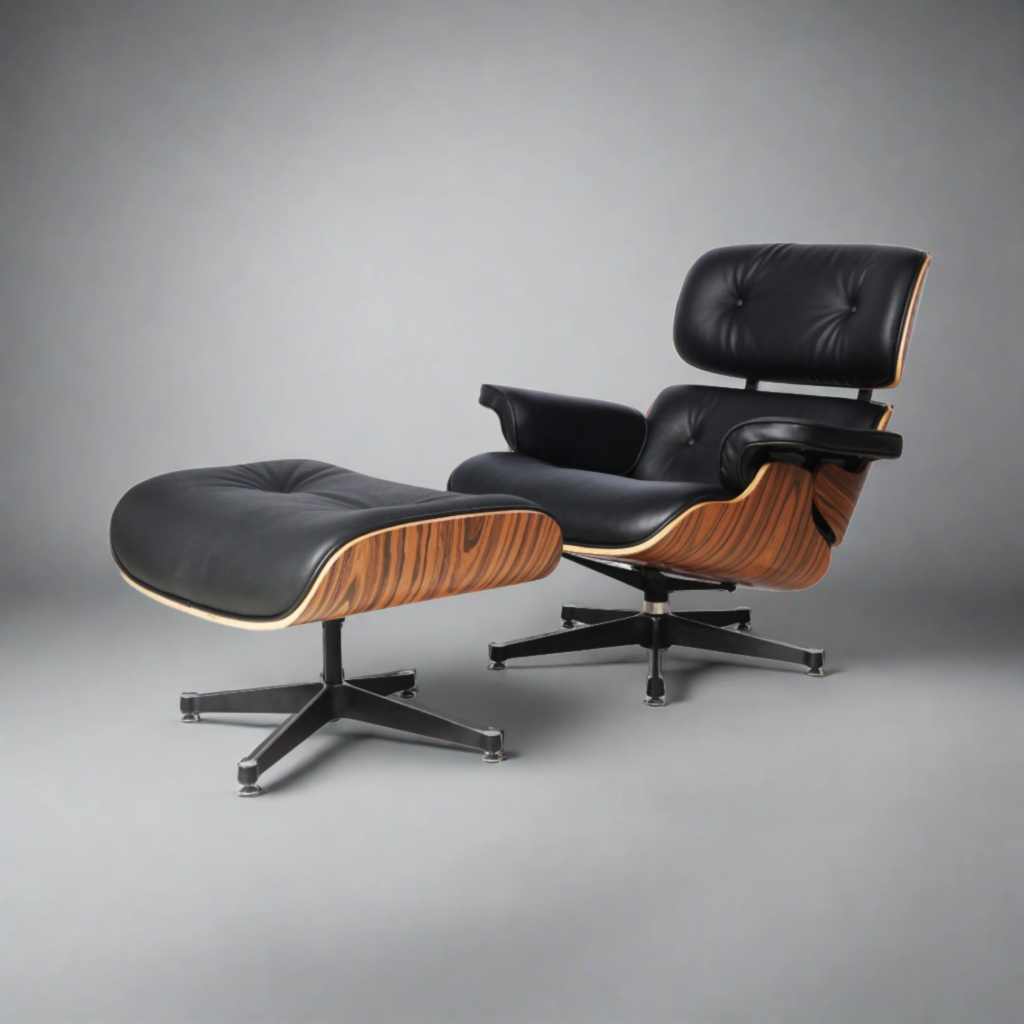
There’s a reason interior designers keep circling back to the same piece when a room feels flat. You add better lighting, swap the rug, rearrange the sofa and something is still missing. Nine times out of ten, what’s missing is a single object with enough presence to give the eye somewhere to land. For a lot of homes, that object turns out to be the eames lounge chair.
This isn’t a new discovery. The chair has been in production since 1956, which makes it older than almost every “modern classic” people compare it to. But its staying power raises a fair question: does buying one actually change how a room feels, or is it just a famous name people pay extra for? Let’s break down what this chair actually does for a space, how it stacks up against other design icons, and how to bring one home without it looking like a showroom display.
The Design Story Behind the Chair
Charles and Ray Eames weren’t trying to make a fashion statement. They wanted to build a chair that felt like an old baseball glove broken in, generous, and inviting the moment you sat down. That goal shaped every part of the construction:
- Three curved plywood shells (headrest, back, and seat) instead of one rigid frame
- Leather cushions attached with buttons, allowing the leather to move and soften naturally
- A die-cast aluminum base that swivels a full 360 degrees
- A matching ottoman, sold as a set, so your feet get the same comfort as the rest of you
What’s easy to miss is how much engineering sits underneath that relaxed appearance. The Eameses spent years perfecting the way plywood could be molded into compound curves, and this chair was one of the pieces that proved it could be done at scale. That history is part of why the charles eames chair is still studied in design schools decades later it wasn’t just a good-looking chair, it was a manufacturing breakthrough wearing a comfortable disguise.
Why It Reads as “Modern” Even Though It’s Not New
Here’s something counterintuitive: a chair built during the Eisenhower administration keeps getting filed under “modern lounge chair” roundups today. That’s not a marketing trick. It’s because the chair’s vocabulary minimal ornamentation, honest materials, visible construction is the same vocabulary contemporary designers still use.
Walk into a newly built loft with polished concrete floors and floor-to-ceiling windows, and the Eames chair looks completely at home, even though nothing else in the room existed when it was designed. Compare that to a piece of furniture from the same decade with heavy carving or ornate trim that would look dated instantly in the same space. Proportion and restraint age well. Decoration doesn’t.
This is also why so many current lounge chair designs borrow directly from it: the low, wide seat; the exposed frame; the emphasis on how a body actually sits rather than how a chair looks in a catalog photo. The Eames chair didn’t follow that trend. It set it.
How It Measures Up Against the Barcelona Chair
If you’re shopping for a design-forward seat, the other name that inevitably comes up is the Barcelona chair. Comparing the two tells you a lot about what kind of room you’re actually decorating.
Barcelona chairs, created by Ludwig Mies van der Rohe for the 1929 World’s Fair, are built on crossed stainless steel legs with a flat, tufted leather seat and back. There’s no recline, no curve that hugs your spine it’s an architectural statement piece more than a place to nap. It photographs beautifully in a lobby, a gallery, or a minimalist office reception.
The Eames chair takes the opposite approach. The shell curves around your shoulders and lower back, the seat cushion is deep enough to pull your legs up onto, and the whole thing tilts back slightly at rest. If your priority is a chair people actually fight over on a Sunday afternoon, the Eames wins. If you want a striking silhouette near an entryway that rarely gets sat in, the Barcelona chair might be the better fit.
Neither one is objectively superior they’re just solving different problems.
A Note on the Eames Office Chair
People occasionally confuse the lounge chair with the eames office chair, and it’s an understandable mix-up since both carry the same last name and the same design philosophy. But they’re built for different jobs entirely. The office chair think the Soft Pad or Aluminum Group series is upright, adjustable, and meant for hours at a desk. The lounge chair reclines, has no wheels, and is built for evenings, not spreadsheets. If your home office needs seating with that same design language, the office chair line is worth a separate look, but don’t expect it to replace the lounge chair in your living room.
Bringing One Into Your Home: A Practical Walkthrough
Owning the chair and styling it well are two different skills. Here’s a sequence that actually works, based on how the piece behaves in real rooms rather than in photos.
- Start with the empty spot, not the chair. Before you buy anything, identify which corner of your home currently has no purpose an unused nook by a window, a dead space beside a bookshelf, an awkward gap near a fireplace. That’s your target zone.
- Measure for the swivel, not just the footprint. The base rotates freely, so the chair needs open floor on every side, not just in front. Leave roughly a foot and a half of clearance so it can turn without knocking a lamp or a plant.
- Match leather tone to your existing wood. If your floors or trim lean warm (oak, walnut), a tan or cognac leather will feel connected to the room. If your space leans cool and grey, a deep espresso or black leather creates contrast instead of matching both work, but they produce very different moods.
- Position the ottoman with intention. Placing it directly in front of the chair creates a formal, symmetrical look. Angling it slightly to one side feels more casual and often fits better in smaller rooms where a straight line of furniture would eat too much space.
- Resist the urge to surround it with more statement pieces. This chair does enough visual work on its own. Pair it with something quiet a simple side table, a floor lamp with warm light rather than another bold shape competing for attention.
- Use it daily. The leather is designed to crease and soften with actual use. A chair that sits untouched in the corner never develops the character that makes it look intentional rather than staged.
Is the Price Tag Justified?
This is usually the last hesitation before buying. A genuine, well-constructed piece isn’t cheap, and it’s fair to ask whether the cost matches the benefit. The honest answer: it depends on how you use your home. If you’re the type to swap out furniture every few years chasing whatever’s current, this isn’t the purchase for you. But if you want one piece that will still look correct in fifteen years and that tends to hold its resale value better than most furniture on the market it’s a different kind of spend entirely.
At Luxe Furnishes, we typically frame it this way for customers: you’re not buying a eames lounge chair, you’re buying the one seat in the house nobody else wants to give up. That’s a hard thing to put a price on, but it’s also exactly why the chair keeps selling, decade after decade.
Frequently Asked Questions
Will an Eames lounge chair look out of place in a non-mid-century home?
No. Its restrained shape and honest materials make it compatible with contemporary, industrial, and even traditional interiors it tends to look intentional in almost any setting as long as it has some breathing room around it.
How is the lounge chair different from the Eames office chair?
The lounge chair is a reclined, at-home seat built for relaxation, with no wheels and a matching ottoman. The office chair line is upright task seating designed for desks, typically with wheels and height adjustment.
Is a Barcelona chair a better choice for a living room?
It depends on the use case. Barcelona chairs are flatter and more formal, better suited for a statement corner than everyday lounging, while the Eames chair is built for extended, relaxed seating.
What size room does this chair actually need?
It doesn’t require a large room, but it does need clearance for the swivel base roughly 18 inches of open space on all sides works for most layouts.
Does the leather require special care?
Basic care is enough: keep it out of direct, prolonged sunlight, condition it occasionally, and let it develop a natural patina rather than trying to keep it looking brand new.
Final Thought
Not every piece of furniture earns the word “investment,” but this one has a track record that backs it up. If your home has a spot that’s never quite worked too empty, too plain, missing something you can’t name there’s a good chance this is the chair that fixes it.