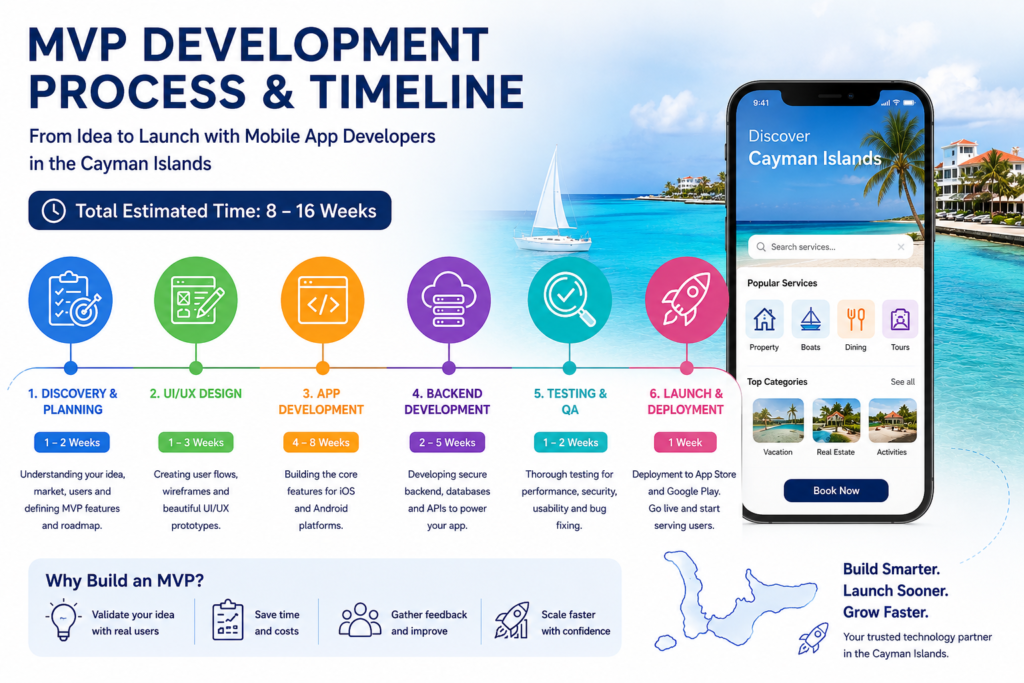
A step-by-step MVP development timeline showing how businesses can move from app idea to launch in the Cayman Islands.
For businesses and startups, a mobile application can create new opportunities to connect with customers, simplify operations, and deliver digital services. However, building a complete application from the beginning can require significant time and resources.
This is where a Minimum Viable Product (MVP) becomes useful.
An MVP focuses on the essential functionality required to launch an application, attract initial users, and gather valuable feedback. For businesses working with mobile app developers in the Cayman Islands, a focused MVP can provide a practical path from an initial idea to a market-ready product.
In most cases, a well-planned mobile MVP can take approximately 8 to 16 weeks to develop. The actual timeline depends on the application’s features, design, integrations, platform requirements, testing, and project scope.
What Is a Mobile MVP?
A mobile MVP is the first functional version of an application that contains the core features needed to address a specific customer need.
The objective is not to launch an application with every possible feature. Instead, businesses identify the functionality that provides the most immediate value.
For example, a property-management MVP could initially include:
- User registration
- Property listings
- Search and filtering
- Property details
- Inquiry forms
- Agent communication
- Basic notifications
More advanced features could be introduced after the first version has been tested with real users.
This approach helps businesses validate their idea before investing in a larger application.
How Long Does MVP Development Take?
A typical mobile MVP can take approximately 8 to 16 weeks, although simple applications may require less time while complex applications may take longer.
The development process usually begins with discovery and planning. This stage establishes the application’s purpose, target users, core features, and technical requirements.
Once the requirements are finalized, UI/UX designers create the application’s user flows, wireframes, and interface designs. Development can then begin while final design elements are completed.
The application is subsequently developed, tested, refined, and prepared for launch.
The timeline is influenced more by project complexity and scope than by geography alone.
Discovery and Planning
The first stage is understanding exactly what needs to be built.
During discovery, the development team may define:
- Business objectives
- Target audience
- User journeys
- Core features
- Technical requirements
- Platform requirements
- Third-party integrations
- Security considerations
A clear development plan can prevent misunderstandings later.
For an uncomplicated MVP, discovery and planning may take around one to two weeks.
UI/UX Design
After the requirements are established, designers create the visual and functional structure of the application.
This can include:
- Wireframes
- User flows
- Screen designs
- Navigation
- Interactive prototypes
- Design systems
The objective should be to create an interface that is easy to understand and simple to navigate.
A focused MVP does not need dozens of screens. It needs a smooth user journey that allows customers to accomplish the application’s primary purpose.
UI/UX design can take approximately one to three weeks, depending on the application’s complexity.
Mobile App Development
Development is usually the largest part of the MVP process.
Developers transform approved designs into a functional mobile application. Depending on the product, this could involve:
- User authentication
- Profiles
- Search functionality
- Forms
- Booking features
- Payments
- Push notifications
- Location services
- APIs
- Content management
A relatively straightforward MVP may require around four to eight weeks of development.
More complex applications may require additional time, particularly when they involve multiple user types, real-time functionality, complex databases, or external integrations.
Backend Development
Many mobile applications require a backend system to manage data and application functionality.
Backend development may include:
- Databases
- User accounts
- Authentication
- APIs
- Business logic
- Content management
- Notifications
- Payment processing
- Administrative functionality
For example, a simple informational application may require a relatively straightforward backend, while a marketplace or booking platform can require considerably more infrastructure.
This is an important consideration when choosing mobile app developers in the Cayman Islands, because the team should understand both mobile development and supporting backend architecture.
Testing and Quality Assurance
Testing is an essential part of MVP development.
Before launch, the application should be evaluated for:
- Functionality
- Usability
- Performance
- Security
- Navigation
- Device compatibility
- API performance
- Error handling
Testing should not be postponed until the final day of development. Continuous testing throughout the project can help identify problems earlier and reduce the risk of major issues before launch.
A dedicated QA phase may take one to two weeks, depending on the application’s complexity.
Launch and Deployment
Once the MVP has passed testing, the development team prepares it for release.
Launch preparation can include:
- App Store configuration
- Google Play configuration
- Application descriptions
- Screenshots
- Privacy documentation
- Analytics
- Production deployment
- Final testing
Businesses should also allow some flexibility around app-store review and approval processes.
What Can Delay an MVP Project?
Several factors can increase the development timeline.
Scope Changes
Adding new features after development begins can create additional design, coding, and testing work.
Complex Integrations
Payment gateways, CRM platforms, maps, booking systems, accounting tools, and other third-party services can increase development requirements.
Multiple User Roles
Applications with customers, administrators, employees, vendors, or agents may require separate dashboards and permission systems.
Extensive Custom Design
Highly customized interfaces, animations, and complex interactions can increase design and development time.
Delayed Decisions
Development can slow down when design approvals, content, technical decisions, or business requirements are delayed.
How to Make MVP Development Faster
Businesses can improve their development timeline by taking a structured approach.
Define the Core Objective
Before development begins, identify the primary problem the application is designed to solve.
Prioritize Features
Separate features into essential, important, and future functionality.
Only essential features should normally be included in the initial MVP.
Prepare Content Early
Application content, images, policies, product information, and other materials should be ready before the final development stage.
Communicate Regularly
Regular communication between the business and development team helps identify issues quickly.
Avoid Scope Creep
An MVP should remain focused. Additional features can be evaluated for future releases based on customer feedback.
Test Throughout Development
Continuous testing helps reduce the number of issues discovered immediately before launch.
Why Choose Mobile App Developers in the Cayman Islands?
Businesses operating in Cayman may benefit from partnering with a development team that understands the local business environment and customer expectations.
When evaluating mobile app developers in the Cayman Islands, businesses should consider more than development cost.
Look for a team that can provide:
- Product planning
- UI/UX design
- Mobile development
- Backend development
- API integration
- Quality assurance
- App deployment
- Maintenance
- Post-launch support
A development partner with end-to-end capabilities can make communication and project management more efficient.
What Happens After the MVP Launch?
Launching the MVP is only the beginning.
Once customers start using the application, businesses can collect valuable information about:
- User registrations
- Feature usage
- Customer engagement
- Conversion rates
- Retention
- App-store reviews
- Customer feedback
This information can guide the next development phase.
The process becomes:
Idea → MVP → Launch → User Feedback → Improvement → New Features
This allows businesses to develop future functionality based on actual customer needs rather than assumptions.
Conclusion
Building a mobile MVP in the Cayman Islands can typically take around 8 to 16 weeks, depending on the application’s complexity, feature requirements, technology, integrations, and testing needs.
The fastest projects are not necessarily those with the largest development teams. They are usually the projects with clear requirements, focused functionality, fast decision-making, effective communication, and disciplined scope management.
For businesses searching for mobile app developers in the Cayman Islands, selecting an experienced team that can handle planning, design, development, testing, deployment, and ongoing support can create a stronger foundation for long-term application growth.
A successful MVP should not attempt to do everything at launch. It should solve an important problem well, provide value to users, and create a foundation for the next stage of development.