Dubai has become a popular jurisdiction for international investors looking to structure businesses, hold assets, manage investments, and expand their international presence. For foreign entrepreneurs, one of the questions that often comes up is whether they can establish an offshore company in the UAE without being a UAE citizen or resident.
The answer is yes. Foreign individuals and overseas companies can establish certain offshore structures in the UAE, subject to the requirements of the relevant jurisdiction and applicable regulations. JAFZA, for example, states that its offshore companies can have individual or corporate shareholders and do not impose a maximum number of shareholders.
For investors considering an offshore company in Dubai for foreigners, however, understanding ownership, eligibility, documentation, permitted activities, banking, and compliance is essential before choosing a structure.
Can Foreigners Own an Offshore Company in Dubai?
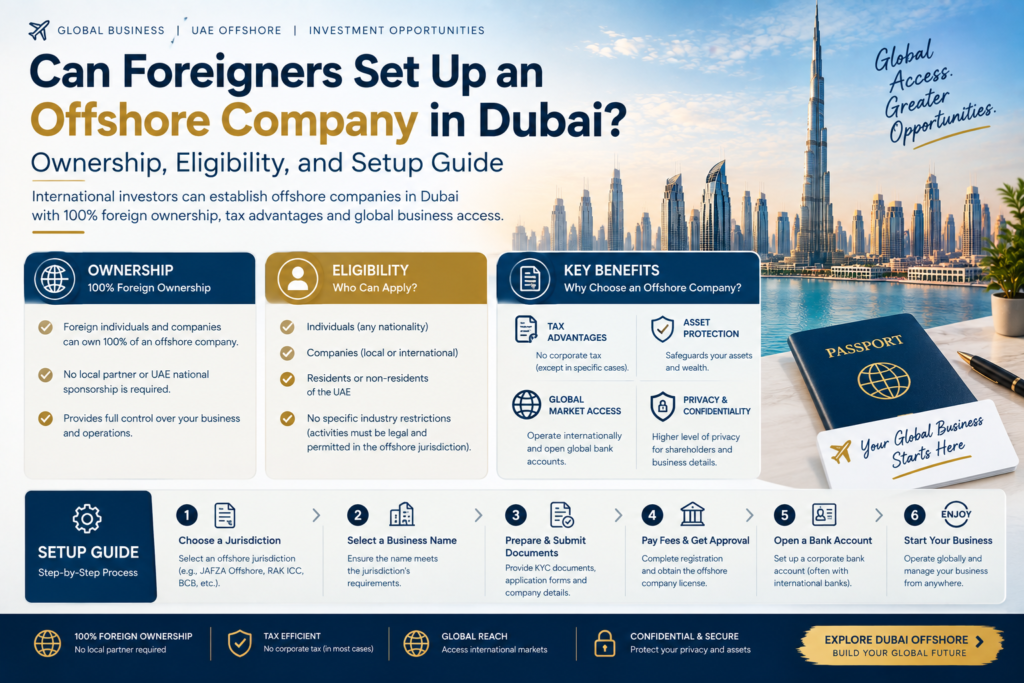
Foreign investors can own an offshore company in Dubai through applicable offshore jurisdictions. JAFZA’s official guidance confirms that an offshore company can have an individual shareholder, a corporate shareholder, or a combination of both.
This means an overseas entrepreneur does not necessarily need to have UAE nationality to become a shareholder.
Foreign ownership can be particularly relevant for:
- International entrepreneurs
- Overseas investors
- Holding companies
- Family wealth structures
- Investment vehicles
- Property-holding structures
- International businesses requiring a UAE-based corporate structure
However, ownership eligibility should not be confused with the right to conduct business within the UAE. Offshore companies have a different purpose from mainland and operating free zone companies.
What Is an Offshore Company in Dubai?
An offshore company is generally structured for activities such as holding investments, owning certain assets, international business structuring, and other permitted purposes rather than operating a conventional business from a UAE commercial location.
JAFZA identifies international trade, holding companies, real estate ownership, intellectual property holdings, and international consulting among potential uses for offshore structures.
An offshore company should therefore be selected based on the investor’s objectives rather than simply because it appears to be a lower-cost company formation option.
If the intention is to actively trade with customers inside the UAE, hire employees locally, operate an office, or provide regulated services in Dubai, an appropriately licensed mainland or free zone structure may be more suitable.
Eligibility Requirements for Foreign Investors
The eligibility requirements depend on the offshore jurisdiction and the shareholder structure.
For example, JAFZA requires an offshore company to have at least one shareholder, while shareholders can be individuals, companies, or both. A registered agent is also required for JAFZA offshore registration.
Foreign investors should generally be prepared to provide information relating to:
- Identity and passport details
- Shareholder information
- Directors and company officers
- Ultimate beneficial owners
- Source and nature of the proposed business or investment
- Corporate documents where the shareholder is another company
- Proof of address or other KYC information where required
The registrar may also request additional documents depending on the applicant and structure.
Documents Required for Foreigners
Documentation is one of the most important parts of establishing an offshore company.
For an individual applicant, JAFZA’s current guidance lists documents such as the founder’s details or CV, passport copy, specimen signature, and the relevant offshore application and constitutional documents.
For a corporate shareholder, requirements can be more extensive. They may include:
- Certificate of incorporation or formation
- Certificate of good standing
- Memorandum and Articles of Association
- Incumbency certificate
- Board resolution
- Power of attorney
- Passport and specimen signature of the authorised representative
Certain corporate documents may need notarisation and attestation depending on their origin and the relevant authority’s requirements.
Because requirements can vary, foreign investors should confirm the latest checklist before preparing or legalising documents.
Do Foreigners Need UAE Residency?
Foreign ownership and UAE residency are separate considerations.
A person can potentially be a shareholder of an offshore company without being a UAE citizen. The exact residency, director, officer, banking, and KYC requirements depend on the selected offshore jurisdiction and the intended structure.
This distinction is important because forming an offshore company does not automatically mean that the owner receives UAE residency.
If obtaining UAE residency is an important objective, the investor should consider whether an offshore company is actually the appropriate structure or whether another UAE company formation route would better match the requirement.
How to Set Up an Offshore Company in Dubai as a Foreigner
The formation process can vary depending on the chosen jurisdiction, but foreign investors can generally expect several key stages.
1. Define Your Business Objective
Start by identifying why the company is being established.
Your objective could involve:
- Holding investments
- Structuring international assets
- Holding eligible UAE property
- Establishing a holding company
- Managing international investments
- Supporting cross-border business arrangements
The purpose should guide the choice of jurisdiction and structure.
2. Choose the Appropriate Offshore Jurisdiction
The UAE has more than one option for corporate and offshore structuring.
RAK ICC, for example, provides corporate structuring solutions through registered agents and supports structures such as holding companies and investment vehicles. Its current formation process involves working with a registered agent, preparing the required documents, submitting the application, and obtaining the incorporation certificate.
JAFZA is another established option for offshore structures in Dubai.
The right choice depends on factors such as:
- Intended activities
- Asset ownership
- Banking requirements
- Corporate structure
- Compliance obligations
- Property objectives
- International tax considerations
- Long-term expansion plans
3. Prepare KYC and Corporate Documents
Foreign investors should prepare the required identification and corporate documents before submitting the application.
This is also where beneficial ownership information becomes important. JAFZA states that UBO information must be disclosed for its companies, including offshore entities.
4. Appoint a Registered Agent Where Required
Certain offshore jurisdictions require formation through an approved or registered agent.
For JAFZA offshore registration, applications and document submissions must be processed through JAFZA Registered Agents.
A registered agent can assist with preparing the application, communicating with the authority, and coordinating required documentation.
5. Submit the Application
Once the documents have been prepared, the application can be submitted through the applicable process.
JAFZA currently states a processing time of approximately 5 to 7 working days for a new offshore company, although actual timelines can depend on document completeness, verification, and additional requirements.
6. Complete Post-Formation Compliance
Formation is not the end of the process.
The company may have ongoing requirements involving:
- Annual renewals
- KYC updates
- Beneficial ownership information
- Corporate records
- Registered agent requirements
- Banking documentation
- Regulatory filings where applicable
Keeping corporate information current is particularly important when shareholders, directors, or beneficial owners change.
Can a Foreign-Owned Offshore Company Open a UAE Bank Account?
A foreign-owned offshore company may be able to apply for a UAE corporate bank account, subject to the bank’s internal compliance and KYC procedures.
However, company formation does not guarantee bank account approval.
Banks may assess:
- Shareholder background
- Ultimate beneficial ownership
- Source of funds
- Expected transaction activity
- Business model
- Countries involved in transactions
- Supporting contracts or invoices
- Financial history
- Tax residency and related information
Foreign investors should therefore treat banking as a separate stage of the overall setup process rather than assuming that incorporation automatically results in an approved bank account.
Can Foreigners Use an Offshore Company to Operate a Business in Dubai?
This is one of the most important distinctions to understand.
An offshore company is not the same as a licensed operating company.
JAFZA explains that an offshore company does not receive a conventional business licence and cannot conduct commercial activity with persons within the UAE under that structure.
Therefore, foreigners planning to establish a restaurant, consultancy, trading business, professional services firm, technology company, or other operating business in Dubai should evaluate a suitable mainland or free zone licence instead.
An offshore structure may still be useful as part of a wider corporate structure, but it should not automatically be treated as a replacement for an operating licence.
Can a Foreign-Owned Offshore Company Own Property?
Property ownership can be one of the reasons international investors consider offshore structures.
JAFZA’s offshore framework provides mechanisms relating to ownership of property in designated areas, subject to applicable UAE laws and requirements. JAFZA also provides an NOC process relating to property ownership.
However, investors should verify:
- Whether the specific property is eligible
- Whether the chosen offshore entity can hold it
- Required NOCs
- Land Department requirements
- Financing arrangements
- Tax implications
- Beneficial ownership disclosure
- Ongoing compliance obligations
Property ownership should therefore be assessed as part of the overall structure rather than as an automatic benefit of offshore incorporation.
Offshore Company vs Free Zone Company for Foreigners
Foreign investors often compare offshore and free zone structures because both can accommodate international ownership.
However, their purposes are different.
| Factor | Offshore Company | Free Zone Company |
|---|---|---|
| Foreign ownership | Generally available depending on jurisdiction | Generally available |
| Main purpose | Holding, structuring, international activities | Operating a licensed business |
| UAE commercial activity | Restricted | Possible under appropriate licence |
| Business licence | Structure-specific | Operating licence issued |
| Office requirements | Structure-specific | Usually linked to the chosen setup |
| Banking | Subject to bank approval | Subject to bank approval |
| Property holding | Possible in eligible circumstances | Possible depending on structure and regulations |
| UAE operations | Limited | More suitable |
| Best suited for | Holding and international structuring | Active businesses |
The correct choice depends on what the foreign investor actually wants to accomplish.
Common Mistakes Foreign Investors Should Avoid
Foreign entrepreneurs can encounter unnecessary delays when they choose a structure without fully understanding its limitations.
Some common mistakes include:
Choosing Offshore Simply Because It Is Cheaper
Lower setup or administration costs do not necessarily make an offshore company the right structure.
The company must serve the investor’s actual business objective.
Assuming Incorporation Guarantees Banking
Banks conduct their own due diligence. A certificate of incorporation does not guarantee that a bank will open an account.
Ignoring UBO Requirements
Foreign investors must understand beneficial ownership disclosure requirements and keep ownership information updated.
Using an Offshore Structure for UAE Trading
An offshore company should not be treated as a substitute for a UAE operating licence where commercial activities require one.
Focusing Only on Setup Costs
Investors should also consider annual renewal, registered agent, banking, compliance, accounting, tax, documentation, and professional advisory costs.
Why Professional Guidance Matters for Foreign Investors
International company formation often involves more than registering an entity.
Foreign investors may need to consider corporate structure, ownership, banking, asset protection objectives, property ownership, tax considerations, beneficial ownership, and ongoing compliance at the same time.
A professional advisor can help compare the available structures before incorporation rather than trying to correct an unsuitable structure later.
For investors exploring an offshore company in Dubai for foreigners, this planning stage can be particularly valuable because the most suitable structure depends heavily on the investor’s country of residence, source of funds, business activities, assets, and long-term objectives.
Final Thoughts
Foreign entrepreneurs can establish offshore structures in the UAE, but the process involves more than proving foreign ownership. Investors need to select the right jurisdiction, understand eligibility requirements, prepare the correct documentation, complete KYC and beneficial ownership procedures, and ensure that the structure is appropriate for its intended purpose.
An offshore company can be useful for international investors seeking holding, investment, asset, or corporate structuring solutions. However, it is not automatically suitable for running an operating business inside Dubai.
For anyone considering an offshore company in Dubai for foreigners, professional guidance can make the difference between simply forming a company and establishing a structure that supports long-term objectives. Dubai Business and Tax Advisors (DBTA) can assist investors in evaluating offshore structures, documentation, banking considerations, tax planning, and ongoing compliance based on their individual requirements