Losing a golf ball in a pond or muddy hazard is frustrating, especially when you can see it but cannot reach it. A good Golf Ball Retriever can save you from losing expensive balls and spending extra money on replacements. However, not every retriever works equally well in wet conditions.
The design of the retriever head makes a major difference in how quickly and securely you can recover a ball. Some designs scoop, others grab, while newer options use rolling mechanisms to grip the ball.
Understanding these differences can help golfers choose equipment that makes recovery easier, particularly when dealing with water, mud, and slippery surfaces.
Why Golf Ball Retriever Head Design Matters
A golf ball sitting on dry grass is relatively easy to collect. Recovering one underwater presents different challenges.
Water can distort the appearance of a submerged ball, making accurate positioning difficult. Mud can also prevent a retriever from getting underneath the ball.
The best head designs address these problems through better contact, gripping strength, and movement.
An effective retriever head should:
-
Hold wet golf balls securely without slipping.
-
Work in shallow water and muddy conditions.
-
Require minimal repositioning.
-
Provide reliable control at longer distances.
-
Make recovery possible without disturbing excessive mud.
These qualities are particularly important for golfers who frequently play courses with water hazards.
Common Golf Ball Retriever Head Designs
Several retriever designs are available, each offering different advantages depending on the recovery conditions.
1. Traditional Scoop Head Design
Scoop-style retrievers use a basket or curved opening to collect golf balls.
The golfer positions the scoop underneath the ball and lifts it from the water.
These designs can work well when balls are clearly visible and resting on firm surfaces.
However, problems may occur when the ball is partially buried in mud. Getting the scoop underneath it can require several attempts.
In murky water, this movement may also disturb sediment and reduce visibility.
2. Claw-Style Retriever Heads
Claw retrievers use gripping arms or spring-loaded components to hold golf balls.
They can provide a secure grip once the ball is positioned correctly.
However, some claw designs require accurate alignment to engage the ball. This can make recovery slower when visibility is poor or the ball rests at an awkward angle.
Their performance depends on the gripping mechanism, construction quality, and surrounding conditions.
3. Rolling Grip Retriever Heads
Rolling grip designs use movement and friction rather than traditional scooping.
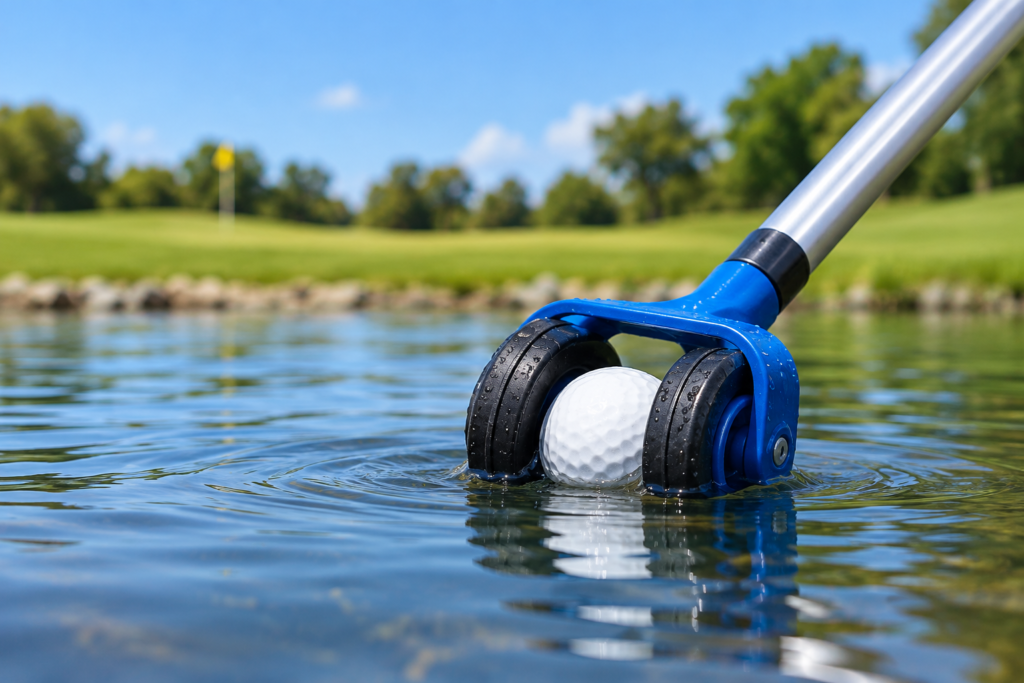
Instead of positioning a basket underneath the golf ball, the golfer rolls the retrieval head across it.
This approach can reduce the need for precise alignment and make retrieving balls from muddy areas easier.
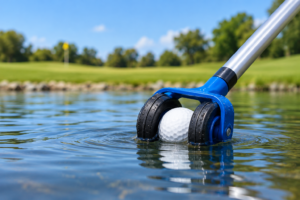
The Water Weasel Golf Ball Retriever uses two rotating discs with a rubber gripping insert. As the head rolls over a golf ball, the mechanism catches and holds it.
The manufacturer designed this system specifically for recovering balls from difficult locations, including water, sand, and mud.
Which Head Design Recovers Wet Golf Balls Fastest?
There is no independent comparative testing presented here that establishes one design as the fastest in every situation.
However, the way each head operates helps explain which designs may perform better under different conditions.
| Retriever Head | Best Conditions | Main Limitation |
|---|---|---|
| Scoop head | Clear, shallow water | Needs access beneath the ball |
| Claw head | Visible balls on firm ground | May require careful alignment |
| Rolling grip head | Muddy or murky water | Requires suitable rolling contact |
For wet balls that are difficult to see or partially embedded in mud, rolling grip mechanisms offer a practical advantage because they can engage the ball without a traditional scooping motion.
How Water Weasel Improves Wet Ball Recovery
The Water Weasel takes a different approach from many conventional golf course tools.
Its rolling-disc mechanism grips golf balls instead of relying on a scoop or basket.
Several features make it useful for golfers dealing with water hazards.
Rubber Gripping Mechanism
The rotating discs contain a rubber gripping system designed to secure balls as the head passes over them.
This helps reduce repeated attempts when a ball is difficult to position.
Extended Reach
The telescopic shaft extends up to 12 feet, allowing golfers to reach balls in ponds, shallow streams, and difficult areas without stepping into the water.
Multiple Ball Collection
According to Water Weasel, the retriever can collect up to four golf balls at once.
This feature can be especially useful when several balls are located close together.
Convenient Storage
The shaft collapses for storage in a golf bag, and the head is removable for travel or replacement.
These practical features make it worth considering among everyday golf bag accessories.
What to Check Before You Buy a Golf Retriever
Before purchasing a retriever, consider where you usually lose golf balls.
If your course has clear, shallow ponds, a simple scoop may meet your needs.
However, courses with muddy banks and murky hazards may require a more adaptable gripping mechanism.
When planning to buy golf retriever equipment, evaluate head durability, shaft length, overall weight, and storage convenience.
A gripping ball retriever should also hold the ball securely as it moves through water.
Choosing the right design can save time and reduce unnecessary frustration during a round.
Tips for Recovering Golf Balls from Muddy Water
Even an effective retriever requires proper technique.
Start by extending the shaft only as far as necessary. A shorter extension generally provides better control.
Position the head near the ball and avoid aggressive movements that stir up sediment.
For the Water Weasel, the manufacturer recommends gentle rolling on sand and slower rocking movements when a ball is stuck in mud.
Once the ball becomes loose, roll the head over it and lift steadily rather than pulling sharply.
Conclusion
The right Golf Ball Retriever head design can make wet ball recovery quicker and more convenient.
Traditional scoops work well in clear water, while claw designs provide another option for accessible balls. Rolling grip heads are especially promising for muddy conditions where conventional scooping becomes difficult.
For golfers looking for an alternative to traditional designs, the Water Weasel Golf Ball Retriever combines rotating discs, rubber gripping technology, and a telescopic shaft.
Choosing a retriever suited to your course conditions can help recover more lost balls and spend less time searching around water hazards.
Frequently Asked Questions
1. Which golf ball retriever head works best in muddy water?
Rolling grip retrievers can be particularly useful in muddy water because they grip balls through rolling contact instead of requiring a scoop underneath them.
2. Can a golf ball retriever pick up multiple balls?
Yes. Certain models, including the Water Weasel, are designed to collect up to four golf balls at once.
3. What is the ideal length for a golf ball retriever?
It depends on the location of the ball. A retriever extending up to 12 feet provides useful reach for many common water hazards.
4. Are gripping ball retrievers better than scoop retrievers?
Gripping designs may be more convenient in mud or murky water, while scoop retrievers can perform well on clear, firm surfaces.
5. Where can I buy a golf ball retriever for wet conditions?
You can explore rolling grip retrievers and product information at Water Weasel Retriever.