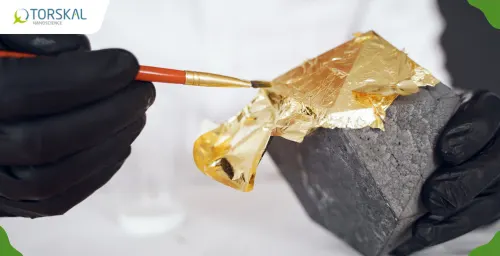
Science continues to change daily life in quiet but powerful ways. Many people see new medical tests and cleaner industrial processes. But they do not know the science behind them. One such science is “colloidal gold nanotechnology”. This already supports many modern industries. Researchers use tiny gold particles suspended in liquid to solve problems with precision and care. These particles may look simply. But they perform complex tasks across many different fields, like medicine and research.
Colloidal gold attracts attention because gold remains stable and safe. It is also easy to work with at very small sizes. Scientists control the size and shape of these particles to achieve specific results. This control lets gold at the nanoscale behave differently from bulk gold. Today, many laboratories and industries rely on this technology for accuracy and safety.
Colloidal gold nanotechnology in modern medical science
Colloidal gold nanotechnology supports many medical and healthcare applications. It also supports accurate testing and targeted research. Additionally, it helps with advanced therapy development across medical fields.
Medical researchers use gold nanoparticles in diagnostic tests. This is because they give clear and fast visual results. Pregnancy test kits and rapid disease tests rely on colour changes caused by gold particles. These colour signals help doctors and patients receive results without complex equipment.
Cancer research also benefits from this gold. Scientists attach these particles to specific molecules. These recognise cancer cells. This approach helps in focused study. It helps with controlled treatment development. Researchers check gold-based systems for heat-based therapy. They also use it for drug targeting in controlled settings.
These particles also support imaging studies. Medical teams track these particles inside the body during research trials. This tracking helps scientists study disease progression. It also helps with treatment response with clarity.
Diagnostic testing and research
Laboratories rely on this gold for daily testing. These particles improve sensitivity. They also improve accuracy in biological tests.
Researchers detect viruses and bacteria with their help. They also detect proteins using gold-based markers.
These particles bind easily with antibodies and proteins. This binding creates reliable testing platforms for medical research and clinical studies. Scientists prefer gold due to its stability and predictable behaviour. Research centres also use different particle sizes for different tasks. They help with controlled interaction with biological samples. This flexibility makes these particles valuable for many experimental designs.
Cancer research and therapy development
This remains one of the most active fields using colloidal gold. Scientists use these particles for targeted therapy research. Gold absorbs light efficiently and converts it into heat. This property supports research into tumour-focused heat treatments under controlled conditions.
Researchers also study these particles as carriers for medicines. Gold helps transport drugs directly to targeted cells during laboratory trials. This approach reduces damage to healthy cells during experimental studies. Green nanotechnology plays an important role in this field. Scientists focus on eco-friendly synthesis methods to reduce chemical waste and environmental harm. Ethical and sustainable research practices continue to help in this work.
Electronics and technology manufacturing
This industry requires precision at the microscopic level.
Colloidal gold supports the production of sensors and circuits. It also helps in the production of conductive components. Gold conducts electricity efficiently and resists corrosion. Manufacturers use gold nanoparticles in printed electronics and flexible circuits. These applications support lightweight and compact device designs. Wearable technology and medical sensors benefit greatly from this approach.
Gold nanoparticles also improve signal accuracy in sensors. Chemical detectors and medical devices rely on gold for stable performance.
Environmental monitoring and water testing
The scientists use this gold for monitoring pollution and water quality.
Gold-based sensors detect toxins and heavy metals. They can also find harmful chemicals in water sources. These sensors give fast and accurate readings. Field researchers prefer portable testing tools that use these particles. These tools help with testing in remote locations without heavy equipment. Accurate data helps communities protect natural resources. It also supports studies related to air quality and soil contamination. Researchers design sensitive detection platforms using these particles for environmental safety monitoring.
Food safety and quality testing
These require fast and reliable detection of contaminants. Colloidal gold supports this need through “sensor-based testing kits”. These kits identify bacteria. They also help find toxins and allergens with high sensitivity. Gold-based tests help with rapid screening without complex equipment. Food producers and safety authorities value this speed and accuracy. This technology supports safer supply chains and consumer confidence.
Drug delivery research platforms
Pharmaceutical research uses these particles to study “controlled drug delivery systems”. Scientists design gold particles that carry drug molecules and release them under specific conditions. Gold helps with precise surface modification. Researchers attach molecules that interact with targeted cells. This interaction supports focused study of medicine behaviour within biological systems.
Colloidal gold remains valuable due to its non-toxic nature during controlled laboratory research. Scientists trust gold for repeated experiments and long-term studies.
Biotechnology and life science research
These labs rely heavily on colloidal gold. Scientists use these particles for protein labelling. In addition, they used it in DNA studies and cellular research. Gold helps visualise biological processes under microscopes.
These particles improve contrast in imaging techniques. This clarity helps with better observation of cellular activity and molecular interactions. Life science researchers also value gold for reproducibility. Consistent particle size and stability support experimental outcomes across multiple studies.
Industrial quality control and materials science
Industries use gold to test material strength. It is also used to check durability and chemical reactions. These particles support “surface analysis and material coating studies”. Manufacturers study material behaviour using gold-based markers. These studies improve product safety and durability. Materials science also checks for gold nanostructures such as nanoflowers and spherical nanoparticles. These shapes give different surface properties and interaction patterns.
Cosmetic and skincare research
This science uses this gold for formulation research. These particles support studies related to “skin interaction and stability”. It is also used to study product longevity. Researchers test gold-based ingredients for controlled absorption and visual enhancement. Gold also adds a premium perception to skincare research products. Laboratory teams focus on safety. They also check for purity and particle size during cosmetic research. “Ethical testing standards” help in this work.
Education and academic research
Universities and research institutions use this gold in teaching and experimentation.
Students study nanoscience concepts using these particles. This is due to their visible properties and safe handling. These particles help demonstrate particle size effects and optical behaviour. It also helps to show chemical interactions. These demonstrations support hands-on learning.
Academic research continues to look for new uses of this gold across disciplines. Collaborative projects help with innovation.
Conclusion
Colloidal gold plays a vital role across many industries today. It has stability and safety. It is also known for its flexibility. This makes it valuable for different fields and industries. Scientists rely on its predictable behaviour to develop accurate tests and advanced therapies. It is used to develop innovative technologies.
Colloidal gold nanotechnology continues to grow as research expands. Sustainable synthesis and ethical research help with its future development. This technology already supports daily life in unseen ways. It promises further progress through responsible innovation.
If you have a requirement for these particles, you can contact us at Torskal.
FAQs
Does colloidal gold require special storage conditions?
It needs stable temperature control. It also needs protection from contamination during storage.
Does particle size affect laboratory results?
Yes. It influences interaction and visibility. It also affects performance in scientific experiments.
Does colloidal gold remain stable over time?
High-quality colloidal gold remains stable when produced and stored under proper conditions.
Does gold nanotechnology support green science goals?
Yes. Green synthesis methods reduce chemical waste and environmental impact.
Does colloidal gold support customised research needs?
Yes. Scientists customise size and shape. They also customise surface properties for specific applications.