Rugged Tablets Distributors
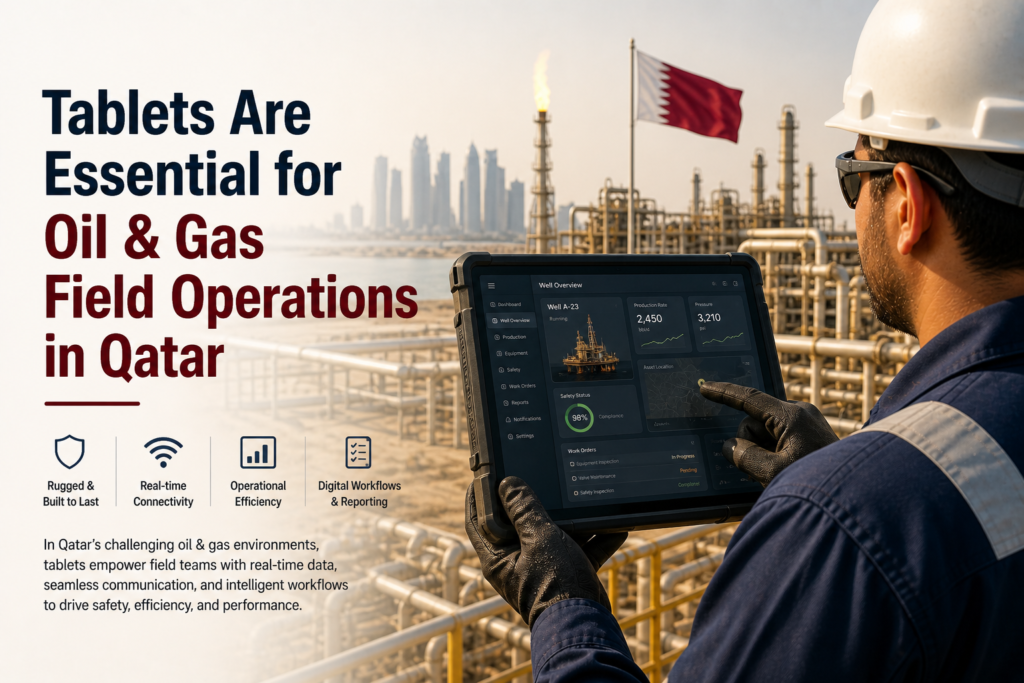
Qatar’s oil and gas sector is the economic engine of one of the wealthiest nations in the world — and it operates in conditions that destroy standard technology faster than procurement teams can replace it. Offshore platforms in the Arabian Gulf expose electronics to salt-laden air, high humidity, and temperature extremes that corrode and disable commercial devices within weeks. Onshore processing facilities in Qatar’s desert interior subject field equipment to silica dust penetration, vibration from heavy plant, and ambient temperatures that push standard devices well beyond their operating specifications before midday. For the engineers, inspectors, maintenance technicians, and operations supervisors who run Qatar’s upstream and downstream energy infrastructure, working with unreliable technology is not simply frustrating — it is a safety risk, a compliance liability, and a direct operational cost. Rugged tablets have become the field mobility standard for Qatar’s oil and gas sector precisely because they are the only mobile computing devices built to survive where the work actually happens.
What are Rugged Tablets?
Rugged tablets are purpose-engineered mobile computing devices designed and independently certified to operate reliably in harsh physical environments — including extreme temperatures, high humidity, heavy dust, water exposure, vibration, and drop impact — that would disable standard commercial tablets within days or weeks of deployment in an oil and gas field setting.
The engineering distinction between a rugged tablet and a consumer tablet marketed as “durable” is not cosmetic. Rugged tablets are built from the ground up with reinforced chassis structures, sealed connector ports, chemically bonded display assemblies, and internal component mounting systems designed to absorb vibration and impact forces that would fracture standard circuit board assemblies. They are certified against internationally recognised standards — primarily MIL-STD-810H for environmental and shock resistance and IP65 to IP68 for dust and liquid ingress protection — through independent testing laboratories that verify real-world performance rather than manufacturer claims. In Qatar’s oil and gas sector, where equipment failure on an active production platform or in a desert processing facility carries consequences measured in safety risk and production downtime, the difference between certified rugged performance and commercial durability marketing is the difference between a device that supports field operations and one that becomes a recurring procurement liability.
Key Features & Benefits
Rugged tablets deliver a set of hardware and operational capabilities specifically aligned with the demands of Qatar’s oil and gas field environments:
- MIL-STD-810H Multi-Stress Certification: Independently tested and certified across multiple environmental stress categories — including high temperature, thermal shock, humidity, altitude, vibration, shock, and sand and dust exposure — rugged tablets carry documented performance evidence that their hardware will function across the full environmental stress profile encountered in Qatar’s offshore platforms, desert processing facilities, and onshore field operations without the performance degradation and failure rates that commercial tablets exhibit in identical conditions.
- ATEX and IECEx Hazardous Area Certification: Qatar’s oil and gas processing environments include areas classified as potentially explosive atmospheres under ATEX and IECEx standards — zones where the presence of flammable gases, vapours, or dust creates ignition risks that prohibit the use of uncertified electrical equipment. Rugged tablets certified for hazardous area use carry ATEX Zone 2 or Zone 1 certification that permits their deployment in Qatar’s classified production areas where standard and non-certified rugged devices are prohibited by HSE regulations and permit-to-work requirements.
- Sunlight-Readable High-Brightness Displays: Qatar’s midday sun renders standard tablet screens completely unreadable outdoors — a fundamental field usability failure for inspectors and technicians who need to reference technical documentation, complete digital inspection forms, and access plant management systems while working at outdoor field locations. Rugged tablets engineered for outdoor use incorporate high-brightness displays — typically 800 to 1200 nits — with anti-reflective surface treatments that maintain full screen readability in direct sunlight without manual shading or workarounds.
- Glove-Compatible Multi-Touch Operation: Oil and gas field workers operate in PPE environments where chemical-resistant, cut-resistant, or thermal gloves are mandatory for safety compliance. Standard capacitive touchscreens become completely unresponsive to gloved touch — forcing the glove removal that PPE protocols prohibit or that creates skin contamination risks in chemical handling environments. Rugged tablets incorporate enhanced touch sensitivity designed to register gloved-hand input reliably, maintaining both operational continuity and PPE compliance simultaneously.
- Long-Duration Battery with Hot-Swap Capability: Field operations in Qatar’s energy sector frequently involve extended work periods at locations remote from charging infrastructure — offshore platform decks, remote wellhead sites, and desert pipeline routes where a dead battery means a lost workday. Rugged tablets are specified with extended battery capacities designed to sustain full operational use across complete field shifts, and the most operationally capable models support hot-swap battery replacement — swapping a depleted battery for a charged one without powering down the device or losing unsaved field data.
Industrial Applications
Rugged tablets serve the complete range of field mobility requirements across Qatar’s upstream, midstream, and downstream oil and gas sector operations:
- Production Platform Inspection and Integrity Management deploying rugged tablets as the primary field data capture interface for structural inspection programmes, equipment integrity assessments, corrosion monitoring surveys, and preventive maintenance rounds on Qatar’s offshore and onshore production platforms — where the combination of marine environment exposure, explosion zone adjacency, and the precision data capture requirements of integrity management programmes make ATEX-certified rugged tablets the only compliant and practical field technology solution
- Pipeline and Transmission Infrastructure Maintenance equipping pipeline inspection teams, cathodic protection surveyors, and right-of-way maintenance crews with rugged tablets that carry georeferenced pipeline GIS data, inspection record access, and field data capture capability across Qatar’s extensive onshore pipeline network — environments where desert heat, sand exposure, and remote location create the full range of environmental stresses that rugged certification addresses
- Permit-to-Work and HSE Management in Field Operations using rugged tablets as the primary interface for digital permit-to-work systems, toolbox talk documentation, incident reporting, and HSE observation recording in Qatar’s oil and gas field environments — where paper-based processes are being systematically replaced by digital workflows that require devices capable of operating in the same conditions as the field personnel using them
- Asset Management and Computerised Maintenance Management providing maintenance technicians and reliability engineers with rugged tablets that connect to CMMS platforms — SAP PM, IBM Maximo, and similar systems — for work order management, equipment history access, spare parts lookup, and maintenance completion documentation in field environments where the plant equipment being maintained imposes the same environmental stresses on the field device as it imposes on the plant itself
- Process Control and SCADA Field Access equipping process operators and control room technicians with rugged tablets that provide secure remote access to SCADA system HMI interfaces, process historian data, and alarm management dashboards from field locations — supporting the safe, informed operational decision-making that process management in Qatar’s complex petrochemical and LNG processing facilities requires
- Training and Competency Assessment in Field Environments deploying rugged tablets as the delivery platform for on-the-job training programmes, competency assessment tools, and digital standard operating procedure libraries that field personnel access at the point of work — embedding technical knowledge delivery into the field environment rather than requiring personnel to travel to training facilities for information that is most relevant when accessed at the worksite
How to Choose the Right One
Selecting the correct rugged tablet for your Qatar oil and gas field operation requires a structured evaluation that addresses environmental certification, operational requirements, and the supply and support infrastructure your deployment scale demands:
- Establish ATEX Certification Requirements for Each Deployment Zone: Qatar’s oil and gas facilities include multiple area classifications — from non-hazardous administrative areas through Zone 2 and Zone 1 potentially explosive atmospheres — and the permit-to-work and HSE requirements for each zone determine the device certification that is legally and operationally required. Map your deployment locations against the facility area classification drawings before specifying any rugged tablet model. A device without the appropriate ATEX certification cannot legally operate in classified zones regardless of its other rugged credentials.
- Specify Operating Temperature Range Against Qatar’s Actual Field Conditions: Qatar’s ambient temperatures in summer regularly exceed 45 degrees Celsius, and surface temperatures on sun-exposed platform decks or desert ground can reach 60 to 70 degrees Celsius. Confirm that the rugged tablet’s operating temperature specification — not just its storage temperature rating — covers the actual temperature conditions of your deployment environment. Operating temperature ceiling is a frequently understated specification that produces field failures in Qatar’s summer conditions when devices are specified against manufacturer headline figures rather than verified operating range data.
- Assess Connectivity Requirements for Offshore and Remote Locations: Qatar’s offshore platforms and remote onshore sites vary significantly in their wireless connectivity provision — from facilities with comprehensive private LTE or 4G coverage to locations relying on satellite connectivity or WiFi-only local area networks. Confirm that the rugged tablet’s connectivity module set — 4G/5G, WiFi 6, Bluetooth, GPS, and satellite modem compatibility — matches the connectivity infrastructure available at your specific deployment locations.
- Evaluate Integration with Your Field Mobility Software Platform: A rugged tablet is only as valuable as the field applications it runs. Confirm that the device’s operating system, processor architecture, and screen resolution are compatible with your CMMS, permit-to-work, GIS, and inspection management software platforms before finalising hardware specification. Application vendor hardware compatibility lists and validation testing are essential steps in rugged tablet procurement for enterprise field mobility programmes.
- Confirm Distributor In-Country Support for Deployment Scale: Rugged tablet deployments in Qatar’s oil and gas sector typically involve dozens to hundreds of devices across multiple sites — a scale that requires a distributor who can provide pre-deployment device configuration, staged rollout support, in-country warranty repair or rapid replacement, and ongoing fleet management services. The operational risk of relying on international warranty support for field-critical devices in Qatar’s energy sector is disproportionate — confirm local support capability as a primary procurement criterion alongside device technical specification.
Why Quality Matters
In oil and gas field operations, device quality is inseparable from operational safety. A rugged tablet that fails mid-inspection on an offshore platform does not simply inconvenience the inspector — it creates a documentation gap in an integrity management programme that regulators and operators depend on for production safety assurance. A permit-to-work system that becomes inaccessible because a field device has failed in an explosive atmosphere zone creates a work authorisation gap that HSE regulations require to be resolved before work can continue — stopping production activities at direct operational cost.
The quality of rugged certification is particularly critical in this context. A tablet marketed as rugged but tested only against simplified drop tests and basic splash resistance — rather than the full MIL-STD-810H test matrix and ATEX certification programme — will produce failure rates in Qatar’s oil and gas field environments that its marketing materials do not predict. Certification rigour is not a procurement formality — it is the evidence that the device will perform in the conditions your field operations actually impose on it, rather than the conditions the manufacturer selected to test it against.
For Qatar’s oil and gas operators, whose operational excellence, safety performance, and regulatory compliance records all depend on the reliability of the field technology supporting them, rugged tablet quality is a risk management decision — and procuring through authorised distributors who can provide genuine certification documentation, product provenance evidence, and in-country support is the procurement approach that manages that risk appropriately.
Conclusion
Qatar’s oil and gas sector demands field technology that matches the environment where the work happens — and rugged tablets certified to the environmental, hazardous area, and operational standards that Qatar’s energy field conditions require are the mobile computing foundation on which the sector’s digital field operations are being built. From offshore platform integrity inspection and pipeline maintenance to permit-to-work management and SCADA field access, the operational use cases that rugged tablets enable in Qatar’s energy sector are those where device reliability is directly connected to safety performance, regulatory compliance, and production continuity. For procurement managers, HSE teams, and field operations directors ready to specify or upgrade their field mobility technology, you can explore certified rugged tablet options and connect with an authorised Rugged Tablets distributor at Rugged Tablets to find the right device specification, ATEX certification, and in-country support arrangement for your organisation’s oil and gas field operation requirements.
Meta Description: