Packaging has become an important part of how products are presented, protected, and experienced. For retailers and brands, the right packaging needs to balance visual appeal, functionality, durability, and practical handling. Among the many packaging formats available today, pillow boxes offer a distinctive shape that can work across a wide range of retail and gifting applications.
While smaller pillow-shaped cartons are commonly associated with jewellery, confectionery, and small gifts, large pillow boxes provide additional space for products that require more room without losing the recognisable curved-edge appearance. Their adaptable structure makes them relevant to modern retail, promotional packaging, seasonal products, apparel accessories, cosmetics, and gift collections.
Understanding how these boxes work, which materials are suitable, and how they should be designed can help businesses make more informed packaging decisions.
What Are Pillow Boxes?
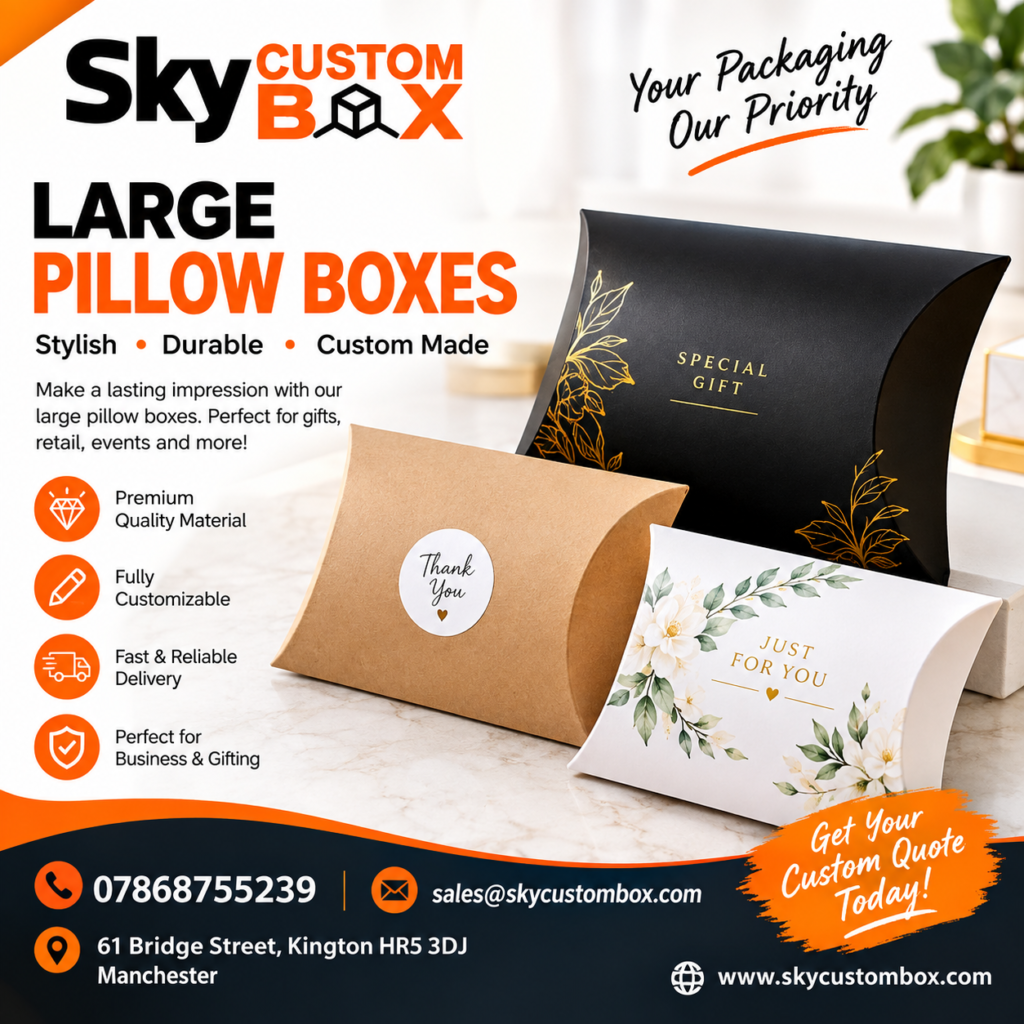
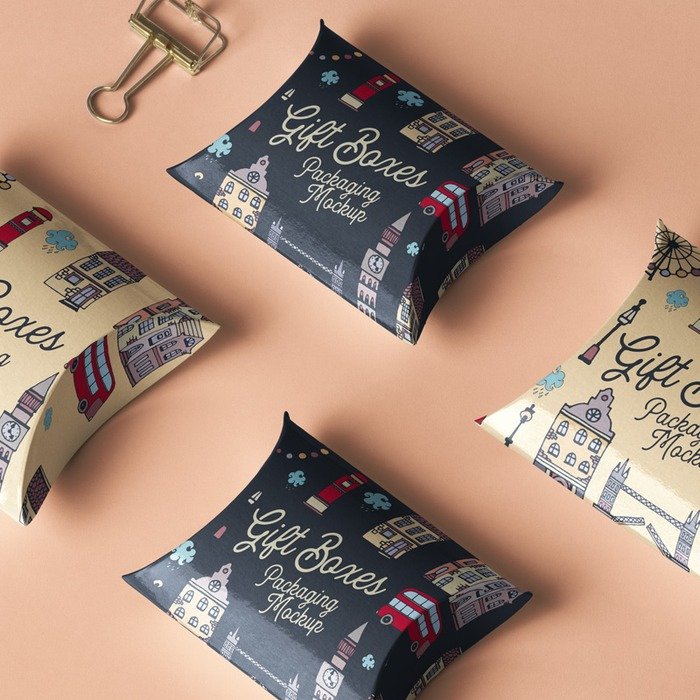
Pillow boxes are folding cartons named for their curved, pillow-like shape. Unlike conventional rectangular cartons, their distinctive silhouette creates a different visual experience when displayed on a shelf, counter, or gift table.
The basic construction usually consists of a die-cut sheet that is folded along predetermined creases. Curved end panels fold inward and lock the box into its characteristic shape. Depending on the product and intended use, the packaging may include additional inserts, windows, handles, or custom printed surfaces.
Typical applications include:
- Gift packaging
- Clothing accessories
- Cosmetics and personal-care products
- Candles and small homeware
- Chocolates and confectionery
- Promotional merchandise
- Wedding and event favours
- Retail accessories
- Seasonal gift collections
The format can also be adapted in different dimensions, making it suitable for products that need more internal volume.
Why Large Pillow Boxes Are Becoming More Useful
Modern packaging design increasingly focuses on combining practical performance with distinctive presentation. Standard rectangular cartons remain widely used, but alternative structures can help products create visual differentiation.
Large pillow boxes can be particularly useful when a product needs additional internal space while maintaining a compact external footprint. Their curved profile can make a package appear less rigid and more gift-oriented than conventional folding cartons.
Several factors contribute to their usefulness.
Distinctive Shelf Presentation
Packaging competes for attention in physical retail environments. Shape is one of the quickest visual signals a customer notices.
A pillow-shaped carton can provide differentiation without requiring excessive decorative elements. A carefully designed structure, combined with appropriate typography and restrained graphics, can create a recognisable package while maintaining a professional appearance.
Flexible Product Applications
Larger dimensions allow the format to accommodate a broader range of products. Depending on the construction and material thickness, they can be considered for items such as scarves, accessories, gift sets, promotional products, lightweight clothing items, and selected homeware products.
The important consideration is not simply whether an item fits inside the box. The packaging should also provide enough clearance to prevent unnecessary compression while keeping the product stable during handling.
Suitable for Gifting
The curved silhouette naturally lends itself to gift-oriented applications. Retailers can use the structure for seasonal collections, celebrations, wedding products, corporate gifts, and special-edition packaging.
Adding tissue paper, inserts, ribbons, sleeves, or internal compartments can further improve the presentation while helping prevent movement inside the carton.
Choosing Materials for Large Pillow Boxes
Material selection has a direct effect on packaging performance. A box designed for a lightweight product may require very different board characteristics from one intended to hold a heavier retail item.
Common material considerations include:
- Folding carton board: Suitable for many lightweight and medium-weight products.
- Kraft board: Often selected for a natural appearance and brands focused on a minimalist aesthetic.
- Recycled board: Can support packaging strategies that incorporate recycled fibre content.
- Rigid board: Provides greater structural strength for premium or heavier applications.
- Corrugated materials: May be appropriate when additional protection is required during transportation.
Material thickness should be evaluated alongside the box dimensions. Increasing the size of a carton without considering board strength can result in unwanted bending, deformation, or poor stacking performance.
For businesses developing packaging at scale, sample testing is therefore an important stage before committing to a large production run.
Design Considerations for Modern Retail Packaging
Good packaging design is not simply about adding graphics to a box. The structure, branding, information hierarchy, opening experience, and manufacturing requirements all need to work together.
1. Consider the Product First
Start with the product’s dimensions, weight, fragility, and presentation requirements. Measure the product carefully and allow appropriate internal clearance.
If the product moves excessively inside the carton, consider an insert or internal support. For fragile items, structural protection should take priority over appearance.
2. Keep the Information Hierarchy Clear
Packaging surfaces are limited, particularly when a curved structure is involved. Important information should therefore be prioritised.
A typical hierarchy might include:
- Brand name or logo
- Product name
- Key product information
- Supporting details
- Regulatory or handling information where applicable
Too much text can make packaging difficult to understand at a glance.
3. Think About Opening and Closing
The customer experience begins before the product is removed from the box. A carton should be easy enough to open without damaging the packaging or the product.
At the same time, the closure needs to remain secure during ordinary handling. Testing the folding mechanism with physical samples can identify weaknesses that may not be obvious in a digital design file.
4. Consider Printing and Finishing
Different printing and finishing methods can significantly change the appearance of a carton.
Potential options include:
- Matte or gloss finishes
- Foil details
- Embossing or debossing
- Spot finishes
- Die-cut windows
- Custom printed interiors
- Minimalist one-colour designs
The right choice depends on the brand identity, product category, budget, and intended customer experience.
Common Challenges and Practical Solutions
Large-format packaging can introduce several challenges that businesses should address during development.
Challenge: Structural Weakness
Larger boxes have more surface area, which can increase the possibility of bending or distortion.
Solution: Select an appropriate board thickness and test assembled samples under realistic conditions.
Challenge: Product Movement
Extra internal space can cause products to shift during transportation.
Solution: Use appropriately sized dimensions, inserts, tissue, or other internal protection where necessary.
Challenge: Inefficient Storage
Unassembled cartons are generally easier to store than fully assembled packaging, but businesses still need to consider storage volume and production schedules.
Solution: Plan packaging quantities around available storage capacity and expected product demand.
Challenge: Shipping Damage
Retail packaging may look attractive but still require protection during distribution.
Solution: Evaluate the complete packaging system, including the inner carton, protective materials, shipping carton, and handling conditions.
Challenge: Excessive Design Complexity
Complicated structures and numerous finishing techniques can increase manufacturing difficulty.
Solution: Establish which design elements genuinely contribute to the product experience and remove unnecessary complexity.
Sustainability and Packaging Decisions
Environmental considerations are increasingly relevant to packaging development. However, sustainability should be evaluated across the entire packaging lifecycle rather than through a single material claim.
Businesses can consider factors such as:
- Recycled fibre content
- Responsible material sourcing
- Appropriate package sizing
- Avoidance of unnecessary components
- Recyclability after use
- Efficient transportation
- Reduced empty space
- Durable construction that protects the product
Right-sizing can be particularly useful. Oversized packaging may consume more material and occupy more transportation space than necessary, while undersized packaging can compromise product protection.
Packaging suppliers such as Sky Custom Box can be considered during the development process when businesses need to explore different carton structures, dimensions, materials, and printing requirements.
The key is to match the packaging format to the actual product rather than selecting a structure solely because it looks attractive.
Applications Across Retail and Gifting
The versatility of pillow-shaped cartons makes them relevant to several sectors.
In beauty and cosmetics, larger cartons can accommodate curated product sets or multiple items presented together.
In fashion and accessories, they can provide packaging for lightweight accessories and giftable retail products.
For events and weddings, customised cartons can be used for favours, keepsakes, or presentation boxes.
In corporate gifting, custom printed packaging can help organise multiple products into a coordinated presentation.
For seasonal retail, the format can also be adapted with limited-edition artwork without requiring a completely different structural concept.
The important factor is matching the box dimensions and internal construction to the product’s specific requirements.
Final Thoughts
Modern packaging needs to perform several jobs at once: protect the product, communicate information, support brand identity, and create a practical customer experience. Pillow boxes offer an alternative to conventional rectangular cartons, while larger versions can provide additional capacity for retail and gifting applications.
Before selecting a packaging structure, businesses should consider product dimensions, board strength, internal protection, printing requirements, storage, transportation, and end-of-life considerations. Physical sampling is especially valuable because it allows designers and manufacturers to identify structural issues before production.
Ultimately, successful packaging is not determined by appearance alone. The most effective solution is one that combines appropriate materials, functional construction, clear communication, efficient logistics, and a design that suits the product and its audience.
Read More: