Explore how agricultural equipment manufacturers in India support modern farming with reliable machinery, efficient solutions, and dependable after-sales support.
Agriculture remains one of the most important sectors of the Indian economy, and the growing need for efficiency has increased the adoption of modern farm machinery. From soil preparation and weed control to crop harvesting and spraying, agricultural equipment can help farmers save time, reduce manual labour, and improve productivity.
With the increasing demand for farm mechanisation, several agricultural equipment manufacturers in India are developing machines designed for different crops, field conditions, and farming requirements. However, selecting the right equipment requires more than simply comparing prices. Farmers need to consider machine performance, durability, maintenance, availability of spare parts, ease of operation, and after-sales support.
Understanding these factors can help farmers and agricultural businesses make better decisions when investing in farm machinery.
The Growing Importance of Agricultural Equipment in India
Indian farming includes a wide variety of crops, soil types, and cultivation methods. Small and marginal farmers may have different machinery requirements compared with large agricultural operations or commercial farming businesses.
Modern agricultural equipment can help address several common challenges. Mechanised equipment can reduce the amount of physical labour required for repetitive tasks while allowing farmers to complete important operations within suitable agricultural timelines.
Equipment such as power weeders, sprayers, reapers, and agricultural engines can support different stages of farming. The right machinery can also contribute to consistent field operations when used correctly and maintained according to manufacturer recommendations.
As labour availability and farming costs continue to influence agricultural decisions, machinery has become an increasingly practical part of modern farming.
Types of Agricultural Equipment Used by Farmers
The requirements of every farm are different, so manufacturers offer a wide range of agricultural machinery. Some commonly used categories include:
Power Weeders
Power weeders are designed to assist with weed management and soil cultivation in agricultural fields, gardens, orchards, and other applications. They can be particularly useful where manual weed removal would require considerable time and effort.
Agricultural Sprayers
Sprayers help farmers apply pesticides, herbicides, fungicides, fertilisers, and other agricultural treatments. Selecting an appropriate sprayer can help achieve more uniform application while reducing unnecessary product wastage.
Reapers and Harvesting Equipment
Harvesting is a time-sensitive stage of crop production. Reapers and related machinery can help reduce the manual effort involved in harvesting certain crops and allow farmers to complete harvesting operations more efficiently.
Agricultural Engines
Engines are an important component of many types of agricultural equipment. Depending on the application, suitable engines can provide the power required for various farming and machinery operations.
Other Farm Machinery
Beyond these categories, agricultural equipment manufacturers may offer machinery and accessories designed for cultivation, irrigation, crop maintenance, harvesting, and other agricultural applications.
What to Consider When Choosing Agricultural Equipment Manufacturers in India
With numerous suppliers and manufacturers available, choosing the right company can sometimes be challenging. Farmers and dealers should evaluate several factors before purchasing machinery.
1. Product Quality
The equipment should be manufactured using appropriate materials and engineering standards for its intended application. Strong construction and dependable components can contribute to longer service life when the machine is operated and maintained correctly.
2. Performance and Efficiency
Farm machinery should be suitable for the intended agricultural task. Buyers should consider factors such as operating capacity, fuel consumption, ease of handling, and compatibility with their farming conditions.
3. Ease of Operation
Agricultural equipment should ideally be practical and straightforward to operate. Clear controls and an appropriate design can make machinery easier for farmers and operators to use effectively.
4. Maintenance and Spare Parts
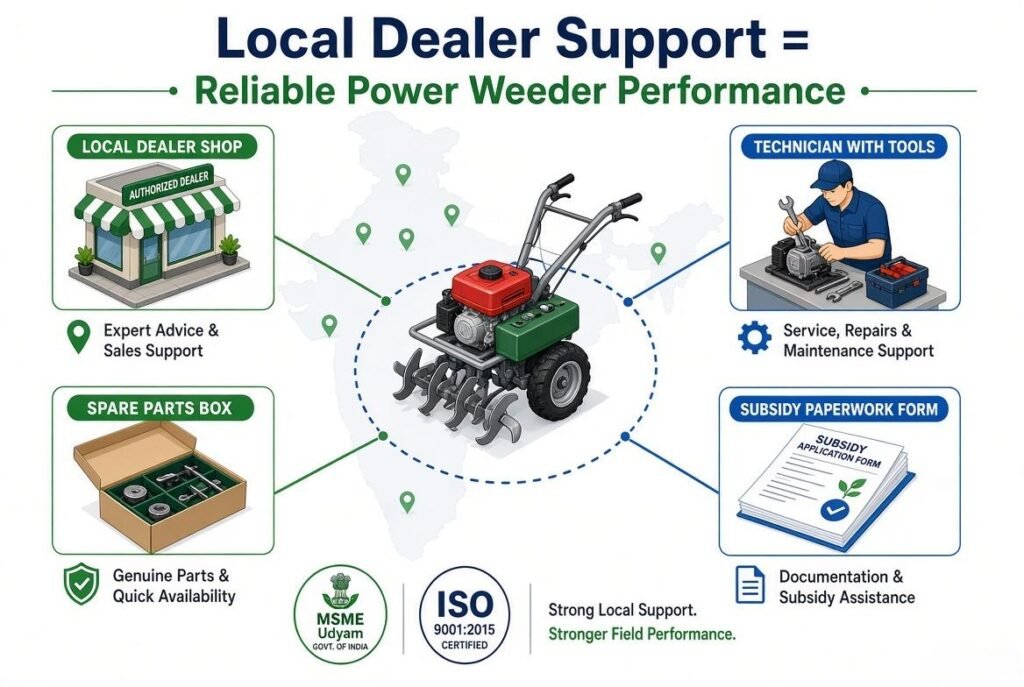
Regular maintenance is essential for agricultural machinery. Before purchasing equipment, buyers should check whether replacement parts, servicing, and technical assistance are readily available.
5. After-Sales Support
Good after-sales service can be an important factor in the overall ownership experience. A manufacturer or supplier that provides technical guidance, service support, and access to spare parts can help customers maintain their equipment over time.
6. Suitability for Indian Farming Conditions
Agricultural machinery used in India needs to accommodate diverse farming environments. Buyers should select equipment based on their crop type, field size, soil conditions, terrain, and specific operational requirements.
Why Local Manufacturing and Support Matter
India’s agricultural landscape is highly diverse. Machinery that works effectively in one region or farming application may not necessarily be the ideal choice for another. This makes product suitability and local support particularly important.
Working with an established Indian manufacturer can provide advantages such as easier access to spare parts, technical assistance, product information, and regional distribution networks.
For farmers, dependable support can be just as important as the initial purchase. Agricultural equipment is often used during specific cultivation and harvesting periods, so unnecessary downtime can affect farm operations.
Royal Kissan: Supporting Agricultural Mechanisation in India
Royal Kissan is an Indian agricultural machinery manufacturer focused on providing equipment for modern farming requirements. Its product range includes power weeders, agricultural sprayers, engines, reapers, and other agricultural machinery.
The company aims to provide practical equipment solutions while supporting customers through its Pan-India supply and support network. By offering different categories of agricultural machinery, Royal Kissan serves the requirements of farmers, agricultural businesses, and equipment dealers looking for dependable farming solutions.
For buyers comparing agricultural equipment manufacturers in India, factors such as product range, machine quality, availability, technical assistance, and after-sales support can help determine whether a manufacturer is suitable for their particular requirements.
The Role of Technology in Indian Farm Mechanisation
Agricultural machinery continues to evolve as farmers look for more efficient ways to manage their operations. Improvements in machine design, engine technology, ergonomics, and equipment functionality are contributing to the wider adoption of mechanisation.
Technology can help farmers perform repetitive operations more efficiently while potentially reducing dependence on manual labour. However, technology should always be selected according to practical farming needs rather than simply choosing the most advanced equipment available.
The most suitable machinery is generally the equipment that matches the farm’s operational requirements, budget, crop, and available support.
Making a Smart Agricultural Machinery Investment
Before purchasing farm equipment, farmers can prepare a simple checklist. They should identify the specific agricultural task the machine needs to perform, estimate how frequently it will be used, and compare relevant specifications.
It is also useful to understand operating and maintenance requirements, warranty terms, spare-parts availability, and service support. Farmers should consider the total cost of ownership rather than looking only at the initial purchase price.
A reliable machine that is properly maintained can provide value over a longer period and support consistent farm operations.
Conclusion
Agricultural mechanisation is playing an increasingly important role in improving the efficiency of farming operations across India. As farmers seek practical ways to manage labour requirements and complete agricultural activities efficiently, the demand for reliable machinery continues to grow.
The wide range of agricultural equipment manufacturers in India gives farmers and agricultural businesses more choices than ever before. However, selecting the right manufacturer requires careful consideration of product quality, performance, durability, maintenance, spare-parts availability, and after-sales support.
Companies such as Royal Kissan are contributing to this growing agricultural machinery ecosystem by offering products including power weeders, sprayers, engines, and reapers, along with Pan-India supply and support.
Ultimately, the best agricultural equipment is not simply the machine with the lowest price or the most features. It is equipment that matches the farmer’s specific requirements, performs reliably, and is backed by dependable support throughout its working life.