Suppose your team just placed a full-page ad in a regional magazine. The layout looks stunning, the copy is sharp, and the call-to-action is clear. But a reader who follows through and visits your website finds something that feels completely unrelated.
This mismatch happens more often than businesses realize. Print and digital teams frequently work in silos, producing materials that clash in tone and appearance. Bringing in a web design company early in the planning stage prevents that disconnect. When both channels share the same creative direction, customers move between them without friction.
The result is a brand experience that feels deliberate rather than accidental. Readers gain confidence when every touchpoint reinforces the same message and style. Below are practical ways to make print and web function as one connected system.
Build a Unified Brand Look
A customer’s first impression might come from a magazine insert or a direct mail piece. Hours later, they type your name into a browser and expect to recognize what they see. Fonts, colors, and imagery that diverge too far from the print version create an uncomfortable gap. That hesitation is often enough to lose the visit entirely.
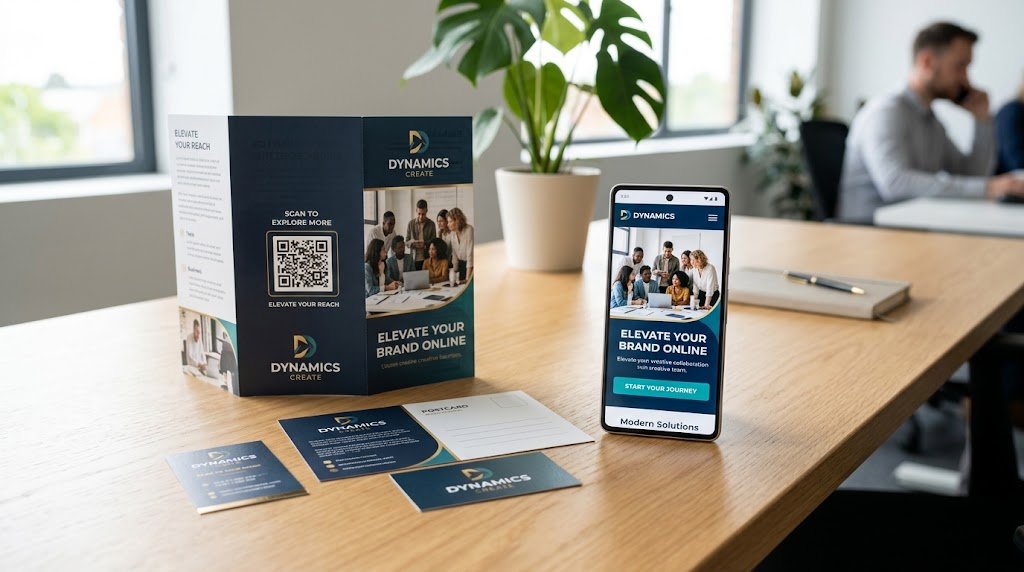
Strong brand alignment means carrying the same palette, typeface choices, and logo presentation into your site. The goal is not pixel-perfect duplication across mediums. Paper and screens behave differently, and each has its own strengths. What matters is that someone moving between the two feels an immediate sense of familiarity.
A talented website designer will start by studying every printed asset you have. Postcards, letterheads, and packaging all reveal how your brand behaves in the physical world. Those details become reference points for the digital build. The end result feels like one brand speaking with a single voice.
Make the Journey from Print to Screen Effortless
Moving from a printed ad to a website should feel natural, not like work. Long URLs typed on a small keyboard invite abandonment. A reader who cannot quickly find your page will simply give up and move on.
Short, descriptive links solve much of that problem. Swap an unwieldy address like “yourcompany.com/services/winter-promo-2024” for “yourcompany.com/winter.” It is easier to remember and far easier to type on a phone. Keep the spelling simple and avoid characters that cause confusion.
QR codes offer another practical route. Placing one on a poster or product packaging lets people jump straight to your content with a quick camera scan. Just remember that the code is only the doorway. The landing page must honor whatever promise the printed piece made.
A web design company can handle the technical setup behind these links and codes. They verify that every redirect resolves correctly across devices and browsers. Without that quality check, a broken link quietly undermines an otherwise polished campaign.
Give Print Campaigns Dedicated Web Destinations
Routing print responses to your generic homepage undermines the effort behind every ad. A homepage has to serve investors, partners, job candidates, and dozens of other audiences at once. When someone acts on a printed piece, they expect a page tailored to what they just saw. Generic pages do not reward that intent.
If a mailer promotes a new product line, the linked page should feature that product line specifically. Matching images, offers, and tone between the mailer and the landing page confirms to the visitor that they are in the right place. That reassurance keeps them on the page longer and increases the chance of conversion.
These dedicated pages also solve print’s biggest tracking problem. Traditional advertising rarely tells you exactly how many people responded to a specific placement. A unique URL tied to one campaign, however, gives precise numbers on visits, time on page, and actions taken. That clarity turns guesswork into actionable insight.
Teams at a web design company often build reusable landing page templates alongside the main site. A template that mirrors your print layout speeds up future launches. Each new campaign becomes a matter of swapping content rather than rebuilding from scratch.
Prioritize the Mobile Experience
Most people encounter print marketing in situations where their phone is already in hand. Scanning a QR code on a menu or a flyer sends them straight to your site on a small screen. A clunky mobile experience at that moment can undo all the effort spent on the printed piece. The window for engagement closes fast.
Effective mobile design demands touch-friendly buttons, readable text, and streamlined navigation. Cluttered layouts that force pinch-zooming or horizontal scrolling frustrate users and increase bounce rates. Every element on the screen needs to earn its place. Simplicity is not a compromise; it is a requirement.
An experienced website designer understands how to present information for fast, on-the-go browsing. Visitors who arrive from print want quick answers: your location, your hours, and how to reach you. If those details are buried behind three menu taps, the prospect has already left. Make the essentials visible within the first screen.
Keep Business Details Identical Across Channels
Brand consistency also applies to the practical information customers depend on. If a billboard states your closing time as 6 PM, your website should reflect that same hour. Small contradictions signal carelessness and make buyers hesitate. No one wants to guess whether your listed hours are reliable.
Search engines pay close attention to business data as well. Google compares your site’s contact information against directory listings and other sources. Discrepancies in your address or phone number can weaken your local search visibility. Accurate, uniform data protects both trust and rankings.
Work with a web design company to display your correct name, address, and phone number in a prominent spot on your site. A live map on your contact page gives readers instant visual confirmation of the location they saw in print. These straightforward touches remove doubt at the exact moment a decision is being made.
Use Print to Intrigue and the Web to Inform
Printed materials shine at capturing attention in a busy world. A striking flyer or an eye-catching storefront display makes someone pause and take notice. Yet a single sheet of paper can only carry so much detail before it becomes cluttered. Depth is simply not print’s strength.
Your website fills that gap. A reader curious about a product line can watch a demonstration video, read customer stories, and compare specifications without limits. Print plants the seed; the web nurtures it into a full understanding. The richer content available online addresses the questions that space on paper cannot.
A website designer Singapore can arrange site content so that print-driven visitors reach their goal quickly. Strategic placement of calls-to-action and supporting details guides people from curiosity to commitment. Each channel covers the other’s limitations, producing a journey that feels complete from start to finish.
Closing Perspective
Running print and digital campaigns in isolation underestimates what both can accomplish. People do not think in terms of channels; they experience one brand. Every interaction, whether on glossy paper or a backlit screen, shapes their perception of who you are.
When the two strategies share a visual identity, a message, and a clear path forward, performance improves on every front. Print ads attract more qualified visitors because they lead somewhere meaningful. Your website earns better engagement because the audience arrives already interested.
As you outline your next print effort, bring the digital side into the discussion before anything goes to press. Early collaboration produces a seamless experience that respects the customer’s time and attention. The ink and the pixels should always be telling the same story.