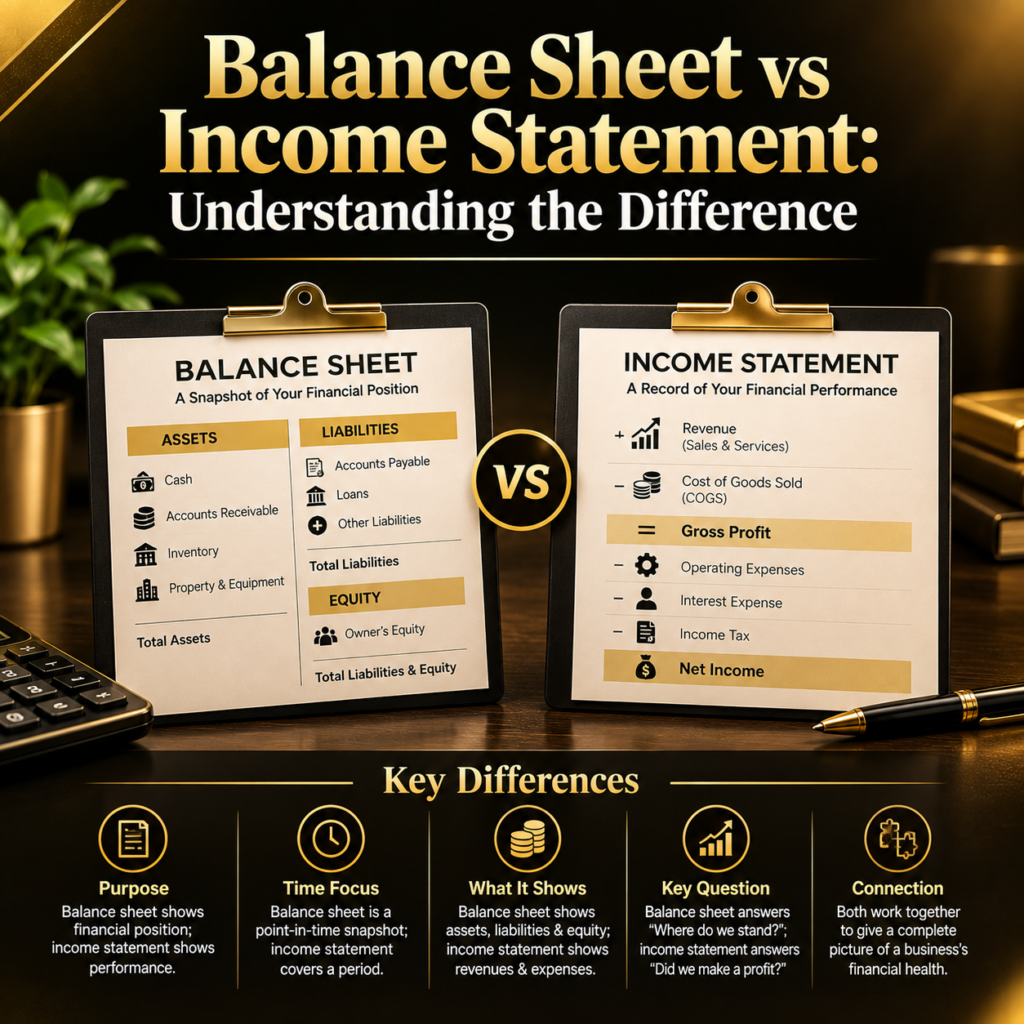
For all those who want to read and understand business financial statements, the knowledge of balance sheet vs income statement is essential. While both are useful for financial data, they take a different lens in analyzing a company’s performance. Business owners, managers, investors, and lenders review the balance sheet and income statement when trying to evaluate the financial position and results of a business.
The simplest method of understanding income statements and balance sheets is to check out the things they measure. A balance sheet is a snapshot of a business’s assets and liabilities. An income statement (also called a profit and loss statement) reports the company’s revenues, expenses, and profit or loss for a period of time.
One of the key considerations for balance sheet vs income statement is timing. The balance sheet is a snapshot of a company’s activities at a specific moment in time, and the income statement is a record of its activities over a specific period of time. When looking at both together, you’ll have a fuller picture of a company’s finances.
Balance Sheet and Income Statement: What Do They Show?
A balance sheet typically consists of three main components: assets, liabilities and shareholders’ or owner’s equity. Property may be cash, stock, machines or accounts receivable. It could be loans, accounts payable or other obligations. Equity is the interest of the owners after liabilities are taken into account.
The income statement vs profit and loss comparison would be easier as they tend to be the same kind of financial reports. A description of income statement will contain revenue, operating expense, other income/expense and net profit / loss.
Another relationship that is relevant to the balance sheet is the relationship with the income statement because the information from the operations of the business can impact both statements. For instance, a sale can help the income statement, but have an impact on the accounts receivable or the cash column on the balance sheet.
Balance Sheet vs Income Statement: Why Both Matter
A balance sheet and an income statement combined can be helpful in gaining more information than either one of them on their own. The balance sheet may assist to illustrate liquidity, assets, debt, and equity, while the income statement can assist to explain the generation of revenue and expenses and profitability.
When looking at the reverse side of the situation, the difference between income statement and balance sheet is evident when you think about the period during which they are used to report. Income statements are typically on a monthly, quarterly or yearly basis, while a balance sheet is made at a specific point in time.
The balance sheet vs profit and loss comparison is the same. The aim of the profit and loss statement is to provide information about financial performance, and the aim of the balance sheet is to provide information about financial position.
Likewise, information from the income statement and balance sheet can aid in budgeting, financial planning, and business decisions. It is essential to look at several financial indicators as a company can be doing very well in terms of revenue, but not have financial or debt problems.
Business owners will find it easier to interpret from the financial report if they know that there are two types of financial statements: balance sheet vs p&l and income statement vs balance sheet. Businesses can also benefit from professional accounting services and cloud bookkeeping, which keep financial records organized, and CFO services that ensure overall financial planning.
In the end, it’s not about which report to use, it’s about understanding the differences. These statements each have a specific function, and a comparison of both will give a better picture of a company’s financial situation and performance.
For more details visit us – https://accountance.net/