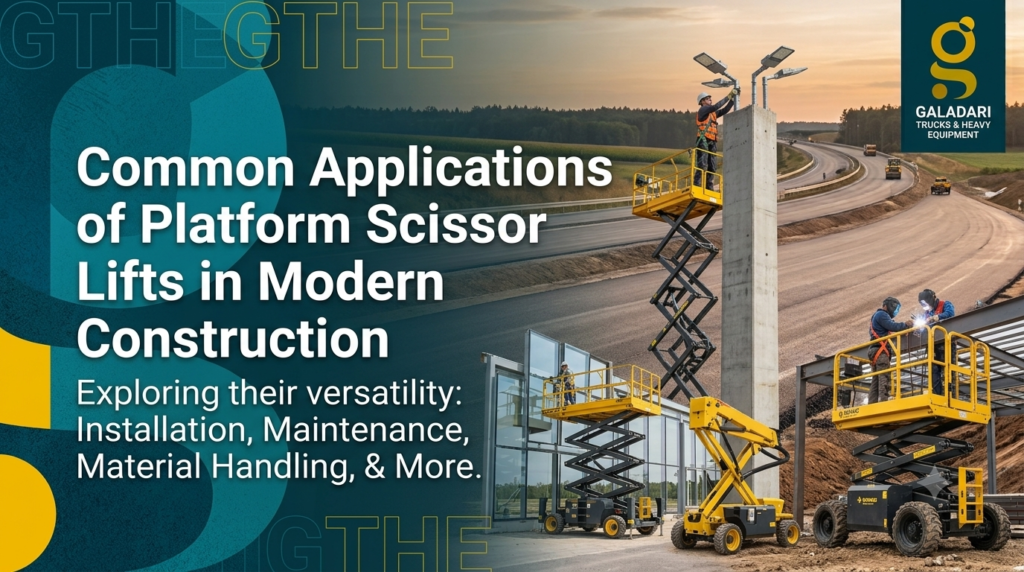
Construction has evolved. Workers no longer rely on ladders for every elevated task. Platform scissor lifts have become essential on job sites worldwide—from residential renovations to massive commercial builds. These machines raise workers, equipment, and materials safely to heights that would be time-consuming or dangerous to reach otherwise.
A scissor lift isn’t just a convenience. It’s a productivity multiplier and a safety investment. Understanding how modern construction leverages these machines reveals why they’ve become standard equipment on virtually every site. Whether you’re managing a project or considering purchasing equipment, knowing the real-world applications clarifies the value proposition.
What Makes Platform Scissor Lifts Essential in Construction?
Platform scissor lifts operate on a simple principle: a diamond-shaped framework of linked steel arms (the “scissors”) expands vertically when hydraulic pressure is applied, raising a stable platform. Unlike boom lifts that extend outward, scissor lifts move straight up—making them ideal for accessing work directly above the base location.
The magic lies in the platform stability and weight capacity. A typical platform scissor lifts system can safely elevate 1,000–2,000 kg of workers and tools to heights of 6–14 metres (depending on model). That capacity, combined with a compact footprint and the ability to work indoors or outdoors, explains why contractors across the world specify scissor lifts for countless applications.
Typical Max Height
6–14m
Varies by model
Payload Capacity
1–2 tonnes
Safe working load
Platform Width
2–3 metres
Compact yet spacious
Operating Speed
0.3–0.5 m/s
Controlled ascent
Real-World Construction Applications
The versatility of scissor lifts spans dozens of construction tasks. Here are the most common ones where they deliver genuine value:
🔨
Interior Finishing and Ceiling Work
Drywall installation, painting, electrical work, and HVAC installation at height all require safe, stable access. A scissor lift provides this without the setup time of scaffolding. Workers can position themselves precisely at ceiling height for hours without fatigue—far better than ladder-based alternatives.
🏢
Facade and Exterior Maintenance
Cleaning, repainting, or repairing building exteriors up to 10+ metres requires equipment that keeps crews secure. Scissor lifts position teams directly at the work surface, improving productivity and safety compared to roped access or swinging scaffolds.
🪟
Window Installation and Glazing
Installing large glazed panels or curtain wall systems demands precise positioning and stability. A scissor lift’s rigid platform eliminates swing and sway, critical when handling expensive glass installations where precision matters.
🔌
Electrical and Mechanical Installation
Running electrical conduit, installing lighting fixtures, or positioning HVAC units at height all benefit from scissor lift access. The stable platform accommodates multiple workers plus tool carts, reducing job site time.
📏
Structural Steel and Concrete Work
Guiding beams into position, inspecting structural connections, or placing concrete at elevated points requires controlled, stable positioning. Scissor lifts excel here because they don’t shift or sway as loads are manipulated.
📦
Material Handling and Logistics
On large construction sites, moving materials to upper floors—roofing tiles, insulation batches, or equipment crates—requires reliable elevation. Scissor lifts eliminate repetitive trips up stairwells, compressing timelines significantly.
Why Scissor Lifts Over Alternatives?
Construction managers often compare scissor lifts against ladders, scaffolding, and boom lifts. Each has a role, but scissor lifts win in specific scenarios:
✓Speed: Set up and ready in minutes—scaffolding takes hours to assemble safely
✓Stability: No swing or sway—critical for precision work like glazing or electrical termination
✓Footprint: Compact enough for indoor use—boom lifts need space and ceiling height
✓Cost: Rental or ownership costs are lower than comparable boom lift alternatives
✓Capacity: Can handle multiple workers plus tools—unlike individual rope access systems
Platform Scissor Lifts in UAE and Middle Eastern Construction
The UAE construction boom has driven significant demand for platform scissor lifts in UAE specifically. Gulf construction projects—from Dubai’s high-rises to Abu Dhabi’s sprawling developments—rely heavily on scissor lift equipment. The hot climate and tight project timelines make scissor lifts particularly attractive: they work in temperatures where other equipment might struggle, and their rapid deployment fits aggressive schedules.
For contractors and project managers looking to buy platform scissor lifts, several options exist: purchase new equipment from manufacturers, acquire used units from auctions or brokers, or lease from regional equipment houses. Each approach has merits depending on project scope and capital constraints.
Safety Note
Platform scissor lifts require operator training and site assessment. Load capacity must never be exceeded, and spreader bars or safety rails prevent falls. Always confirm equipment certification and maintenance records before deployment on your site.
Selecting the Right Scissor Lift for Your Project
When planning to use or buy platform scissor lifts, consider these factors:
Height required: Projects needing access only to 4–5 metres can use compact models. Commercial buildings often demand 10–14 metre capacity.
Indoor vs. outdoor: Outdoor units need robust weatherproofing. Indoor models can be lighter and more maneuverable.
Rough terrain: Some units have pneumatic tyres for uneven ground; others require level surfaces.
Fuel type: Electric scissor lifts suit indoor work. Diesel or LPG models work anywhere but produce emissions.
Frequently Asked Questions
Q. Is a scissor lift safer than a ladder for elevated work in construction?
Ans: Absolutely, in most scenarios. A scissor lift provides a stable platform for multiple workers and tools, eliminating the single-point-of-failure risk that ladders introduce. Workers aren’t balancing on narrow rungs—they’re standing on a wide, flat surface with guardrails. Falls from platforms are rare if workers use safety harnesses as required. That said, ladders still have a place for quick, low-height tasks where a scissor lift would be overkill. But for work lasting more than a few minutes or at heights above 4–5 metres, a scissor lift is demonstrably safer.
Q. How much does it cost to rent a scissor lift on a construction site?
Ans: Rental rates vary by region and unit size. In most Western markets, a standard platform scissor lift rents for £150–300 per day, £400–700 per week, or £800–1,500 per month. Larger 14-metre units cost more—up to £400+ daily. Rental companies typically require insurance and operator certification. In the UAE, rental rates are competitive—expect AED 400–800 daily for standard models, with monthly rates offering 50–60% savings over daily rates. If you use equipment regularly, purchasing might be more economical. A used platform scissor lift can be acquired for £5,000–15,000, paying for itself in 12–24 months of regular use depending on rental costs in your market.
Q. What’s the difference between an electric and diesel scissor lift, and which should I choose?
Ans: Electric scissor lifts are quiet, produce zero emissions, and work indoors without ventilation concerns. They’re ideal for finishing work in occupied buildings or areas with air quality restrictions. Diesel models are more powerful, work in extreme weather, and never need charging—critical for outdoor projects in remote locations. In the UAE heat, diesel units are popular because their robust hydraulic systems handle temperature extremes that strain electric alternatives. Choose electric for interior commercial or residential projects. Choose diesel for outdoor, heavy-duty, or multi-day continuous use. Some operators buy both to match project requirements.
Q. Can you operate a scissor lift on uneven ground or rough terrain?
Ans: Standard scissor lifts require relatively level ground—typically no more than 2–3 degrees of slope. However, rough-terrain scissor lifts exist specifically for construction sites with uneven surfaces. They feature all-terrain tyres, articulated chassis, and stabilizers to operate safely on slopes up to 10–15 degrees. These units cost more to rent or purchase but are essential for site prep, demolition, or exterior work where ground is genuinely rough. Before deploying any scissor lift on uneven terrain, always conduct a site assessment and ensure the unit’s specifications match ground conditions. Operating beyond design parameters risks tipping—a serious hazard.
Thanks, wikinewsportal.com