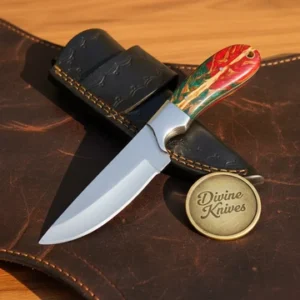
When building a reliable backcountry gear kit, choosing between a Camp Kukri and a traditional camp hatchet is a common debate among bushcrafters and campers. Both tools are designed to process wood, build shelters, and clear campsites, but they approach these tasks with different weight distributions, cutting styles, and versatility profiles. At Divineknives, we analyze how these tools perform under real-world conditions so you can select the best option for your trekking style.
While a hatchet relies on a heavy, concentrated iron head to crush through thick logs, a kukri offers a much longer cutting edge that excels at slicing, limbing, and carving alongside splitting duties. Evaluating factors like pack weight, safety, ease of carry, and task versatility helps you make an informed choice for your next expedition.
Chopping Efficiency and Kinetic Energy Distribution
A traditional hatchet concentrates most of its total mass into a small, heavy head mounted at the end of a wooden or composite handle. This top-heavy design creates powerful striking force over a small area, making it ideal for chopping through thick, frozen, or dense hardwood logs. However, the short cutting edge requires precise accuracy; a missed stroke can strike the handle or miss the target entirely.
In contrast, a Camp Kukri distributes its mass along a long, sweeping forward-curved blade, offering a significantly larger hitting surface. This extended cutting area makes striking saplings, clearing brush, and splitting kindling much easier and safer, as there is less risk of deflection. The team at Divineknives designs kukri profiles that deliver hatchet-like chopping power with the agility and control of a large fixed-blade knife.
Multi-Tool Versatility Slicing, Carving, and Food Prep
Where the Camp Kukri truly outperforms a camp hatchet is in its broad multi-tool capability. A hatchet is almost exclusively a impact chopping tool; performing delicate tasks like shaving feather sticks, slicing food, or skinning game with a hatchet head is awkward and inefficient. Carrying a hatchet usually forces you to carry a secondary belt knife for general utility work.
A kukri eliminates the need for extra tools by offering distinct cutting regions along a single blade. By choking up on the handle near the bolster, you can use the lower portion of the edge for precise wood carving, notch cutting, and food preparation. Divineknives crafts versatile blades that allow campers to pack lighter while retaining complete cutting functionality across all campsite tasks.
Safety Dynamics and Field Handling Differences
Safety is a critical consideration when working far from medical assistance in the backcountry. Hatchets carry a higher risk of glancing blows, where a missed strike can cause the heavy head to bounce off hard wood toward your legs or feet. Controlling a hatchet requires proper stance, a clear chopping block, and constant focus to avoid severe accidents.
Because a Camp Kukri features a longer edge and a lower center of gravity relative to your grip, glancing blows are much less likely to deflect dangerously. The continuous cutting surface catches the wood even if your aim is slightly off. At Divineknives, we incorporate pronounced finger guards and flared pommels into our handle designs to ensure your hand remains firmly locked in place during heavy use.
Pack Weight, Portability, and Sheath Systems
For backpackers and wilderness trekkers, every ounce counts when packing for long miles on the trail. A traditional hatchet with a heavy steel head and thick handle can easily weigh 2 to 3 pounds, adding substantial weight to your pack. Furthermore, hatchets are notoriously awkward to mount comfortably on a hip belt or backpack frame.
A high-performance Camp Kukri offers a far better power-to-weight ratio, delivering heavy chopping capability at a fraction of the bulk. Paired with a fitted leather or Kydex sheath, a kukri rides flat against your hip or attaches securely to the side of your pack. Divineknives supplies custom-fitted sheaths with every blade, ensuring comfortable carry and immediate accessibility on the trail.
Conclusion
While a traditional hatchet remains a solid tool for stationary wood processing, a Camp Kukri offers far greater versatility, safety, and packing efficiency for the modern outdoorsman. Its ability to chop, split, carve, and slice reduces pack weight while handling every campsite duty with ease. At Divineknives, our handcrafted collection bridges traditional forging techniques with modern ergonomic engineering. Equip your field kit with a handcrafted kukri today and enjoy complete self-reliance in the wild.