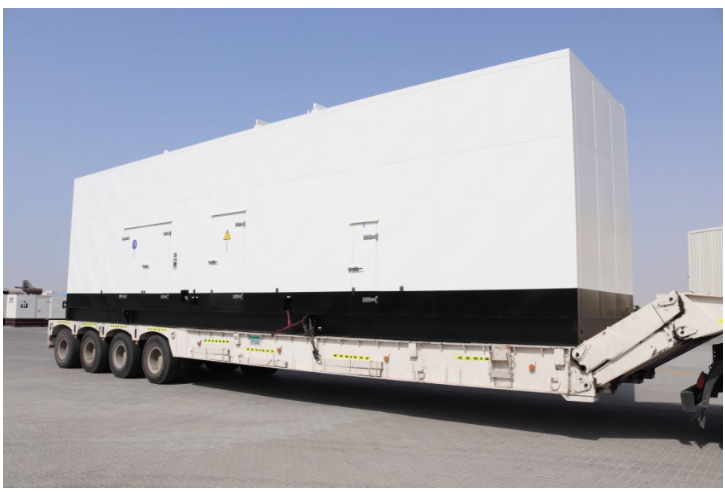
Building a permanent, civil-constructed substation room takes time most GCC power and industrial projects don’t have to spare. Containerized switchgear solves that timeline problem directly: a factory-built steel enclosure housing medium- or low-voltage switchgear, delivered ready to connect rather than built on-site over weeks of civil works. For utilities, EPC contractors, and oil & gas operators across the UAE, Kuwait, and Bahrain, that difference between “delivered” and “constructed” is often the deciding factor in the specification.
This guide covers what a genuine containerized switchgear unit actually includes, why it’s become the default choice over site-built alternatives, and how to tell a real manufacturer from a reseller when sourcing one in the region.
What’s Actually Inside a Containerized Switchgear Unit
A properly specified containerized switchgear enclosure isn’t just a steel box with equipment placed inside it — it’s engineered around the switchgear’s operating and safety requirements from the start. At minimum, that means:
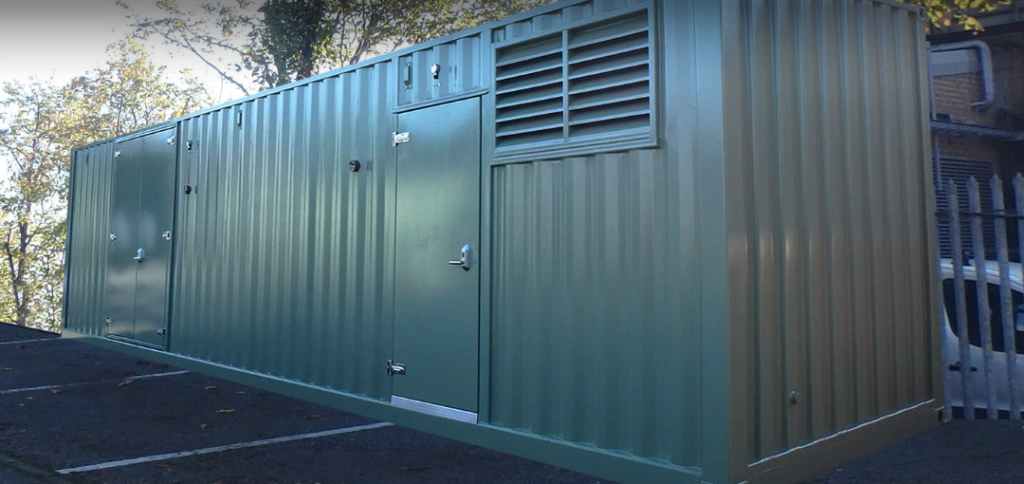
- Access doors and easy cable access, positioned for safe switchgear operation and maintenance without reconfiguring the unit.
- Lifting arrangements rated for the container’s full loaded weight, so the unit can be transported and positioned as a single piece.
- Sufficient ventilation and safety clearances around the switchgear itself, matched to its heat output and IP rating.
- A weatherproof finish — typically epoxy painting as standard, with powder coating available — built to IP23 as a baseline, with IP54, IP55, or IP65 options for harsher environments.
- ISO 20ft or 40ft container footprints, giving standard transport and crane-handling compatibility across GCC ports and sites.
Beyond the baseline, options that matter for GCC deployments specifically include forced ventilation, air conditioning and filtration (critical for switchgear reliability in high ambient heat), sound attenuation for noise-sensitive sites, and integrated fire detection and suppression systems — the difference between a basic containerized enclosure and one actually engineered for continuous, unattended operation.
Why GCC Projects Are Specifying Containerized Switchgear Over Site-Built Rooms
The case for containerized switchgear over a traditional civil-built switch room comes down to three practical factors:
Speed. A containerized unit is manufactured in parallel with site civil works rather than after them, and arrives ready to connect — a meaningful schedule advantage on projects where power availability is the critical path.
Relocatability. Unlike a poured-concrete substation room, a containerized switchgear unit can be lifted, transported, and redeployed if the project scope or site layout changes — relevant for oil & gas operators managing multiple sites or phased developments.
Consistency. Factory fabrication means every unit is built and tested to the same specification, rather than depending on site-specific civil contractor quality — an easier basis for utility or EPC approval processes.
Containerized Switchgear in Kuwait and Bahrain
Demand for switchgear containers in Kuwait tracks closely with the country’s oil & gas and power generation project pipeline, where containerized electrical rooms are specified for both new-build substations and temporary/interim power arrangements during plant upgrades. The same applies to switchgear containers in Bahrain, where space-constrained industrial sites and offshore-adjacent facilities favor a delivered, pre-tested unit over extended on-site construction.
In both markets, the practical sourcing question is the same: does the manufacturer ship a UAE-fabricated unit built to the same specification sold domestically, or is the “container” actually a locally modified standard shipping container without the ventilation, fire-rating, and lifting-point engineering a real switchgear enclosure requires.
Manufacturer vs. Reseller: What to Check Before Buying
Search for containerized switchgear manufacturers in Dubai or containerized switchgear manufacturers in the UAE and the results mix genuine fabricators with traders reselling a generic container fitted out after the fact. Before specifying a supplier, confirm:
- Is the unit designed and fabricated in-house, or is it a standard container retrofitted by a third party?
- Can the manufacturer provide the specific fire rating, IP rating, and ventilation specification for your switchgear model — not a generic brochure figure?
- Is the lifting arrangement engineered and load-tested for the container’s fully equipped weight?
- Can the manufacturer customize dimensions, access points, and finish (powder coating, sound attenuation, offshore-spec) to your project, or only offer a fixed catalogue unit?
- Does the manufacturer export to Kuwait and Bahrain directly, with documentation to match regional utility requirements?
A manufacturer that can answer all five directly — rather than deferring to “check with our engineering team” — is the one actually building to switchgear-specific standards rather than assembling a generic container.
About the author: This article was contributed by Al Bahar MCEM (Mohamed Abdulrahman Al-Bahar Metal Enclosures & Cabinets Manufacturing LLC), a Dubai-based fabricator of containerized switchgear and transformer containers, built to IP23–IP65 specifications with offshore, sound-attenuated, and custom-built options, serving power generation, oil & gas, and industrial clients across the UAE, Kuwait, Bahrain, Oman, and Qatar.