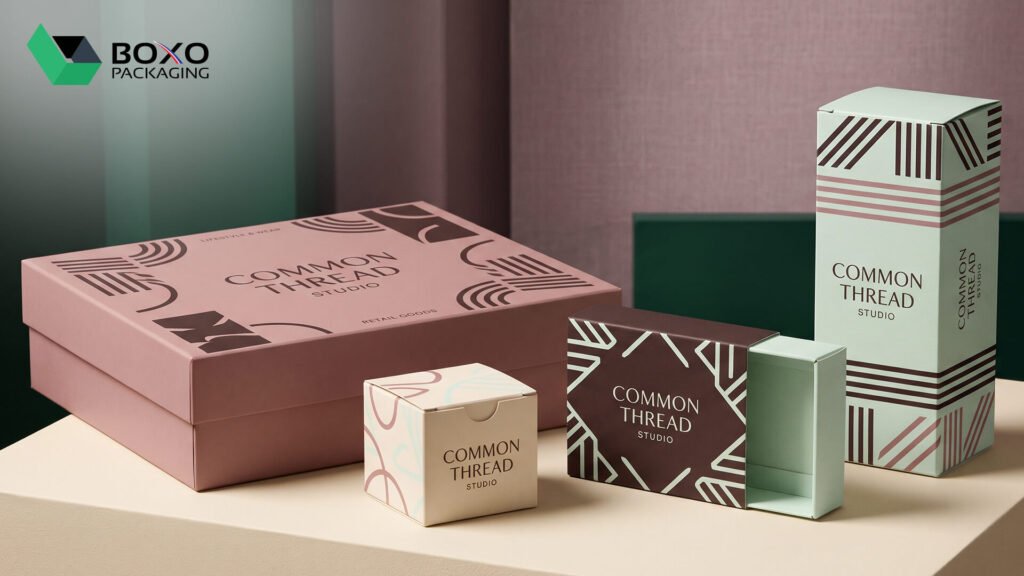
Print is what lets a carton speak for the product when no one is there to explain it, carrying your name, colour and key details at a glance. For brands preparing a first stockist listing, custom printed retail packaging is where artwork, structure and unit cost have to be weighed against each other. This guide covers formats, board weights, print methods, finishing, costs and sample testing so you can brief a supplier clearly.
What Printed Shelf Cartons Need to Achieve
A printed retail carton has to hold the product securely, stay neat under handling and carry barcodes, batch codes, ingredients and any legal wording. Made to measure sizing means the print wraps cleanly around your exact product instead of being squeezed onto a stock shape.
Many stockists set their own rules for dimensions, barcode position and display method. Asking for these before artwork begins can prevent costly changes later.
Carton Formats That Carry Print Well
The right format depends on how much printed surface you need and whether the product stands, lies flat or hangs from a peg. These are the styles most brands shortlist first.
- Reverse tuck carton: a flat packed box with flaps closing from opposite ends, offering clean front and side panels for bottles, tubes and jars.
- Hanging tab carton: a box with a punched tab, designed for peg display and a bold printed front.
- Shelf ready tray: a die cut tray that tears open so a case can go straight on the shelf, with branding on the front panel.
- Rigid gift box: a firm greyboard box wrapped in printed paper, used for premium and seasonal lines.
Board Weights and Surface Options
Folding retail cartons are usually made from SBS board at 300 to 400 GSM, which gives a bright, smooth surface for sharp print and holds its shape on the shelf. Lighter items suit the lower end, while glass, jars and boxed sets benefit from the upper range.
Kraft board at 250 to 350 GSM suits natural or artisan lines, though its brown tone mutes lighter colours and can dull bright inks. Rigid greyboard feels substantial but costs more and needs more storage space. For outer cartons, E flute corrugated looks tidy, while B flute or double wall adds crush resistance for heavier stock.
Where boxes touch food, ask your supplier about materials that comply with UK food contact rules, and request supporting documentation. At Boxo Packaging, we usually ask for product weight, dimensions and sales channel before suggesting a board grade.
Print Methods and Finishes Compared
Offset printing gives the most accurate colour on larger runs, which matters when a brand shade must match across a whole range. Digital printing suits short runs, trial listings and seasonal variants, while flexographic printing is usually kept for corrugated outers and simple one or two colour artwork.
Spot gloss, soft touch lamination and foil stamping help a carton stand out, but laminated and foiled boards can be harder to recycle. Water based inks and aqueous coatings guard against scuffs and are generally simpler to process. Ask for a physical proof, since screens and printed colour differ, and test that barcodes scan, as dark backgrounds and glossy finishes can interfere.
Cost Factors and Sustainability
Price depends on quantity, board weight, number of print colours, finishing, tooling and any inserts or hanging features. A one or two colour print on standard board keeps costs down, while full colour coverage, foil, embossing and rigid construction raise them quickly.
FSC certified board shows that fibre comes from managed sources, though it does not make a carton fully green, as every material has some footprint. Heavy coverage and laminates can reduce recyclability, so a restrained design with one strong feature often works better for both budget and disposal.
Ordering Tips Before You Commit
Ask for a physical sample filled with your real product, and place it on a shelf or peg to judge how the print looks and holds up. Check the proof for colour, spelling, barcode placement and legal text, and test the closure repeatedly.
Allow extra lead time, because production and freight can take several weeks, and new tooling can add to this. A reliable supplier will question your specification rather than simply accept it, especially around board strength, print coverage and stockist requirements. That is how we work at Boxo Packaging, because fixing a problem early costs far less than a reprint, especially with custom printed retail packaging.
Counter Display Boxes for Cafes Selling Snacks at the Till
The till is the last place a customer pauses, and a few well-placed snacks can add a pound or two to every order. But crumbs, sticky wrappers and a half-empty tray make the spot look tired very quickly. Planning Counter Display Boxes for a cafe means thinking about hygiene, speed and the busiest ten minutes of the morning. These checks cover what to measure, test and ask before you order.
Why Food Displays Need Extra Thought
A display for stationery can sit untouched for weeks. One holding flapjacks, biscuits or wrapped bars is handled all day by customers and staff, so it needs to stay clean and easy to wipe.
Watch your own counter for a morning and note where hands reach, where crumbs gather and what gets knocked. Those spots tell you where the board needs to be strongest and which surfaces will take the most wear.
Measuring Wrapped Snacks and Loose Treats
Wrapped bars stack neatly, while cookies and brownies need a lip or a liner. Measure a typical item at its longest, widest and tallest points, including any wrapper or paper case.
Write the internal dimensions in the order length, width, height so nobody reads them back to front when the order is placed. Then count how many items should sit in each row, because a unit that holds too few will be empty by lunchtime.
Keeping Crumbs and Grease Under Control
Butter and chocolate leave marks on plain board, and loose crumbs collect in folds. Fill a sample with real stock and leave it on your counter for a full day.
Check the base and corners for stains, and see whether a damp cloth can wipe the surface clean. Where items touch the board directly, rules differ by region, so check the current requirements for your market. This is general information, not legal advice. Avoid printing material or safety claims unless your supplier can show you evidence you can verify.
Making Refills Quick During a Rush
Staff refill between customers, often with one hand free. A unit that needs lifting out or taking apart will soon be left half empty.
Hand a sample to a team member and time a full refill with a stopwatch. Note any pause at a tab, a tight lip or a base that shifts. Open fronts and simple trays usually save the most seconds.
Four Details to Confirm Before You Request a Quote
Send these together and your quote will be quicker and easier to compare:
- The free counter footprint and height, plus the number of snacks the unit should hold
- The item size and weight, including any wrapper or paper case
- The front style you prefer, such as an open tray, a low lip or a flap
- The print colours, finishes and your expected order quantity
Trying Real Snacks Before Anything Is Printed
A flat drawing cannot show how a unit copes with sticky fingers and a morning queue. At Boxo Packaging, the process starts with you sending over your product, so the fit is judged against the real item. You then request samples, test them at your own till and with your own staff, and review the fit, print and structure together. Production begins only once you are satisfied, which makes it easier to settle on Counter Display Boxes that suit your cafe.
A good snack display stays clean, refills quickly and holds enough stock to last the rush. Honest measuring, a full day of real use and a printed sample checked in counter lighting will catch most problems early. Boxo Packaging supports that careful, sample-first approach, so your till stays tidy and your treats stay tempting.