Efficient chemical transfer is essential for maintaining safe, consistent, and reliable operations in industrial facilities. From water treatment plants to chemical manufacturing units, industries need suitable storage and dosing equipment to handle process chemicals according to their operational requirements. Dosing Tank for Efficient Chemical Transfer Operations help industries store, prepare, and supply chemicals to compatible process systems in a controlled manner.
A properly selected dosing tank can support accurate chemical preparation, organized fluid handling, and smoother plant operations. Its design depends on the chemical being handled, required capacity, operating temperature, installation space, and the dosing equipment connected to the tank.
Petron Thermoplast offers industrial tank solutions for project-specific requirements. Businesses planning a new chemical handling system or upgrading an existing installation can evaluate suitable tank materials, configurations, and customization options based on their process specifications.
What Is a Chemical Dosing Tank?
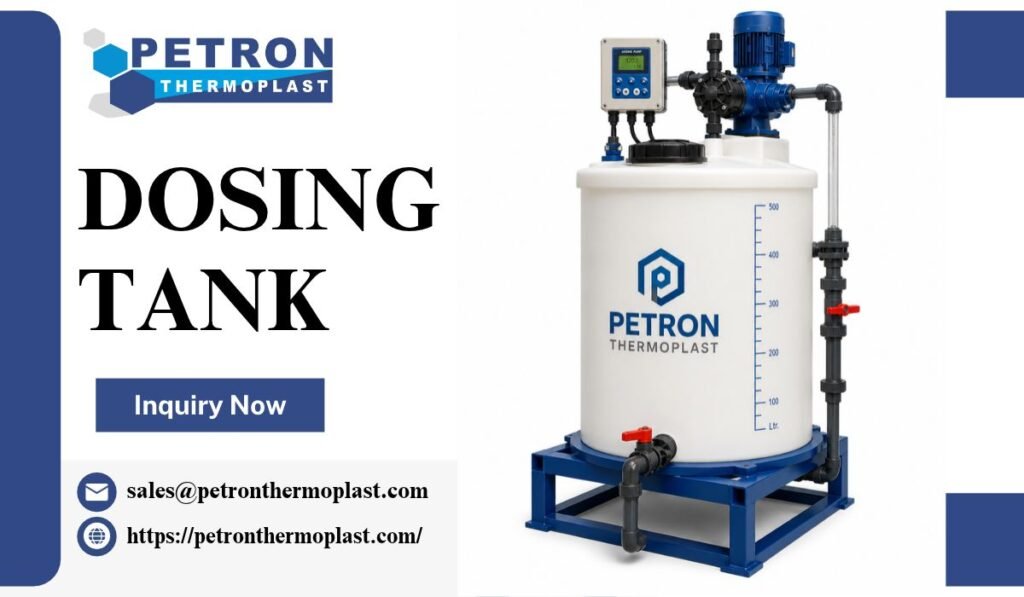
A chemical dosing tank is a container used to hold or prepare chemicals before they are introduced into a process. Depending on the application, it may be connected to a dosing pump, pipeline, mixer, level indicator, valves, and other process equipment.
These tanks are used in applications where chemicals need to be supplied to a system in planned quantities. Examples include water treatment, wastewater treatment, industrial cleaning, chemical processing, and selected manufacturing operations.
A dosing tank does not automatically control chemical injection by itself. The required dosing accuracy depends on the complete system, including the pump, instrumentation, calibration, control settings, and operating conditions. Selecting the right tank helps create a compatible arrangement for chemical storage, preparation, transfer, and dosing.
Why Dosing Tanks Are Important for Chemical Transfer Operations
Industrial chemical handling requires more than simply storing a liquid. The equipment must suit the chemical properties and support the intended process.
Dosing tanks can contribute to efficient operations in several ways.
- Organized Chemical Handling
A dedicated tank provides a designated location for holding or preparing process chemicals. This helps operators organize chemical handling activities and coordinate the transfer process.
- Support for Controlled Dosing
When connected to a compatible dosing pump and control system, a dosing tank supports the supply of chemicals to a process at the required rate. Pump selection and calibration remain essential for achieving the intended dosing performance.
- Reduced Manual Handling
A properly designed installation can reduce the need for repeated manual pouring or transferring of chemicals. This can improve operational convenience and help limit unnecessary operator exposure when combined with appropriate safety controls.
- Flexible Installation Options
Industrial facilities have different space and process requirements. Tank dimensions, outlet positions, access openings, and equipment connections can be planned according to the approved design.
- Improved Process Coordination
A suitable tank arrangement can help operators coordinate chemical preparation, transfer, replenishment, and monitoring. This is particularly useful where several treatment or production stages depend on chemical dosing.
Types of Dosing Tanks for Industrial Applications
The appropriate tank type depends on the chemical, required capacity, installation arrangement, and operating conditions. Common options include the following.
- HDPE Dosing Tanks
High-density polyethylene (HDPE) tanks may be suitable for compatible chemicals and industrial liquid-handling applications. HDPE is lightweight and resistant to many corrosive environments, but compatibility must be checked for the exact chemical concentration and service temperature.
These tanks can be considered for selected water treatment, wastewater treatment, and process applications.
- PP and PPH Dosing Tanks
Polypropylene (PP) and polypropylene homopolymer (PPH) tanks are used in certain industrial chemical handling applications because of their useful chemical resistance and fabrication possibilities.
The appropriate grade should be selected according to the fluid, temperature, concentration, and mechanical requirements of the installation.
- PVDF Dosing Tanks
Polyvinylidene fluoride (PVDF) is a high-performance fluoropolymer used in demanding chemical-handling environments. It may be considered where the chemical compatibility requirements justify its use.
PVDF suitability should be verified for the specific chemical and operating conditions. Its higher material cost may also influence the final selection.
- FRP Dosing Tanks
Fiber-reinforced plastic (FRP) tanks can be suitable for selected industrial applications. Their performance depends on the resin system, reinforcement, fabrication quality, and compatibility with the chemical being stored.
The resin and structural design must be reviewed before an FRP tank is selected for a particular chemical service.
- Customized Process Dosing Tanks
Some industrial projects require a specific tank shape, outlet arrangement, support structure, or equipment layout. Customized tanks can be designed around these requirements, subject to material limitations and engineering approval.
Key Features to Consider in a Dosing Tank
A dosing tank should be selected based on the complete operating requirement rather than capacity alone.
Important features may include:
- Suitable tank material: Select a material compatible with the chemical and operating environment.
- Appropriate capacity: Determine the required working volume based on chemical consumption, replenishment frequency, and process demand.
- Inlet and outlet connections: Specify connection sizes and locations to suit the piping arrangement.
- Level monitoring: Consider a compatible level indicator or sensor for monitoring the chemical level.
- Pump compatibility: Check that the tank outlet and installation arrangement suit the selected dosing pump.
- Access and maintenance: Plan suitable access for inspection, cleaning, and servicing.
- Support and installation: Ensure the base, supports, and surrounding structure can safely accommodate the filled tank.
- Containment and ventilation: Evaluate secondary containment, ventilation, and other safety provisions according to the chemical and applicable regulations.
Applications of Dosing Tanks in Different Industries
Water Treatment Plants
Water treatment facilities may use dosing tanks to prepare or hold compatible treatment chemicals before controlled addition to the water treatment process. The tank and dosing equipment must suit the chemical and required dosing rate.
Wastewater Treatment
Wastewater treatment systems may require chemicals for pH adjustment, treatment, or other process stages. Suitable dosing tanks help organize chemical preparation and transfer within the treatment facility.
Chemical Manufacturing
Chemical production facilities use different chemicals at various stages of manufacturing. Dosing tanks can form part of a system for preparing and supplying compatible process liquids.
Pharmaceutical and Specialty Manufacturing
Some manufacturing processes require carefully controlled chemical addition. Tank material, cleanliness, traceability, and process requirements must be assessed according to the applicable industry standards and product specifications.
Industrial Cleaning Systems
Certain industrial cleaning processes use chemicals that must be prepared and supplied in planned quantities. The tank material and associated components should be selected for the cleaning chemical and operating temperature.
Manufacturing and Process Plants
Factories may integrate dosing tanks with pumps, pipelines, mixers, sensors, and control systems to support chemical handling across different production stages.
Benefits of Choosing a Suitable Dosing Tank
A well-selected dosing tank can support industrial operations in several ways:
- Better process organization: Provides a dedicated location for chemical preparation or holding.
- System integration: Can be configured for connection with compatible pumps, valves, and monitoring equipment.
- Material-specific chemical resistance: The correct material can help reduce corrosion-related problems associated with unsuitable materials.
- Project flexibility: Suitable tank configurations can accommodate different layouts and installation constraints.
- Maintenance planning: Accessible connections and inspection provisions can make routine servicing easier.
- Operational consistency: When integrated with correctly selected dosing equipment, the tank supports a planned chemical supply arrangement.
Why Choose Petron Thermoplast for Dosing Tank Requirements?
Petron Thermoplast provides industrial thermoplastic and fabricated tank solutions for a range of project requirements. When evaluating a dosing tank, buyers can share their process details to help determine a suitable configuration.
For project-based inquiries, provide the required tank capacity, chemical name and concentration, operating temperature, installation location, connection requirements, and any available engineering drawings.
Petron Thermoplast can review the submitted requirements and discuss applicable product options, customization possibilities, and bulk order needs. Material suitability, final design, delivery schedule, and any special configuration should be confirmed for each project. Visit the Petron Thermoplast website to discuss your industrial tank requirements:
Conclusion
Dosing Tanks for Efficient Chemical Transfer Operations play an important role in organizing chemical preparation, holding, and transfer across compatible industrial processes. The right solution depends on chemical compatibility, working capacity, temperature, equipment connections, installation conditions, and the required operating arrangement.
HDPE, PP, PPH, PVDF, and FRP may each be suitable for different applications, but the final material should always be selected after reviewing the actual service conditions. A complete system assessment should also consider dosing pumps, monitoring equipment, containment, and maintenance access.
Petron Thermoplast welcomes inquiries for industrial dosing tank requirements. Share your specifications and project details to discuss suitable options for your chemical handling installation.