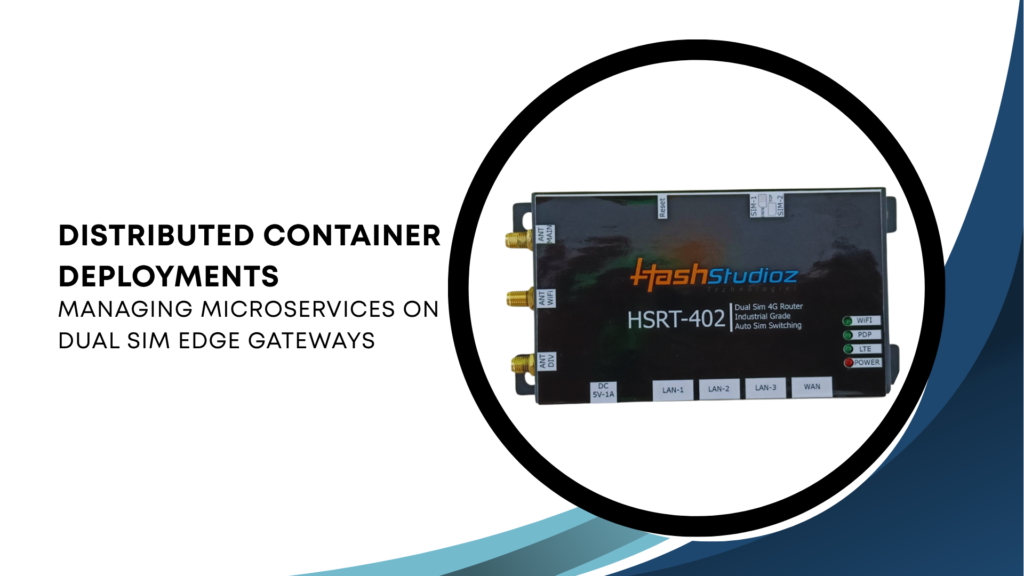
Edge computing keeps growing at a fast pace. The global edge computing market moved past $650 billion in 2026 and analysts expect it to grow at a compound annual rate above 20% for the next five years. This growth pulls container platforms out of the data center and into the field. Engineers now run microservices on small, rugged gateways placed in factories, farms, ships, and remote cabinets. A large share of that hardware relies on cellular connectivity through a Dual SIM Industrial Router. This article explains how teams design, deploy, and manage container workloads on this class of hardware.
Why Edge Gateways Need Container Deployments
Traditional industrial systems ran one application per device. That model breaks down once a site needs data collection, protocol translation, local analytics, and security monitoring on the same box. Containers solve this problem well.
A container packages code, libraries, and configuration into one unit. Teams can update one service without touching the others. This matters at the edge, where a technician cannot always drive to a remote site for a manual fix.
Key reasons operators choose containers at the edge:
- Faster rollout of new features across many sites
- Isolation between services running on shared hardware
- Consistent behavior between test labs and field devices
- Lower risk during updates, since a failed container can roll back on its own
Grand View Research places the industrial IoT segment as the leading application area for edge computing, and hardware still holds a major share of edge spending. Gateways sit at the center of that spending, and container support has become a standard requirement for new hardware purchases.
What Is a Dual SIM Industrial Router
A Dual SIM Industrial Router is a ruggedized networking device built for field conditions. It holds two SIM slots, so it can connect to two separate mobile carriers or two data plans on the same carrier. This design gives the device a backup path when one signal drops or one carrier has an outage.
Unlike a home router, an Industrial Router runs in wide temperature ranges, resists vibration, and often includes DIN rail mounting for cabinets. Many models also run a small Linux operating system with container support built in.
Typical features found on this hardware class:
- Two SIM card slots with automatic failover
- Wide input voltage range, often 9 to 36 volts DC
- Operating temperature from -40°C to 75°C in many models
- VPN support for secure remote access
- Onboard storage for container images and logs
- Serial and digital I/O ports for legacy industrial equipment
Because these routers combine networking and compute, teams treat them as small edge servers rather than plain modems. This shift is the reason container orchestration now matters at this layer of the network.
Container Orchestration Basics for Edge Environments
Kubernetes dominates container orchestration in the data center, but a full Kubernetes cluster needs more memory and CPU than most gateways offer. Edge teams turn to lighter tools instead.
Common orchestration choices at the edge:
- K3s: A stripped-down Kubernetes distribution built for low-resource devices
- Docker Swarm: A simpler clustering tool with a smaller footprint
- Balena: A fleet management platform built around containers for IoT devices
- Podman: A daemonless container engine that suits single-node gateways
Each option trades features for a smaller memory footprint. K3s, for example, can run on a device with as little as 512MB of RAM, which fits many mid-range gateways. A full Kubernetes control plane usually needs several gigabytes per node, so it rarely fits inside a compact industrial box.
Managing Microservices on Dual SIM Edge Gateways
Running microservices on a Dual SIM Industrial Router brings a mix of standard container practices and field-specific adjustments. The sections below cover the areas that need the most attention.
1. Network Resilience and Failover
A gateway in a remote location cannot depend on one carrier. Weather, tower maintenance, and network congestion all cause outages. Dual SIM hardware handles this at the physical layer, but container orchestration must handle it at the application layer too.
Best practices for network-aware container design:
- Set short timeout values for outbound API calls, so a service does not hang during a SIM switch
- Queue data locally during an outage and sync once the link returns
- Use a lightweight message broker such as MQTT for intermittent connections
- Monitor SIM status through router APIs and expose that status to the orchestrator
Field data from telecom operators shows that dual-path connections reduce downtime events by a wide margin compared to single-SIM setups, since a second carrier rarely fails at the same moment as the first.
2. Resource Constraints and Right-Sizing
Edge gateways carry far less compute power than a rack server. A typical industrial gateway ships with two to four CPU cores and 1 to 4GB of RAM. Every container must earn its place on that budget.
Steps that help teams fit more services onto limited hardware:
- Set memory and CPU limits on every container, not just the large ones
- Choose minimal base images, such as Alpine Linux, to cut image size
- Remove unused libraries from custom images before deployment
- Run health checks on a schedule rather than continuously, to save CPU cycles
A well-tuned gateway can run five to eight small microservices at once, covering data collection, protocol conversion, local rules, and a lightweight dashboard.
3. Remote Fleet Management
A single site is easy to manage by hand. A fleet of 500 gateways is not. Container platforms built for the edge include fleet tools that push updates over the air.
Fleet management tasks that container tools automate:
- Rolling updates across sites in small batches, to limit the blast radius of a bad release
- Automatic rollback if a health check fails after an update
- Central logging that pulls data from each device without a full log transfer
- Group policies that apply different configurations to different site types
Rolling updates matter most on cellular links, since a full image transfer to hundreds of devices at once can strain mobile data plans. Staggered rollout schedules keep monthly data costs predictable.
4. Security at the Edge
An Industrial Router often sits outside a locked data center. Physical access risk goes up, and so does the need for strong container security.
Security steps that fit this environment:
- Sign container images and verify signatures before deployment
- Store secrets in a vault rather than inside container images
- Restrict SIM-based data plans to a private APN where the carrier supports it
- Apply firmware and container runtime updates on a fixed schedule
- Segment container networks so a compromised service cannot reach the router’s management plane
Segmentation matters because a gateway often bridges an operational technology network and a cellular uplink. A weak boundary between containers can turn a small breach into a full site compromise.
Real-World Example: A Utility Field Deployment
A regional water utility installed Dual SIM Industrial Router units at 200 pump stations. Each router ran three containers: a data collector for sensor readings, a rules engine for pressure alerts, and a small web server for local diagnostics.
The dual SIM design gave each site two carrier paths. When one carrier had a regional outage, the fleet kept reporting through the backup SIM without a single missed reading. The utility reported a drop in unplanned site visits after the rollout, since staff could push fixes remotely instead of driving to each pump station.
This case shows the core value of pairing container platforms with dual-path cellular hardware: local intelligence keeps running, and the network layer keeps the data flowing even during a carrier fault.
Common Challenges and How Teams Solve Them
Container deployments at the edge run into a few recurring problems.
- Limited storage space: Many gateways ship with 8 to 32GB of onboard flash. Teams solve this by pruning unused images on a schedule and by keeping log retention short on the device itself, with full logs shipped to a central server.
- Inconsistent connectivity: Some sites sit in low-signal areas. Teams design containers to run offline-first, with local buffering and a sync step once the link comes back.
- Hardware diversity: A fleet built over several years may include multiple router models. Teams standardize on a common base image and container runtime version, so the same orchestration tooling works across the whole fleet.
- Update fatigue: Frequent small updates can wear out flash storage over time on some devices. Teams batch minor changes into fewer, larger release cycles instead of pushing daily patches.
Looking Ahead
Edge AI spending is rising fast, and much of that workload will land on gateway-class hardware. The edge AI market reached over $25 billion in 2025 and analysts project strong growth through the next decade. As router hardware gains more CPU and memory headroom, teams will run larger models locally, cutting reliance on cloud round trips even further.
Dual SIM hardware will stay relevant as this trend grows. AI inference at the edge often needs steady uplinks for model updates and result reporting, and a second carrier path lowers the odds of a total connectivity loss during a critical window.
Conclusion
Container platforms turn a simple cellular gateway into a capable edge computer. An Industrial Router adds the network resilience that field deployments need, since a single carrier outage no longer takes a site offline. Teams that right-size their containers, automate fleet updates, and design for intermittent connectivity get the most value from this hardware class. As edge computing spending grows past $700 billion in the next few years, this pairing of lightweight orchestration and dual-path connectivity will keep expanding across manufacturing, utilities, transportation, and remote industrial sites.