Modern diesel-powered equipment depends on accurate monitoring, reliable communication, and responsive control to maintain efficient and safe operation. As engines become more electronically controlled and emissions requirements become more demanding, equipment manufacturers need control solutions that can communicate with the engine ECU while giving operators clear access to important operating information.
An electronic diesel engine controller serves as a central interface between the engine and the equipment operator. It can provide access to engine data, diagnostic information, alarms, throttle functions, regeneration status, and other control features. For OEMs and equipment builders, selecting the appropriate controller is an important part of designing a dependable engine-powered machine.
What Does an Electronic Diesel Engine Controller Do?
An electronic diesel engine controller communicates with the engine’s electronic control unit through established communication protocols such as SAE J1939. This allows the control system to receive information from the engine and present relevant parameters to the operator.
Depending on the application, the controller may display engine speed, diagnostic trouble codes, maintenance information, warning conditions, and other operating parameters. It can also provide control functions such as engine speed adjustment and external shutdown.
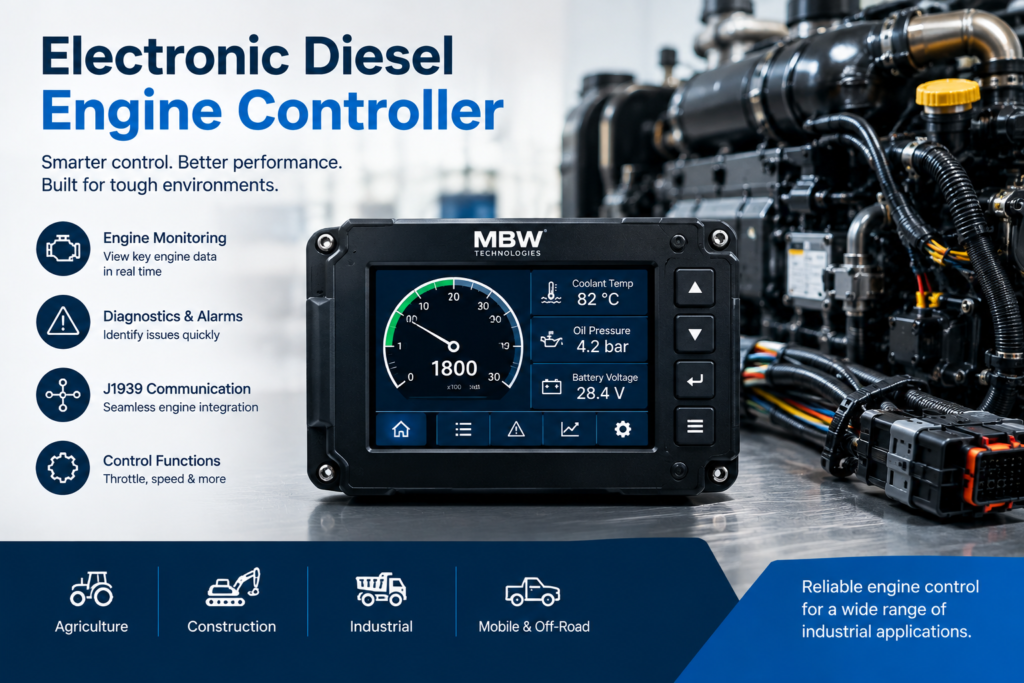
For applications requiring advanced monitoring and control, the electronic diesel engine controller from MBW Technologies is designed for Tier 4 Final and Stage V engine applications. The M154P Pro Series combines a graphical color display with J1939 communication, diagnostic information, configurable inputs, alarms, engine speed controls, and regeneration support.
Why J1939 Communication Matters
SAE J1939 is widely used for communication between electronic components in heavy-duty and off-highway equipment. A controller that can properly communicate through J1939 can access engine information without requiring every parameter to be monitored through separate physical instruments.
This communication capability can make the operator interface more informative while helping equipment manufacturers integrate engine data into their overall machine architecture. Diagnostic messages, engine parameters, alarms, and control commands can be handled through the electronic network.
Both the M154P and M154B series use a full-featured J1939 interface for accessing engine data and diagnostic information. The M154B, for example, can report J1939 diagnostic messages from the engine ECU and provide configurable throttle control through CANBus communication.
Building a Complete Diesel Engine Control System
A modern diesel engine control system typically includes more than a controller alone. The complete system may incorporate an engine ECU, operator display, sensors, throttle controls, wiring harnesses, alarms, shutdown circuits, and optional expansion modules.
The way these components are integrated depends on the equipment and its operating environment. An agricultural machine may have different control requirements from an industrial pump or mobile off-road machine. Panel location, enclosure protection, remote controls, operator visibility, and available installation space can all affect the final design.
The M154B Basic Series provides a configurable option for T4i, T4F, and Stage V engine applications. It can be supplied as a panel-mounted unit, with an enclosure, or as a kit for integration into a customer-specific panel design.
Monitoring and Operator Visibility
Engine monitoring is particularly important when equipment operates under demanding conditions. Operators need to know when an engine is operating normally and when attention is required.
The M154B provides a graphical LCD display for viewing engine data, along with diagnostic messages, visual alarms, configurable engine speed limits, and regeneration information. Its DPF regeneration functions can provide on-screen instructions for applicable operating conditions.
The M154P Pro Series takes the interface further with a 3.5-inch graphical color display, system fault logging, quad-display configuration, database viewing, warning indicators, and guided regeneration prompts for applicable Tier 4 Final and Stage V engines.
Choosing Between Basic and Advanced Control
The appropriate controller depends on the application’s technical requirements. A straightforward installation may only require essential engine monitoring, throttle control, diagnostics, and alarms. More advanced equipment may require color graphics, extensive fault information, aftertreatment visibility, regeneration guidance, and additional configurable functions.
For basic monitoring and control requirements, the M154B Basic Series provides a configurable platform with J1939 communication, engine data access, throttle control, diagnostic visibility, and optional expansion capabilities.
For more demanding Tier 4 Final and Stage V applications, the M154P Pro Series offers additional display, diagnostic, alarm, and regeneration features. MBW also supports application-specific panels, housings, interface cabling, and engineering requirements.
Supporting Reliable Equipment Integration
An effective engine control solution should be considered as part of the complete machine rather than as an isolated component. Controller selection, wiring, operator interface, enclosure design, engine communication, and safety functions all contribute to the final system.
By selecting an electronic controller that matches the engine and equipment requirements, OEMs and equipment builders can create a more organized control architecture while giving operators better visibility into engine operation. This approach can support easier troubleshooting, practical maintenance, and dependable control across a wide range of diesel-powered applications.