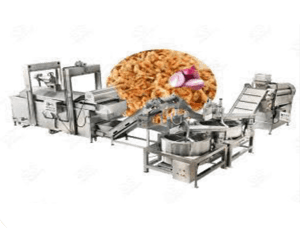
fried onion plant
Fried onions are one of the most universally consumed food ingredients across Pakistan, South Asia, and the Middle East — present in biryanis, curries, ready meals, fast food toppings, and packaged food products in virtually every kitchen and food service operation in the region. Yet despite this ubiquitous demand, the production of consistently high-quality fried onions at commercial scale remains one of the more technically demanding food processing operations to establish correctly. For entrepreneurs and food manufacturers considering entry into this market, understanding the complete production journey — from raw onion intake through to sealed retail packaging — is the essential first step. A properly configured fried onion plant is not a single machine but an integrated sequence of processing stages, each of which contributes to the colour, texture, oil content, shelf life, and food safety profile of the finished product.
What is a Fried Onion Plant?
A fried onion plant is a complete industrial production facility or integrated equipment line designed to process fresh raw onions continuously through all stages required to produce commercially packaged fried onion products — from initial cleaning and peeling through slicing, drying, frying, de-oiling, cooling, and final packaging.
Unlike a single onion frying machine, a complete fried onion plant represents the full system in which every processing stage is engineered to work in sequence, with the output quality, moisture content, and throughput rate of each stage directly determining the performance requirements of the next. The quality of the finished fried onion — its golden colour consistency, crispness, oil content, aroma, and shelf life — is the cumulative result of how well every stage in that sequence is specified, commissioned, and operated. For commercial fried onion producers targeting Pakistan’s retail, food service, and export markets, understanding the complete plant layout is as important as understanding any individual machine within it.
Key Features & Benefits
A well-designed fried onion plant delivers operational and commercial advantages that justify its position as a serious food processing investment:
- End-to-End Automated Processing: A complete fried onion plant minimises manual handling from raw intake to sealed packaging — reducing labour costs, eliminating inconsistencies introduced by manual processing steps, and maintaining product hygiene standards across the full production run without dependence on operator skill variability.
- Consistent Product Colour and Texture: Precisely controlled slicing thickness, pre-drying parameters, and frying temperature and time settings interact to produce a uniform golden colour and crisp texture across every batch — the two most visible quality attributes that determine consumer acceptance and retail buyer confidence in a branded fried onion product.
- Controlled Oil Content for Shelf Life and Compliance: Integrated de-oiling systems — centrifugal de-oilers or vibrating drainage conveyors — remove excess surface oil from the fried onion immediately after frying, reducing the fat content of the finished product and significantly extending shelf life by slowing the oxidative rancidity that surplus surface oil accelerates.
- High Throughput for Commercial Scale Production: Industrial fried onion plants are designed for continuous operation across full production shifts — processing several hundred to several thousand kilograms of raw onion per hour depending on plant configuration, enabling commercial volumes that manual or semi-automated production methods cannot achieve.
- Food-Grade Stainless Steel Construction Throughout: All product-contact equipment across the plant — washing tanks, slicing machines, conveying systems, fryers, de-oilers, and packaging feeders — is fabricated from food-grade stainless steel that supports the thorough washdown and sanitation required between production runs in a food manufacturing environment.
Industrial Applications
The fried onion plant and its output serve a remarkably broad range of food industry segments across Pakistan and export markets:
- Retail Packaged Fried Onion Brands producing branded consumer packs of fried onions for supermarket shelves — where consistent golden colour, uniform crispness, and controlled oil content determine brand reputation and repeat purchase rates in Pakistan’s growing packaged food retail sector
- Food Service and HoReCa Supply producing bulk packaged fried onions for supply to hotels, restaurants, fast food chains, caterers, and institutional kitchens that use fried onion as a primary cooking ingredient and garnish at scale — a large and growing demand segment in Pakistan’s expanding food service industry
- Ready Meal and Convenience Food Manufacturers incorporating fried onion as a component ingredient in packaged biryani kits, curry bases, instant soup mixes, and other convenience food products where consistent fried onion quality directly affects the flavour and visual appeal of the finished meal product
- Export-Oriented Fried Onion Producers packaging fried onions for export to the Gulf Cooperation Council countries, the United Kingdom, and other markets with significant South Asian diaspora populations — where Pakistani fried onion products compete on quality, price, and consistency against established regional suppliers
- Spice and Condiment Manufacturers incorporating fried onion powder or flakes as a flavour ingredient in spice blends, seasoning mixes, soup powders, and instant noodle flavour sachets — a high-value processing application where consistent raw material quality directly affects finished seasoning flavour profile
How the Plant Works: Stage by Stage
Understanding the complete production sequence of a fried onion plant helps food entrepreneurs and plant managers appreciate why each stage matters and what happens to product quality when any stage is incorrectly specified or operated.
Stage 1 — Raw Onion Intake and Cleaning: Fresh onions arrive at the plant with field soil, loose outer skin, and surface contamination that must be removed before processing begins. A rotary drum washer or brush washing system cleans the onion surface, while a de-stoning conveyor removes heavy debris. The quality and thoroughness of this initial cleaning stage directly affects the hygiene of all downstream equipment and the microbiological quality of the finished product.
Stage 2 — Peeling: Industrial onion peeling is achieved through one of two primary methods — abrasive drum peeling, which removes outer skins through mechanical friction, or pneumatic peeling, which uses high-pressure air pulses to strip skin layers from the onion surface. Pneumatic peeling is generally preferred in commercial fried onion production as it minimises product damage and reduces the moisture loss from abrasion that abrasive peeling causes. Yield at this stage directly affects raw material cost per kilogram of finished product.
Stage 3 — Slicing: Peeled onions pass through industrial slicing machines that cut them into uniform rings or half-rings of a consistent defined thickness — typically between 2 and 4 millimetres for fried onion products. Slice thickness uniformity is one of the most critical quality variables in fried onion production: thick slices require longer frying time, absorb more oil, and are prone to uneven drying; thin slices burn and darken before they develop the golden colour that consumer and food service buyers expect.
Stage 4 — Pre-Drying: Sliced onions contain 85 to 90 percent moisture by weight — and removing a significant proportion of this moisture before frying is the key to producing fried onions with low oil content, long shelf life, and consistent crispness. Industrial belt dryers or tunnel dryers reduce the moisture content of sliced onion from raw levels down to 15 to 30 percent before the frying stage — dramatically reducing the amount of oil absorbed during frying by limiting the volume of water that must be replaced by oil in the product structure. Pre-drying also reduces frying load on the oil bath, extending oil life and improving temperature stability during production.
Stage 5 — Frying: Pre-dried onion slices enter the continuous fryer at a controlled feed rate and travel through hot palm oil or vegetable oil at temperatures typically ranging between 155 and 175 degrees Celsius. Belt speed and oil temperature are set together to achieve the target final moisture content of 2 to 5 percent and the signature golden colour without over-browning. Oil filtration and level management during frying maintain oil quality and consistent frying conditions across the full production run.
Stage 6 — De-Oiling and Cooling: Freshly fried onions exit the fryer carrying surface oil that must be removed immediately to achieve the target fat content and prevent rancidity development during shelf life. Centrifugal de-oilers spin the fried onion briefly at controlled speed to remove surface oil by centrifugal force — the most effective de-oiling method for crumbly, fragile fried products. The de-oiled onion then passes through a cooling conveyor that reduces product temperature to near-ambient before packaging — preventing condensation inside sealed packs that would compromise crispness and accelerate spoilage.
Stage 7 — Weighing, Packaging, and Sealing: Cooled fried onion is fed into automatic weighing and packaging systems that portion the product into retail or bulk pack sizes, fill into laminated pouches with nitrogen flushing to exclude oxygen, and seal the pack with heat sealing equipment. Nitrogen flushing is particularly important for fried onion packaging — the high oil content makes the product susceptible to oxidative rancidity in the presence of oxygen, and modified atmosphere packaging extends shelf life from weeks to several months.
Why Quality Matters
In fried onion production, quality failures are cumulative and visible. A slicing machine producing inconsistent thickness creates a frying problem that no temperature setting can fully compensate. An undersized pre-dryer sending high-moisture slices into the fryer increases oil absorption, darkens colour, and reduces shelf life simultaneously. A de-oiler operating at incorrect speed leaves excess surface oil that shortens shelf life and increases fat content beyond the specification declared on the packaging label.
For Pakistani fried onion producers targeting export markets or modern retail supply chains, this cumulative quality dependency means that investing in correctly specified, well-built equipment at every stage of the plant is the only route to consistent, compliant, commercially competitive product. A single underspecified stage undermines the investment in every correctly specified stage around it.
Conclusion
Building a successful fried onion plant requires understanding the complete production journey — from raw onion intake through every processing stage to sealed retail packaging — and ensuring that each stage is correctly specified, integrated, and operated to contribute its part to the finished product’s colour, texture, oil content, and shelf life. For food entrepreneurs and plant managers ready to invest in a complete commercial fried onion production facility, you can explore detailed technical configurations and application-matched equipment options for a professionally engineered Fried Onion Plant designed to deliver the production consistency, throughput capacity, and food safety compliance that competitive commercial fried onion production demands.