Discover how hot melt adhesive supports fast, reliable bonding across industries, with insights into applications, benefits, selection, and Super Bond Adhesives.
In modern manufacturing, businesses continuously look for bonding solutions that can improve production efficiency, product quality, and durability. Among the various adhesive technologies available today, hot melt adhesive has become an important choice for many industrial and commercial applications.
Hot melt adhesives are thermoplastic bonding materials that are applied in a molten state and develop their bond as they cool and solidify. Their fast setting characteristics, versatility, and compatibility with automated production processes make them suitable for industries such as woodworking, furniture, packaging, bookbinding, product assembly, and many other manufacturing applications.
Selecting the right adhesive requires an understanding of the materials being bonded, production conditions, application equipment, required bond performance, and environmental factors. A suitable hot melt solution can help manufacturers achieve consistent bonding while supporting efficient production processes.
What Is Hot Melt Adhesive?
Hot melt adhesive is a thermoplastic adhesive supplied in forms such as pellets, granules, blocks, or sticks, depending on the application and dispensing system. Unlike water-based adhesives, it does not depend on water evaporation to form its initial bond.
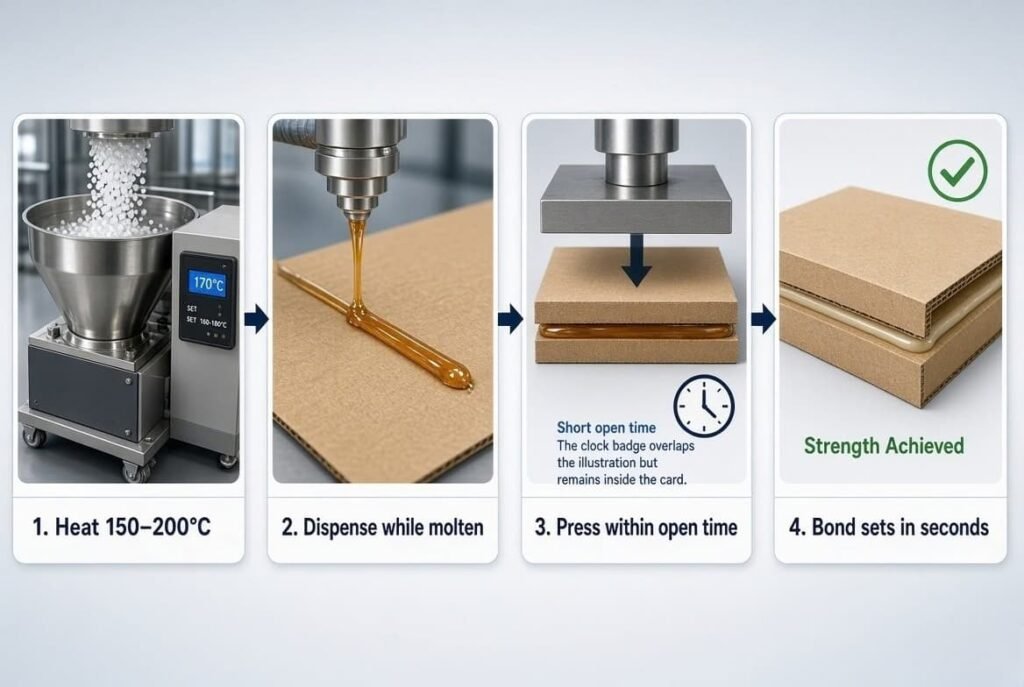
The adhesive is heated until it reaches the required application temperature and is then applied to the selected substrate. As the adhesive cools, it solidifies and creates the bond.
This relatively simple bonding mechanism makes hot melt technology useful where production speed and quick handling are important. However, the correct product must always be selected according to the substrate, equipment, application temperature, and required performance.
Major Applications of Hot Melt Adhesive
Hot melt adhesive is used across numerous industries because different formulations can be developed for different substrates and production processes.
1. Woodworking and Furniture
Woodworking and furniture manufacturing are important application areas for hot melt adhesive. It can be used in suitable applications involving furniture components, decorative surfaces, edge banding, profile wrapping, panel processing, and general assembly.
Manufacturers can benefit from fast setting and efficient application when the adhesive is properly matched with the materials and production equipment.
2. Packaging
The packaging industry uses hot melt adhesives for applications such as carton sealing, case closing, packaging assembly, and selected paper and board products.
High-speed production lines can benefit from adhesives that develop a bond quickly, allowing packaged products to move efficiently through subsequent production stages.
3. Bookbinding
Hot melt adhesive is also used in suitable bookbinding applications where efficient adhesive application and quick setting are important. Depending on the formulation and equipment, it can be applied to different parts of the binding process.
4. Product Assembly
Industrial manufacturers use hot melt technology for selected assembly applications involving compatible materials. Its ability to be dispensed through automated equipment makes it useful for production environments where repeatability and process efficiency are important.
Benefits of Hot Melt Adhesive
The popularity of hot melt adhesive is connected to several practical advantages.
Fast Setting
One of its most important characteristics is rapid setting after application. This can help reduce waiting time between bonding and subsequent production operations.
Efficient Application
Hot melt adhesives can be applied using suitable manual, semi-automatic, or automated dispensing systems. This provides manufacturers with flexibility when designing their production processes.
Good Process Efficiency
Because the adhesive develops its initial bond as it cools, it can support manufacturing operations that require relatively quick handling of bonded components.
Versatile Formulations
Hot melt adhesives can be formulated for different applications and substrates. Manufacturers can select products based on requirements such as adhesion, flexibility, setting behavior, and temperature performance.
Suitable for Automated Manufacturing
In high-volume manufacturing, adhesive application can be integrated with automated machinery. This can improve consistency and reduce variations associated with manual application when the process is properly controlled.
How to Select the Right Hot Melt Adhesive
Choosing a hot melt adhesive should not be based only on price. The adhesive must be compatible with the complete manufacturing process.
Consider the Substrate
First, identify the materials that need to be bonded. Wood, paper, fabric, foam, plastic, and other substrates can have different surface characteristics, so adhesive compatibility is important.
Check Application Temperature
Different hot melt formulations have different recommended processing temperatures. The adhesive should be used within the manufacturer’s specified conditions and with compatible equipment.
Evaluate Setting Requirements
Production speed can influence adhesive selection. A fast-moving production line may require a formulation with appropriate open time and setting characteristics.
Consider Environmental Conditions
Temperature, humidity, moisture exposure, and other operating conditions can influence long-term bond performance. The adhesive should be selected according to the actual environment in which the finished product will be used.
Test Before Full-Scale Production
Application testing is an important step before introducing an adhesive into a large production process. Testing allows manufacturers to evaluate adhesion, appearance, setting behavior, equipment compatibility, and overall performance.
Why Choose an Experienced Adhesive Manufacturer?
Working with an experienced adhesive manufacturer can provide advantages beyond simply purchasing an adhesive product. Technical knowledge, product consistency, application support, and understanding of different industries can help businesses identify a suitable bonding solution.
Super Bond Adhesives is a leading adhesive manufacturing company with a history spanning more than four decades. Established in 1974, the company has focused on developing adhesive solutions for different industries and applications.
Its long-standing experience reflects a commitment to excellence, customer satisfaction, and continuous improvement. For businesses evaluating hot melt solutions, working with an experienced manufacturer can help them understand product selection and application requirements more effectively.
You can learn more about Super Bond Adhesives through its official website.
Quality and Safe Handling
Quality control is an important part of adhesive manufacturing. Consistent raw materials, controlled formulation, production monitoring, testing, and appropriate packaging can all contribute to reliable product performance.
Users should also follow the manufacturer’s technical and safety instructions. Since hot melt adhesives are applied at elevated temperatures, appropriate equipment, operating procedures, protective measures, and employee training are important.
Storage conditions should also follow the manufacturer’s recommendations to help maintain product quality.
Conclusion
Hot melt adhesive has become a valuable bonding technology for industries that require efficient application, fast setting, and reliable bonding performance. Its applications extend across woodworking, furniture, packaging, bookbinding, product assembly, and other suitable manufacturing processes.
However, the best adhesive depends on the specific application. Substrate compatibility, application temperature, setting requirements, equipment, production speed, and environmental conditions should all be considered before selecting a product.
With more than four decades of experience since its establishment in 1974, Super Bond Adhesives continues to focus on adhesive solutions and customer requirements. For manufacturers looking for suitable hot melt bonding technology, selecting an experienced adhesive partner and conducting appropriate application testing can be an important step toward achieving consistent production results.